

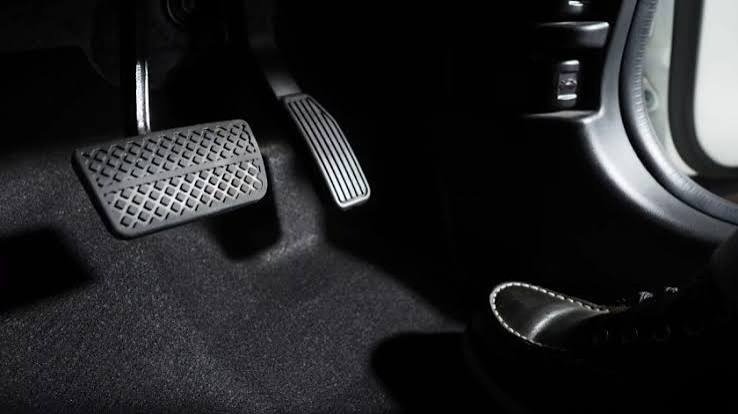
If you are learning to drive or sitting in a car for the first time, one of the most basic questions you may have is, which side is the brake in a car? It sounds like a simple question, but knowing the correct position of the brake pedal is one of the most important things a driver needs to understand before moving a vehicle. The good news is that most cars follow a familiar pedal arrangement, making it relatively easy to remember once you understand the basic layout.
In a typical automatic car, the brake pedal is positioned to the left of the accelerator pedal. In a manual car, the brake pedal is normally located between the clutch and accelerator. Although the steering wheel may be positioned on either the left or right side of the vehicle depending on the country and vehicle design, the basic pedal arrangement usually remains consistent.
Understanding the pedal layout can help new drivers feel more comfortable and confident behind the wheel. It also helps prevent confusion when moving between different vehicles. However, pedal positions and controls can vary in unusual or specially designed vehicles, so it is always wise to familiarize yourself with a car before driving it.
This guide explains where the brake pedal is located, how it differs between automatic and manual cars, how the brake system works, and what new drivers should know about using the brake safely and confidently.
Which Side Is the Brake in a Car?
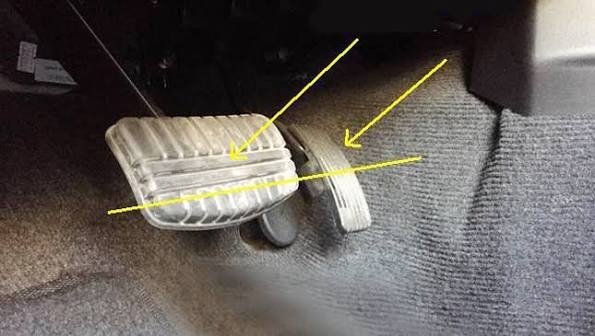
In a standard automatic car, the brake pedal is usually on the left side of the accelerator pedal. Since most automatic cars have only two main pedals, identifying them is fairly straightforward. The brake is generally the larger pedal, while the accelerator is narrower and positioned farther to the right.
The important point to remember is that “left of the accelerator” does not necessarily mean that the brake pedal is on the far left side of the entire pedal area. In an automatic vehicle, the arrangement is normally brake on the left and accelerator on the right.
In a manual car, there are three pedals. From left to right, the normal arrangement is the clutch, brake, and accelerator. Therefore, the brake pedal sits in the middle.
This arrangement has become a familiar standard across most conventional passenger vehicles. It allows drivers to develop consistent pedal habits and makes it easier to operate different cars without having to completely relearn the controls.
If you are sitting in an unfamiliar car, however, do not assume every control will be exactly where you expect. Take a moment to look at the pedals, check the owner’s manual if necessary, and understand the vehicle’s controls before starting to drive.
Where Is the Brake Pedal Located?
The brake pedal is located in the driver’s footwell, directly below the dashboard area. Its exact height, width, and shape can vary between vehicle models, but its position relative to the other pedals is usually predictable.
The brake pedal is designed to be easy to reach because braking is one of the most frequently used actions while driving. A driver needs to be able to move from the accelerator to the brake smoothly when traffic conditions change.
In most vehicles, the brake pedal is also larger than the accelerator pedal. This design provides a broad surface for the driver’s foot and makes it easier to apply braking pressure when needed.
The location of the brake pedal is not determined by whether the steering wheel is on the left or right side. A right-hand-drive vehicle may have the steering wheel on the right, while a left-hand-drive vehicle has it on the left, but the pedal arrangement generally follows the same basic order.
Brake Pedal in an Automatic Car
An automatic car normally has two main pedals: the brake and accelerator. Looking from left to right, the brake is usually first and the accelerator is second.
The driver generally operates both pedals using the right foot. When acceleration is needed, the right foot moves to the accelerator. When the vehicle needs to slow down or stop, the foot moves to the brake.
Using one foot for both pedals helps reduce the possibility of pressing both pedals at the same time. It also encourages a consistent driving position and allows the driver to keep the other foot away from the pedals.
The brake pedal may feel different from the accelerator because it is connected to the vehicle’s braking system. Pressing it causes the braking system to create the force necessary to slow the vehicle.
If you are new to automatic driving, spend some time becoming familiar with the position and feel of the pedals while the vehicle is safely stationary. This can help you recognize the controls before you begin moving.
Brake Pedal in a Manual Car
Manual cars normally have three pedals. From left to right, they are the clutch, brake, and accelerator.
The clutch is used when changing gears and when starting or stopping the vehicle in a manual transmission. The brake controls the vehicle’s slowing and stopping process. The accelerator controls engine power and vehicle acceleration.
The brake is therefore the middle pedal in a conventional manual car.
This arrangement is important for new manual drivers because each pedal has a different function. Learning to identify the pedals without looking down is an important part of becoming comfortable with manual driving.
Manual driving requires more coordination because the driver has to manage the clutch, gear selection, accelerator, and brake. With practice, the positions become familiar, and the movements become much more natural.
Which Pedal Is the Brake and Which Is the Accelerator?
The easiest way to distinguish the brake and accelerator in a standard automatic car is to remember their position.
The brake pedal is on the left, while the accelerator is on the right.
The brake is usually wider and designed for the driver’s foot to apply controlled pressure. The accelerator is normally narrower and allows the driver to control engine power with relatively small movements.
In a manual car, the brake is between the clutch and accelerator. This means the pedal arrangement from left to right is:
Clutch → Brake → Accelerator
Remembering this simple sequence can make it much easier to identify the controls.
However, drivers should not rely only on pedal size or appearance. Different vehicles can have different designs. The safest approach is to become familiar with the specific vehicle before driving.
Does the Brake Position Change in Right-Hand-Drive Cars?
A common question among new drivers is whether the brake moves to the opposite side when a vehicle has a steering wheel on the right.
Generally, no. The steering-wheel position and pedal arrangement are separate aspects of vehicle design.
In a typical right-hand-drive manual car, the pedals still follow the familiar left-to-right order of clutch, brake, and accelerator. In an automatic vehicle, the brake generally remains to the left of the accelerator.
This means that someone moving between a left-hand-drive and right-hand-drive vehicle does not normally need to relearn the basic pedal order.
What does change is the driver’s seating position and steering control. A driver accustomed to one configuration may need some time to become comfortable with the other, especially when judging vehicle position, road placement, and turning.
The best habit is to check the controls whenever you enter a vehicle you are not familiar with.
Why Is the Brake Pedal Usually in the Middle?
The brake pedal occupies the middle position in most manual cars because it needs to be conveniently accessible while the driver operates the vehicle.
The clutch is positioned on the left because it is operated by the left foot. The accelerator is positioned on the right because the right foot commonly handles acceleration and braking. The brake sits between them, making the arrangement practical for vehicle operation.
In an automatic vehicle, there is no clutch pedal, so the brake and accelerator occupy the available pedal area.
This arrangement has become familiar to drivers around the world. Consistency is useful because a driver who changes from one conventional car to another can quickly understand the basic pedal layout.
Vehicle manufacturers can still make differences in pedal shape, spacing, and feel, but the fundamental arrangement is generally recognizable.
How Does the Brake Pedal Work?
Understanding what happens when you press the brake pedal can make the pedal layout easier to appreciate.
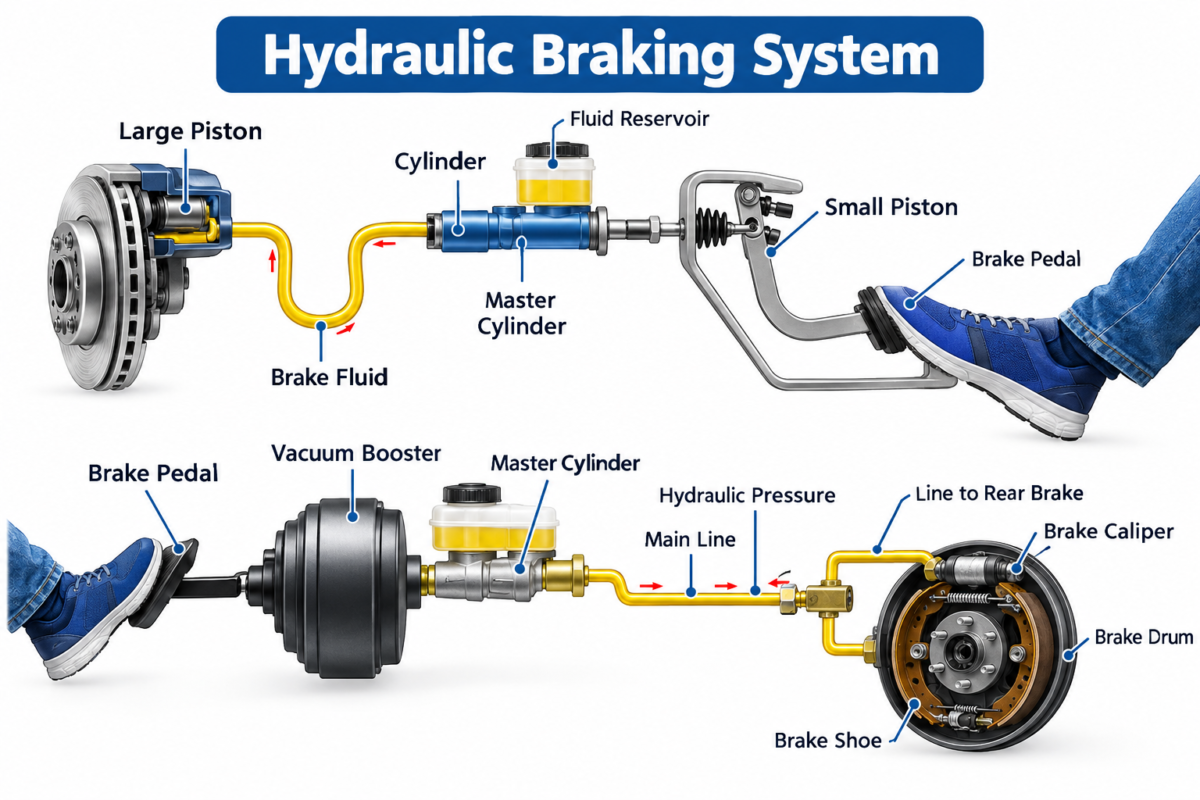
When the driver presses the brake pedal, the vehicle’s braking system converts that foot movement into braking force. In many conventional vehicles, hydraulic brake fluid is used to transmit pressure through the braking system.
The pressure eventually reaches components near the wheels, where friction is created to slow the rotating wheels.
Modern braking systems may include several technologies designed to improve braking performance and vehicle control. These can include anti-lock braking systems, electronic brake-force management, and other electronic assistance systems.
The brake pedal is therefore much more than a simple switch. It is the driver’s primary control for reducing vehicle speed and bringing the vehicle to a stop.
Pressing the Brake Pedal
When you press the brake pedal, the braking system responds to the pressure you apply.
A gentle press can provide gradual deceleration, while stronger pressure produces greater braking force. Drivers need to learn how much pressure is appropriate for different situations.
Normal traffic often requires smooth and controlled braking. A sudden obstacle or emergency may require much stronger braking.
Understanding what happens when you press the brake pedal can make the pedal layout easier to appreciate. When you press the brake pedal, the vehicle’s braking system converts your foot movement into braking force. Modern vehicles use different braking technologies, and braking performance is regulated through vehicle safety standards. The National Highway Traffic Safety Administration (NHTSA) provides information about vehicle safety and federal braking requirements.
The exact pedal feel can differ between vehicles. Some cars have a firm pedal, while others may feel slightly different. Drivers should become familiar with the normal behavior of the vehicle they operate.
Brake Pads and Rotors
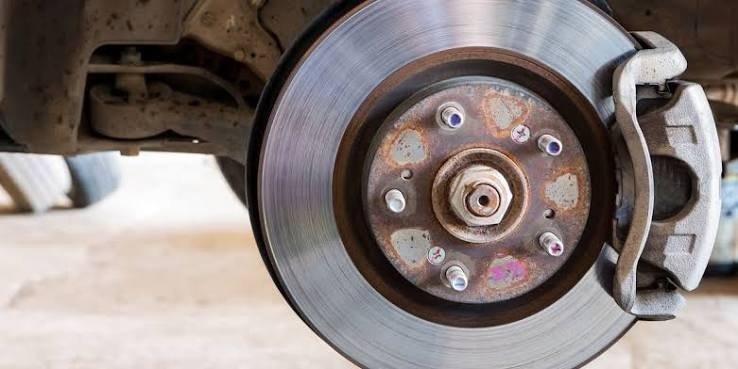
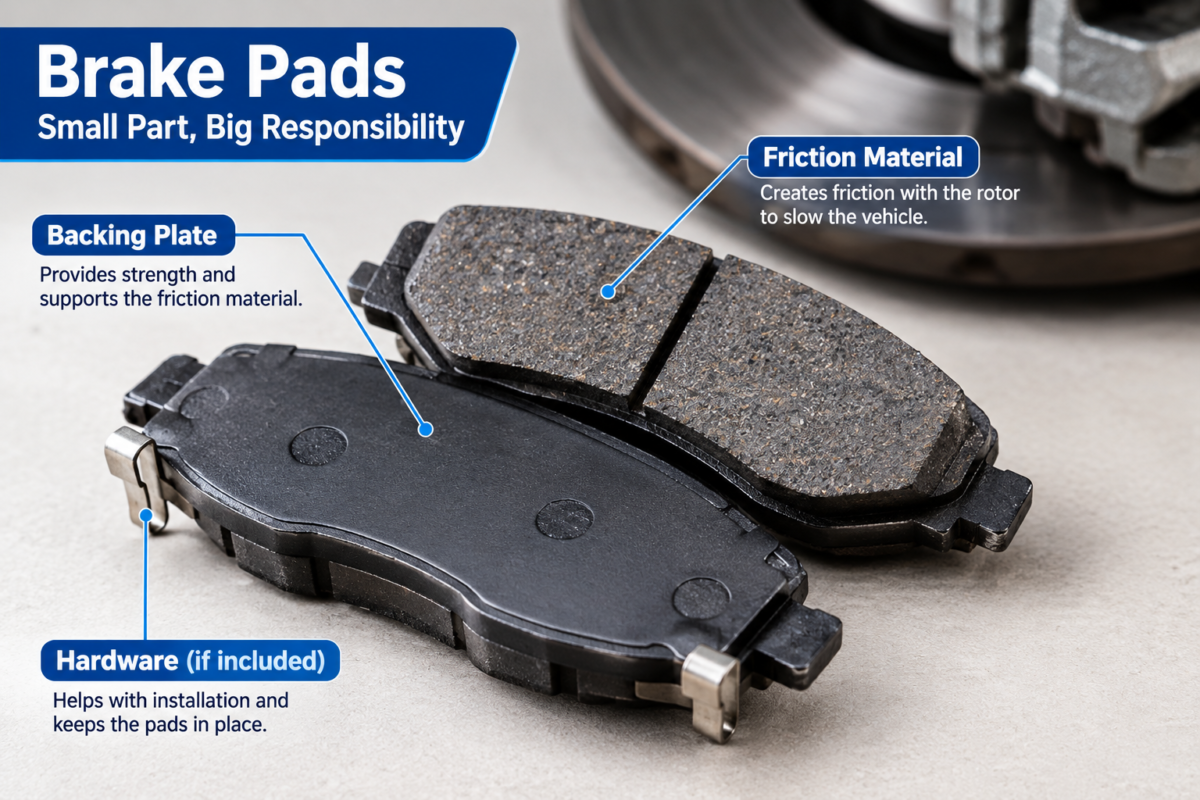
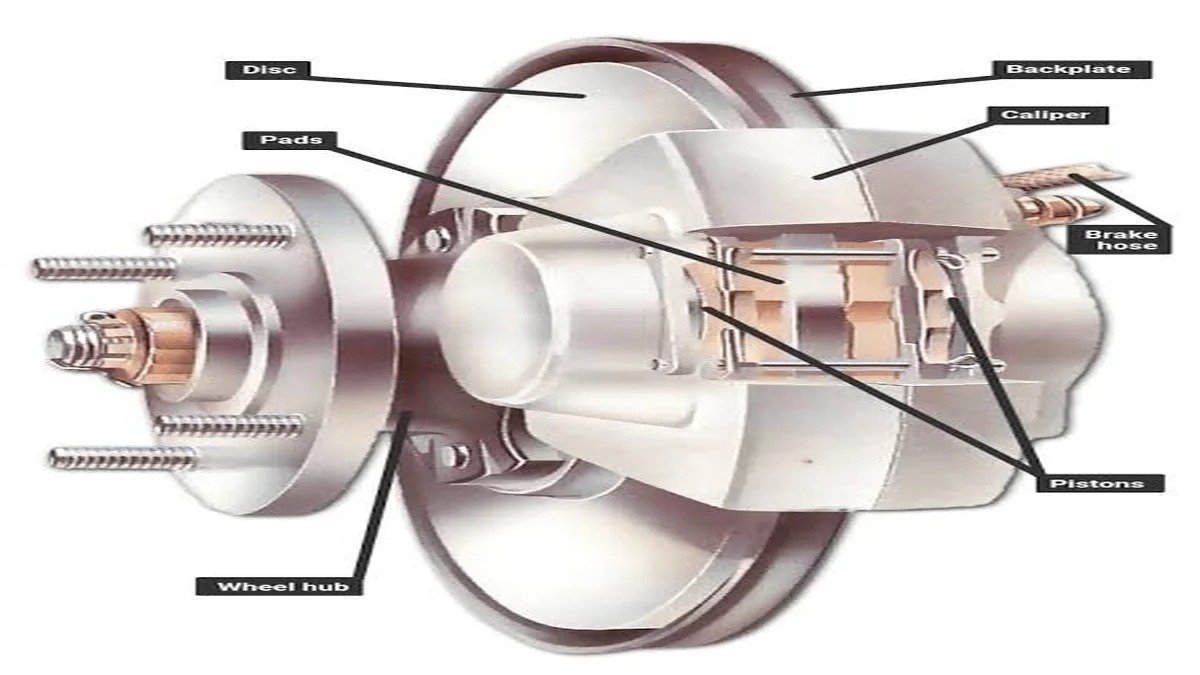
Many modern passenger vehicles use disc brakes. These systems commonly include brake pads and brake rotors.
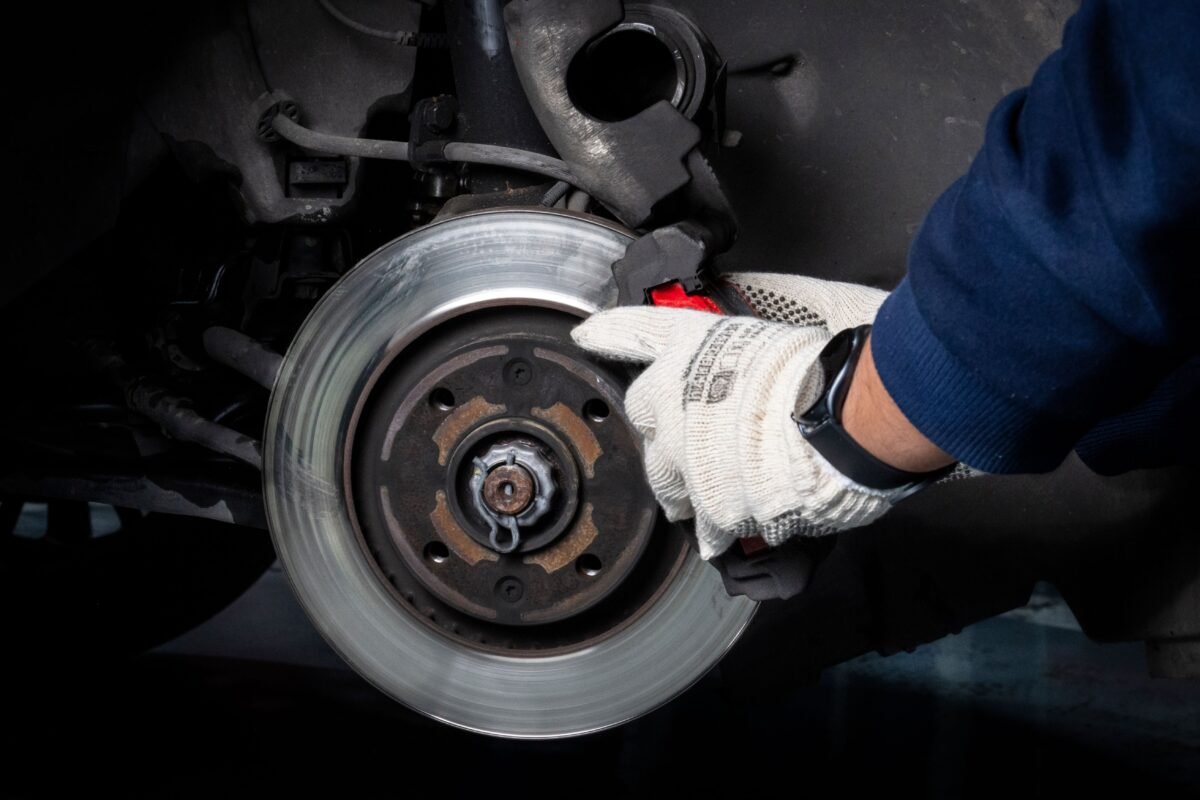
When the brake pedal is pressed, the braking mechanism causes the brake pads to apply force against the rotating rotor. The resulting friction slows the wheel.
Because this process creates heat and causes gradual wear, brake components need regular inspection and maintenance.
Brake pads are wear items and eventually need replacement. Rotors can also wear or develop problems depending on vehicle use and condition.
If braking performance changes noticeably, it is important to have the system inspected by a qualified automotive professional.
ABS and Modern Braking Systems
Many modern cars are equipped with an anti-lock braking system, commonly called ABS.
ABS is designed to help prevent the wheels from locking during hard braking. By rapidly adjusting brake pressure at individual wheels, the system can help the driver maintain steering control while braking heavily.
A driver may feel a pulsing sensation through the brake pedal when ABS activates. This can be normal during an ABS event.
Drivers should not become confused by this sensation. Instead, they should maintain appropriate control of the vehicle and follow safe driving practices.
Brake Pedal vs. Accelerator Pedal
The brake and accelerator pedals perform completely different jobs.
The accelerator is used to increase engine power and help the vehicle move faster. The brake is used to reduce speed or stop the vehicle.
In an automatic car, both pedals are located close together, which is why correct foot placement matters.
A driver should develop the habit of identifying the pedal before applying pressure. Smooth movements are especially important in traffic because sudden acceleration or braking can make the vehicle harder to control.
New drivers sometimes feel nervous because the two pedals are close together. With proper instruction and supervised practice, the arrangement becomes much easier to understand.
The goal is not to rush the learning process. Good driving comes from developing controlled, predictable habits.
How Should You Use the Brake Pedal Safely?
Using the brake pedal safely begins with understanding its location and function. Once you know which pedal is the brake, the next step is learning how to apply it smoothly.
In ordinary driving, brake early enough to allow the vehicle to slow gradually. Looking ahead at traffic, intersections, pedestrians, and road conditions gives you more time to react.
Avoid unnecessary last-second braking whenever possible. Maintaining a suitable following distance gives you more room to slow down safely.
When approaching a stop sign or traffic signal, gradually reduce speed and apply the brake with controlled pressure. As the vehicle slows, adjust the pressure as needed.
Different road surfaces also affect braking. Wet, loose, icy, or otherwise slippery surfaces can increase stopping distances. Drivers should adjust their speed and following distance to match the conditions.
Most importantly, avoid distractions. Your attention should remain focused on the road and the vehicle’s controls.
Common Brake Pedal Mistakes New Drivers Make
Learning the pedal layout is one thing, but developing good habits takes practice.
One common mistake is confusing the brake and accelerator. This is more likely to happen when a driver is inexperienced, distracted, or suddenly surprised by a situation.
Another mistake is looking down at the pedals while the vehicle is moving. Drivers should learn the pedal positions so they can operate them without taking their eyes away from the road.
Some drivers also rest their foot on the brake pedal without realizing it. Even light pressure can activate the brake lights and may contribute to unnecessary brake wear.
Another issue is braking too late. Waiting until the last possible moment can make stopping more difficult and uncomfortable.
A better approach is to look ahead, anticipate traffic conditions, and use the brake smoothly.
What If the Brake Pedal Feels Different?
A change in brake-pedal behavior should never be ignored.
If the pedal feels unusually soft, spongy, excessively hard, or lower than normal, there may be a problem with the braking system. Similarly, unusual vibration, noise, or changes in stopping performance deserve attention.
A brake pedal that does not feel normal can have several possible causes. The problem may involve hydraulic components, brake fluid, brake pads, rotors, or other parts of the braking system.
Drivers should not attempt to diagnose or repair a serious braking problem while continuing to drive normally. If the braking system appears unsafe, have the vehicle checked by a qualified professional.
Brake systems are critical safety components, so unusual behavior should always be treated seriously.
How to Remember Which Side Is the Brake
If you are struggling to remember the pedal arrangement, keep the rule simple.
For an automatic car:
Brake → Accelerator
From left to right, the brake is on the left, and the accelerator is on the right.
For a manual car:
Clutch → Brake → Accelerator
The brake is therefore the middle pedal.
Another useful way to remember it is that the accelerator is generally the pedal farthest to the right. The brake sits immediately to its left in an automatic vehicle.
However, do not rely entirely on memory when entering a completely unfamiliar vehicle. Take a moment to inspect the controls while the car is safely parked.
Brake Pedal Position in Different Types of Cars
Different types of vehicles can use different technologies, but conventional pedal arrangements remain quite familiar.
Automatic Cars
Automatic cars normally have two primary pedals. The brake is on the left and the accelerator on the right.
Manual Cars
Manual vehicles normally have three pedals. The clutch is on the left, the brake in the middle, and the accelerator on the right.
Hybrid Cars
Many hybrid vehicles use a two-pedal automatic-style arrangement. The brake is generally positioned to the left of the accelerator.
Hybrid vehicles can have regenerative braking systems that recover some energy during deceleration. However, the driver still uses the brake pedal as the primary braking control.
Electric Vehicles
Most electric vehicles also use two pedals, with the brake on the left and accelerator on the right.
Electric cars may offer regenerative braking or one-pedal driving features. These technologies can change how the vehicle slows when the accelerator is released, but the conventional brake pedal remains available for braking.
Drivers should read the vehicle instructions and understand how its specific driving modes work before using them on public roads.
Why Is Knowing the Brake Position So Important?
Knowing the brake position is more than a basic driving lesson. It is an essential part of vehicle control.
When traffic suddenly slows, a pedestrian enters a crossing, or another unexpected situation occurs, the driver needs to know exactly where the brake pedal is.
A driver who understands the pedal layout can react more naturally and avoid unnecessary hesitation.
This is particularly important for new drivers. When someone is still learning, there are already many things to think about, including steering, mirrors, traffic signs, road position, speed, and other road users.
Knowing the pedals automatically reduces one source of uncertainty.
That is why instructors often spend time helping learners become familiar with the basic controls before they begin more complicated driving exercises.
Should You Use Your Left Foot to Brake?
In a conventional automatic vehicle, drivers are generally taught to use the right foot for both the accelerator and brake.
This creates a consistent habit and keeps the left foot free.
In a manual car, the left foot operates the clutch while the right foot controls the brake and accelerator.
There can be specialized driving situations and vehicle designs where different techniques are used by trained drivers, but ordinary drivers should follow the guidance provided by their driving instructor and the vehicle manufacturer.
For beginners, consistency is especially valuable. Developing one clear and controlled foot position makes it easier to avoid accidental pedal inputs.
How Can Beginners Practice Identifying the Brake?
A beginner can become familiar with the brake pedal before driving by sitting in the driver’s seat while the vehicle is safely parked.
Look at the pedals and identify each one. In an automatic vehicle, identify the brake and accelerator. In a manual vehicle, identify the clutch, brake, and accelerator.
Pay attention to the spacing between the pedals and their shapes.
You can also practice moving your foot between the accelerator and brake while the vehicle remains stationary and safely secured. The purpose is simply to become familiar with the movement.
Once you begin supervised driving, practice smooth braking in a safe and appropriate environment under the guidance of a qualified instructor.
The more familiar the pedal layout becomes, the less you will need to think consciously about where the brake is.
Does Every Car Have the Same Brake Pedal Layout?
Most conventional passenger cars follow the familiar pedal arrangement, but it is important not to assume that every vehicle is identical.
Special-purpose vehicles, modified vehicles, older designs, and certain unusual controls may differ.
Some vehicles may also have additional pedals or controls depending on their design.
For this reason, whenever you enter a new vehicle, take a moment to familiarize yourself with the driver’s controls. This is especially important if you are borrowing a vehicle, renting one, learning to drive a different car, or switching from a manual transmission to an automatic.
Knowing the general rule is helpful, but checking the actual vehicle is always the safer approach.
Brake Pedal Position and Driver Confidence
Confidence behind the wheel does not come from driving quickly or taking unnecessary risks. It comes from understanding the vehicle and controlling it smoothly.
Knowing which side is the brake in a car is one of those small pieces of knowledge that can make a new driver feel more comfortable.
Once you understand that the brake is normally to the left of the accelerator in an automatic car and between the clutch and accelerator in a manual car, the layout becomes easy to remember.
With practice, your foot movements become more natural. You can concentrate more on traffic, road signs, mirrors, and other important aspects of driving.
Good driving is built from simple habits repeated correctly.
FAQs
Which side is the brake in a car?
In a typical automatic car, the brake pedal is positioned to the left of the accelerator. In a manual car, the brake is normally the middle pedal between the clutch and accelerator.
Is the brake pedal on the left or right?
In an automatic car, the brake is on the left side of the accelerator. In a manual car, it is normally in the middle of the three pedals.
Which pedal is the brake in an automatic car?
The brake is generally the wider pedal located to the left of the accelerator. Drivers normally use the right foot to operate both pedals.
Where is the brake in a manual car?
In a conventional manual car, the brake pedal is located in the middle. The order from left to right is clutch, brake, and accelerator.
Do right-hand-drive cars have the brake on a different side?
Usually, no. The steering wheel may be on the right, but the conventional pedal arrangement generally remains the same. In a manual vehicle, the pedals are normally clutch, brake, and accelerator from left to right.
Is the brake pedal always in the middle?
The brake is normally the middle pedal in a manual car. In an automatic car, there are usually only two pedals, so the brake is positioned to the left of the accelerator.
Why is the brake pedal usually bigger?
A larger brake pedal provides a broad surface for the driver’s foot and makes it easier to apply controlled braking pressure. Exact pedal dimensions vary between vehicles.
Can the brake pedal feel different in different cars?
Yes. Brake-pedal firmness, travel, and responsiveness can vary between vehicles. Drivers should become familiar with the normal feel of the specific vehicle they are driving.
What should I do if my brake pedal feels unusual?
If the brake pedal suddenly feels soft, spongy, excessively hard, unusually low, or otherwise different, the vehicle should be checked by a qualified automotive professional. Braking problems should not be ignored.
Is the brake the same in electric and hybrid cars?
Most electric and hybrid passenger vehicles still have a conventional brake pedal located to the left of the accelerator. However, regenerative braking can change how the vehicle slows when the accelerator is released.
Final Thoughts
Knowing which side is the brake in a car is one of the first and most useful things every new driver should learn. In a typical automatic car, the brake pedal is located to the left of the accelerator, while a conventional manual car has the clutch on the left, brake in the middle, and accelerator on the right. This familiar arrangement makes it easier for drivers to understand the basic controls and move between different vehicles with confidence.
Although the general pedal layout is consistent, every vehicle can have its own pedal feel, spacing, and additional driving features. That is why taking a moment to become familiar with an unfamiliar car is always a smart habit. Drivers should also pay attention to unusual brake-pedal behavior and have potential braking problems inspected by a qualified professional.
Safe driving is built on awareness, patience, and good habits. Once the brake pedal position becomes familiar, operating the vehicle becomes much more natural. Whether you are learning to drive an automatic, practicing with a manual transmission, or getting used to a hybrid or electric vehicle, understanding the brake is an essential step toward becoming a confident and responsible driver.




One thought on “Which Side Is the Brake in a Car? Discover the Simple, Powerful Guide to Brake Pedal Position & Safe Driving”