

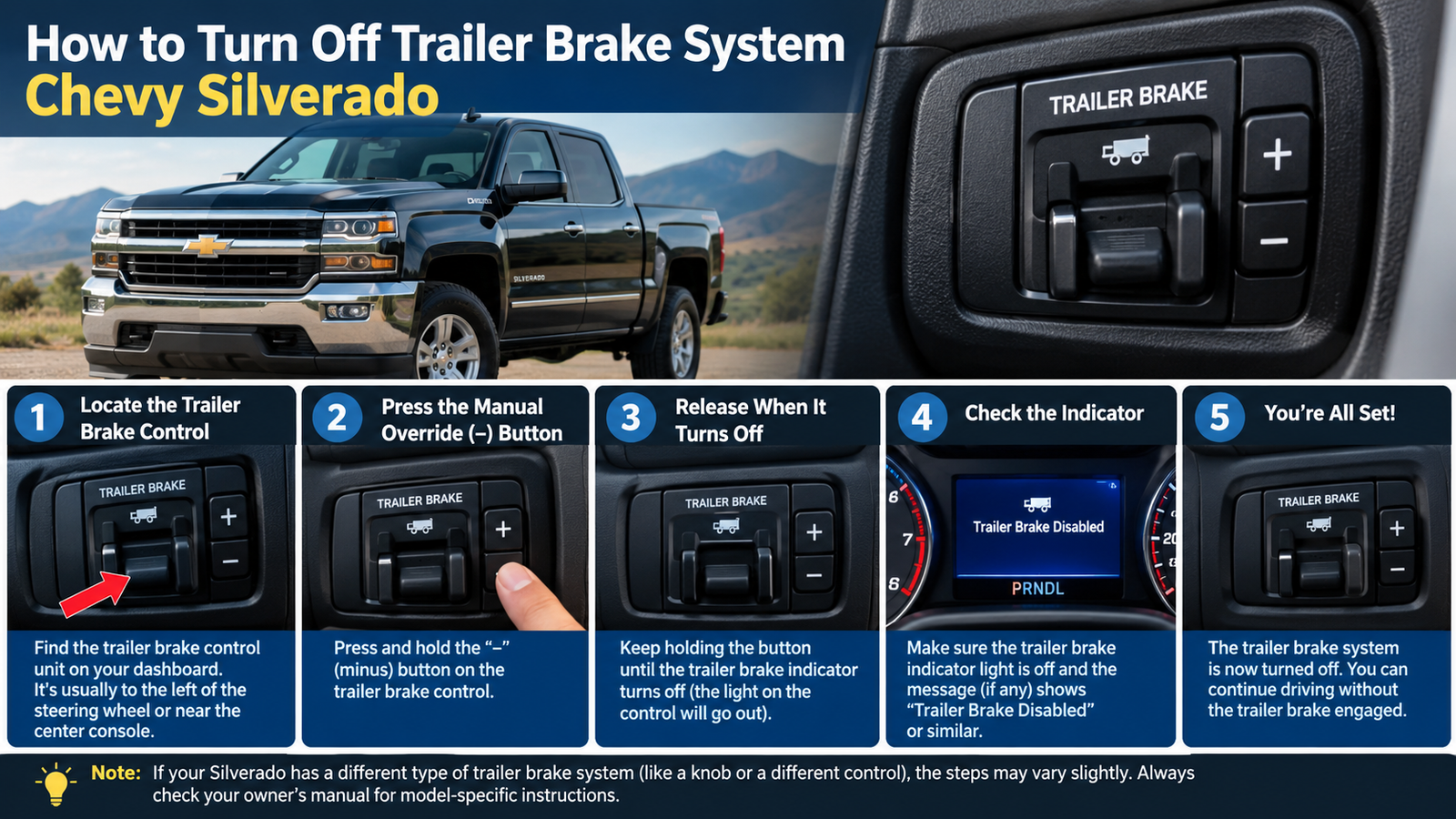
When you own a Chevy Silverado and regularly tow a trailer, the trailer brake system is one of those features you quickly learn to appreciate. It helps the truck and trailer slow down together, improves control, and can make towing feel much more predictable. However, you may occasionally see a trailer brake message on the dashboard or wonder how to turn off trailer brake system Chevy Silverado when you are no longer towing.
The important thing to understand is that “turning off” the trailer brake system can mean several different things. Some drivers simply want to stop a trailer-related message when no trailer is connected. Others want to adjust the trailer brake gain, while some may be dealing with a warning caused by a wiring or electrical problem. These situations should not all be treated in the same way.
Your Silverado’s trailer brake controller is designed to work with compatible trailer braking equipment. Depending on the Silverado generation, model year, trim, and equipment, the controls and menu options can be different. Because of that, there is no single button combination that works for every Silverado.
The safest approach is to identify what your truck is actually doing before attempting to disable or change anything. If you are towing a trailer equipped with brakes, the trailer braking system is an important part of the overall towing setup. Instead of simply trying to eliminate a warning, it is better to understand why the message appeared and whether the system is operating correctly.
This guide explains the trailer brake system, possible reasons you may want to turn it off, how brake gain works, what common warnings mean, and when professional assistance may be necessary.
What Is the Trailer Brake System on a Chevy Silverado?
The trailer brake system on a Chevy Silverado helps the truck control the brakes on a compatible trailer. Rather than relying entirely on the truck’s brakes to slow the entire combination, the trailer can contribute braking force through its own braking equipment.
This is especially useful when towing a heavier trailer. A trailer adds considerable weight behind the truck, and that additional weight affects acceleration, stopping distance, handling, and overall control.
A properly configured trailer brake controller allows the Silverado and trailer to work together. When the truck brakes, the controller can send an appropriate electrical signal to the trailer’s electric brakes.
The system is designed to give the driver more control over the towing combination. When everything is adjusted correctly, braking can feel smoother because the trailer is helping rather than simply following behind the truck.
Understanding the Integrated Trailer Brake Controller
Many properly equipped Silverado models use an integrated trailer brake controller. The controller is incorporated into the vehicle and allows the driver to adjust trailer braking according to the towing situation.
One of the most important settings is trailer brake gain. Gain determines how much braking force the controller requests from the trailer brakes when the truck’s brake pedal is applied.
It is important to understand that the gain setting is not necessarily an on/off switch. Lowering the gain changes the amount of trailer braking assistance. It does not automatically mean that the trailer brake system has been completely disabled.
The exact controls can vary by Silverado model year. Therefore, owners should always check the instructions specific to their vehicle rather than assuming that a procedure shown for one generation will work the same way on another.
Why Does the Chevy Silverado Have a Trailer Brake System?
The main purpose of a trailer brake system is to improve control while towing. A truck pulling a trailer has to manage more weight than the truck alone, and the trailer can influence how the entire combination behaves during braking.
When a trailer has functioning brakes, those brakes can contribute to slowing the trailer itself. This reduces the amount of work the truck’s braking system has to perform and can make the towing combination easier to control.
Trailer brakes can also help reduce the tendency of the trailer to push against the truck during braking. Properly adjusted braking helps the truck and trailer behave more like a coordinated unit.
For these reasons, the trailer brake system should not be treated as an unnecessary feature. If you are towing a trailer that requires or uses brakes, keeping the system properly configured is an important part of responsible towing.
Why Would You Want to Turn Off the Trailer Brake System?
There are several reasons a Silverado owner might search for how to turn off trailer brake system Chevy Silverado. However, the reason behind the request matters because the correct solution can be completely different depending on the situation.
For instance, if you have disconnected your trailer but a trailer-related message remains on the dashboard, you may simply be dealing with a detection or electrical issue.
Another driver might be trying to reduce trailer braking because the brakes feel too aggressive. In that case, adjusting the trailer brake gain may be more appropriate than turning the system off.
A third driver may be seeing a warning indicating a problem with the trailer brake system. In that situation, disabling the system is not a real repair. The underlying problem should be investigated.
When the Trailer Is Not Connected
If there is no trailer attached to your Silverado, you normally have no reason to apply trailer braking. However, an unexpected trailer message can sometimes appear because of a connector, wiring, electrical, or detection issue.
Before changing settings, check whether anything is connected to the trailer socket. Inspecting the connector can be a useful first step.
When You Are Troubleshooting a Problem
You may also want to turn off or stop using the trailer brake function temporarily while diagnosing a problem. This should be approached carefully.
If the trailer brake system is reporting a fault, the safest response is generally to identify the cause rather than simply suppress the warning. A warning can indicate that the truck is not communicating correctly with the trailer.
When the Trailer Brakes Feel Too Strong
Sometimes drivers assume that strong trailer braking means the system should be turned off. In reality, the trailer brake gain may simply need adjustment.
If the trailer brakes engage too aggressively, reducing the gain according to the vehicle’s instructions may produce a smoother result.
How to Turn Off Trailer Brake System Chevy Silverado
There is an important distinction between turning off trailer braking and disconnecting a trailer or adjusting the brake controller.
There is not one universal procedure for every Chevy Silverado. The available functions depend on the model year, factory equipment, trailer brake controller, and vehicle configuration.
If your goal is simply to stop the truck from controlling trailer brakes because no trailer is attached, disconnecting the trailer’s electrical connection and verifying that the vehicle is no longer detecting the trailer may be all that is necessary.
If the vehicle continues displaying a warning after the trailer has been disconnected, that is a different situation. It may indicate an issue that requires diagnosis.
Step 1: Park the Silverado Safely
Before checking or changing trailer brake settings, park the Silverado in a safe location. If you have been towing, make sure the truck and trailer are secure before inspecting anything.
Put the vehicle in Park and follow the normal safety procedures described in the owner’s manual.
This first step may seem obvious, but it matters whenever you are working around a vehicle and trailer connection.
Step 2: Determine Whether a Trailer Is Connected
Look at the trailer hitch area and electrical connector. If a trailer is attached, do not assume that turning off the trailer brake function is harmless.
If you are not towing and a trailer-related message remains, check whether the trailer plug is still connected.
A loose, damaged, dirty, or corroded connector can interfere with communication between the truck and trailer.
Step 3: Check the Trailer Brake Controller
If your Silverado has an integrated trailer brake controller, locate its controls. Depending on the model year, the controller may include gain controls and a manual trailer brake lever or switch.
The controller is designed to manage trailer braking rather than simply act as a basic on/off switch.
If your goal is to change braking strength, the appropriate action may be to adjust gain rather than attempt to disable the entire system.
Step 4: Check the Driver Information Center
Your Silverado’s Driver Information Center can display messages associated with the trailer system.
Read the message carefully. A message indicating that a trailer is connected is different from a message indicating a trailer brake fault.
Do not assume every trailer-related message means the same thing.
If your truck provides trailer settings through its infotainment system or vehicle menus, use the options provided for your specific model.
Step 5: Consult the Correct Silverado Owner’s Manual
This is one of the most important steps.
Silverado trucks have been produced across multiple generations, and trailer-control features can change between model years. A procedure that applies to an older truck may not apply to a newer Silverado.
Use the owner’s manual for your exact vehicle configuration. Pay attention to the sections covering trailer towing, trailer brakes, brake controller settings, and trailer electrical connections.
Can You Completely Disable the Trailer Brake System?
This is where many online explanations become confusing.
Reducing the trailer brake gain is not necessarily the same thing as completely disabling the trailer brake system.
The gain control changes the amount of braking assistance supplied to the trailer. It is intended to help match trailer braking performance to the towing situation.
Completely bypassing or modifying a factory braking system is a different matter. Drivers should not improvise electrical modifications simply to eliminate a warning or stop the controller from operating.
If the system is malfunctioning, the better solution is to diagnose the problem.
A trailer brake system exists for an important reason. If your trailer depends on its electric brakes, disabling them can affect how the truck and trailer stop.
How to Adjust Trailer Brake Gain on a Chevy Silverado
Understanding brake gain can make the question of how to turn off trailer brake system Chevy Silverado much easier to understand.
Trailer brake gain is essentially the amount of braking power the controller requests from the trailer brakes.
A heavier trailer may require a different setting than a lighter trailer. Trailer brake condition, load distribution, road conditions, and other factors can also affect braking behavior.
The correct setting should be established according to the vehicle and trailer manufacturer’s guidance and tested carefully in an appropriate safe environment.
What Happens When the Gain Is Too High?
If the gain is set too high, the trailer brakes may apply more aggressively than necessary.
You may notice that the trailer feels as though it is braking harder than the truck. The combination can feel less smooth, and the trailer may react noticeably when braking.
If this occurs, the answer is not necessarily to turn the entire system off. Properly adjusting the gain may be the more appropriate solution.
What Happens When the Gain Is Too Low?
If the gain is too low, the trailer may provide insufficient braking assistance.
The truck may end up doing more of the braking work, while the trailer contributes less than intended.
That is why finding an appropriate setting matters. The goal is coordinated braking rather than maximum or minimum braking force.
How to Know Whether Trailer Brake Gain Needs Attention
Pay attention to how your Silverado and trailer behave during normal braking.
If braking feels smooth and controlled, the system may be operating appropriately. If the trailer seems to push the truck, brake too aggressively, or provide inconsistent assistance, the setup deserves attention.
Changes in trailer weight can also influence braking behavior. A trailer carrying a different load may not behave exactly like an unloaded trailer.
Instead of making random adjustments, follow the procedure recommended for your Silverado and trailer.
Common Chevy Silverado Trailer Brake System Problems
Trailer brake issues are not always caused by the controller itself. The electrical connection between the truck and trailer is an important part of the system.
Trailer Wiring Problems
Trailer wiring can become damaged from weather, road debris, improper repairs, or normal wear.
A damaged wire can interfere with the electrical signal needed to operate the trailer brakes.
If you notice damaged insulation, exposed wiring, loose connections, or other obvious problems, the trailer should be inspected before normal towing continues.
Dirty or Corroded Trailer Connector
The trailer connector is exposed to the environment. Moisture, dirt, and corrosion can affect electrical connections.
A poor connection can create intermittent problems that seem confusing because the system may work normally at one moment and produce a warning later.
Keeping the connector clean and properly protected can help maintain a reliable connection.
Trailer Ground Problems
A good electrical ground is important for trailer systems.
A poor ground can cause strange electrical behavior, including problems with lights and braking-related functions.
If several trailer electrical systems begin acting unusually at the same time, the wiring and ground connections deserve inspection.
Faulty Trailer Brake Components
The problem may also be located on the trailer rather than the Silverado.
Trailer brake assemblies, wiring, connectors, and other electrical components can wear or fail.
That is why diagnosing only the truck may not solve the problem.
What Does a “Trailer Brake System” Warning Mean?
A trailer brake warning can have several possible causes.
The exact message displayed on your Silverado matters. A warning may indicate that the vehicle has detected an issue with the trailer braking connection or system.
If the warning appears while towing, do not assume it is safe to continue normally without checking the situation.
Pay attention to changes in braking behavior. If the trailer does not appear to be braking correctly, reduce the risk by stopping in a safe location and checking the trailer and vehicle according to the appropriate instructions.
How to Reset a Trailer Brake Warning on a Chevy Silverado
A reset should not be confused with a repair.
If a warning appears because of a temporary connection issue, reconnecting a properly functioning trailer may allow the system to operate normally. However, if the warning keeps returning, simply clearing or resetting it does not solve the underlying cause.
Repeated warnings deserve further investigation.
If the message remains even when no trailer is connected, there could be an issue involving the vehicle’s trailer detection, wiring, controller, or another related component.
For persistent problems, professional diagnosis can save time and prevent unnecessary parts replacement.
Why Your Silverado May Not Detect the Trailer Correctly
A Silverado may fail to recognize a connected trailer for several reasons.
The trailer plug could be improperly seated. The connector could have corrosion. Wiring could be damaged. The trailer’s electrical system could have a fault.
In some cases, compatibility between the vehicle and trailer equipment can also be relevant.
Rather than immediately assuming the Silverado’s controller has failed, inspect the entire connection between the truck and trailer.
The trailer itself is part of the braking system, so both sides need to work correctly.
Is It Safe to Drive With the Trailer Brake System Turned Off?
If you are not towing a trailer, trailer braking obviously is not being used to stop a trailer.
The situation changes when you are towing a trailer equipped with brakes.
A functioning trailer braking system can be an important part of safe towing because the trailer adds weight behind the truck. If the trailer’s brakes are unavailable when they are expected to operate, braking performance and control can be affected.
For this reason, disabling trailer braking simply because a warning is inconvenient is not a good solution.
If you are experiencing a trailer brake fault while towing, deal with the problem before continuing normal towing whenever practical and safe.
Trailer Brake System vs. Truck Brake System
It is also important to understand that the trailer brake system and Silverado’s regular service brakes are not the same thing.
The truck’s brakes are responsible for stopping the Silverado itself. The trailer brake controller helps manage braking on a compatible trailer.
The two systems work together during towing, but they have different components and functions.
This distinction helps explain why a trailer brake warning does not necessarily mean that the Silverado’s main brake system has failed.
At the same time, a trailer brake warning should not be ignored simply because the truck’s brakes still appear to work normally.
Tips for Maintaining Your Silverado Trailer Brake System
Regular maintenance can prevent many towing problems.
Inspect the Trailer Connector
Before towing, take a moment to inspect the electrical connector.
Look for dirt, corrosion, bent terminals, loose connections, or visible damage.
A clean and secure connection helps the truck communicate properly with the trailer.
Check Trailer Wiring
Follow the visible trailer wiring and look for obvious signs of damage.
Wires can become worn or damaged over time, particularly around areas that move or are exposed to road conditions.
Chevrolet provides detailed towing information for Silverado owners, including guidance related to trailer equipment, towing setup, and vehicle operation. Before changing any trailer-related settings, it is a good idea to review the information available through the official Chevrolet website and use the documentation specific to your Silverado model.
Inspect the Trailer Brakes
The trailer’s braking components need maintenance too.
If braking performance changes, the trailer should be inspected rather than assuming the Silverado controller is responsible.
Test the System Before a Long Trip
Before beginning a long towing trip, make sure the trailer is connected correctly and that its systems are operating as expected.
A problem discovered close to home is generally easier to address than one discovered far from a service facility.
Silverado Towing Settings You Should Understand
Trailer brake gain is only one part of responsible towing.
You should also understand the Silverado’s towing capacity, trailer weight, payload limitations, hitch equipment, tire requirements, and other relevant specifications.
The trailer should be properly matched to the truck.
Overloading either the truck or trailer can create additional braking and handling challenges.
Understanding these factors makes towing safer and helps you make better decisions when a trailer-related warning appears.
When Should You Take Your Silverado to a Professional?
There are times when basic inspection is not enough.
If the trailer brake warning continues after checking the connection, professional diagnosis may be appropriate.
You should also seek qualified assistance if the trailer brakes are not responding correctly, the controller behaves unexpectedly, wiring appears damaged, or electrical problems continue to return.
A professional can inspect the truck and trailer and determine whether the problem originates in the vehicle, trailer, wiring, connector, or braking components.
This can be particularly valuable when the issue is intermittent. Electrical problems can sometimes be difficult to identify without proper testing equipment.
Common Mistakes to Avoid With Trailer Brakes
One common mistake is assuming that reducing gain completely disables the system. It does not necessarily work that way.
Another mistake is repeatedly clearing a warning without finding its cause.
Some drivers also focus entirely on the Silverado and forget that the trailer itself contains wiring and braking components that can fail.
Finally, avoid making improvised electrical modifications to the trailer connector or factory brake controller. A braking system is not a good place for trial-and-error wiring changes.
FAQs
How do I turn off trailer brake system Chevy Silverado?
The exact process depends on the Silverado model year and equipment. If you are no longer towing, disconnecting the trailer’s electrical connection and checking the vehicle’s trailer status may be enough. If a trailer brake warning remains, investigate the cause rather than simply trying to disable the warning.
How do I turn off trailer brake gain on a Silverado?
Trailer brake gain is generally an adjustable setting, not a simple on/off function. The controls and available settings depend on the Silverado model year and factory equipment. Follow the instructions specific to your truck.
Why does my Chevy Silverado say trailer brake system?
A trailer brake message can be related to the trailer connection, wiring, electrical communication, controller, or trailer braking equipment. The exact dashboard message is important when determining the next step.
Can I drive my Silverado without trailer brakes?
If you are towing a trailer that is equipped with or requires functioning brakes, you should not assume it is safe to continue towing with the trailer braking system unavailable. Trailer braking requirements can also depend on the trailer and applicable laws.
Why is my Silverado not detecting my trailer brakes?
Possible causes include a poor trailer connector connection, damaged wiring, corrosion, grounding problems, trailer-side faults, or issues with the vehicle’s trailer brake system.
Does lowering trailer brake gain turn the system off?
No. Lowering the gain generally reduces the amount of braking assistance requested from the trailer. It should not automatically be treated as completely disabling the trailer brake system.
Can a bad trailer plug cause a brake warning?
Yes, an electrical connection problem can interfere with communication between the truck and trailer. Inspecting the connector is therefore a sensible troubleshooting step.
Should I ignore a trailer brake warning if the truck brakes work?
It is better not to ignore a persistent trailer brake warning when towing. The Silverado’s regular brakes and the trailer braking system perform different roles, so normal truck braking does not necessarily mean the trailer braking system is functioning properly.
Does every Chevy Silverado have the same trailer brake controls?
No. Silverado features can vary by model year, trim, equipment package, and generation. Always use information that matches your specific vehicle.
Final Thoughts
Understanding how to turn off trailer brake system Chevy Silverado starts with recognizing that “turn off” can mean different things. You may simply have disconnected your trailer, need to adjust trailer brake gain, or be dealing with a warning caused by an electrical or braking problem. These situations require different solutions, so there is no universal procedure that should be applied to every Silverado.
If you are not towing, checking the trailer connection and vehicle status is a sensible first step. If you are towing, however, the trailer brake system should be treated as an important part of the complete towing setup. Reducing brake gain is not necessarily the same as disabling the system, and clearing a warning does not necessarily repair the problem that caused it.
Your Silverado’s model year and equipment can also affect the available controls and procedures. For that reason, always verify the instructions for your exact truck before changing trailer-braking settings.
Most importantly, do not bypass a genuine trailer brake fault simply to make a dashboard message disappear. Inspect the connection, wiring, trailer brakes, and controller when appropriate, and seek qualified assistance when the problem continues. A properly functioning and correctly adjusted trailer brake system helps your Silverado and trailer work together more smoothly, giving you greater confidence and control whenever you tow.





One thought on “How to Turn Off Trailer Brake System Chevy Silverado? Discover the Smart, Safe & Simple Way to Manage Trailer Braking”