

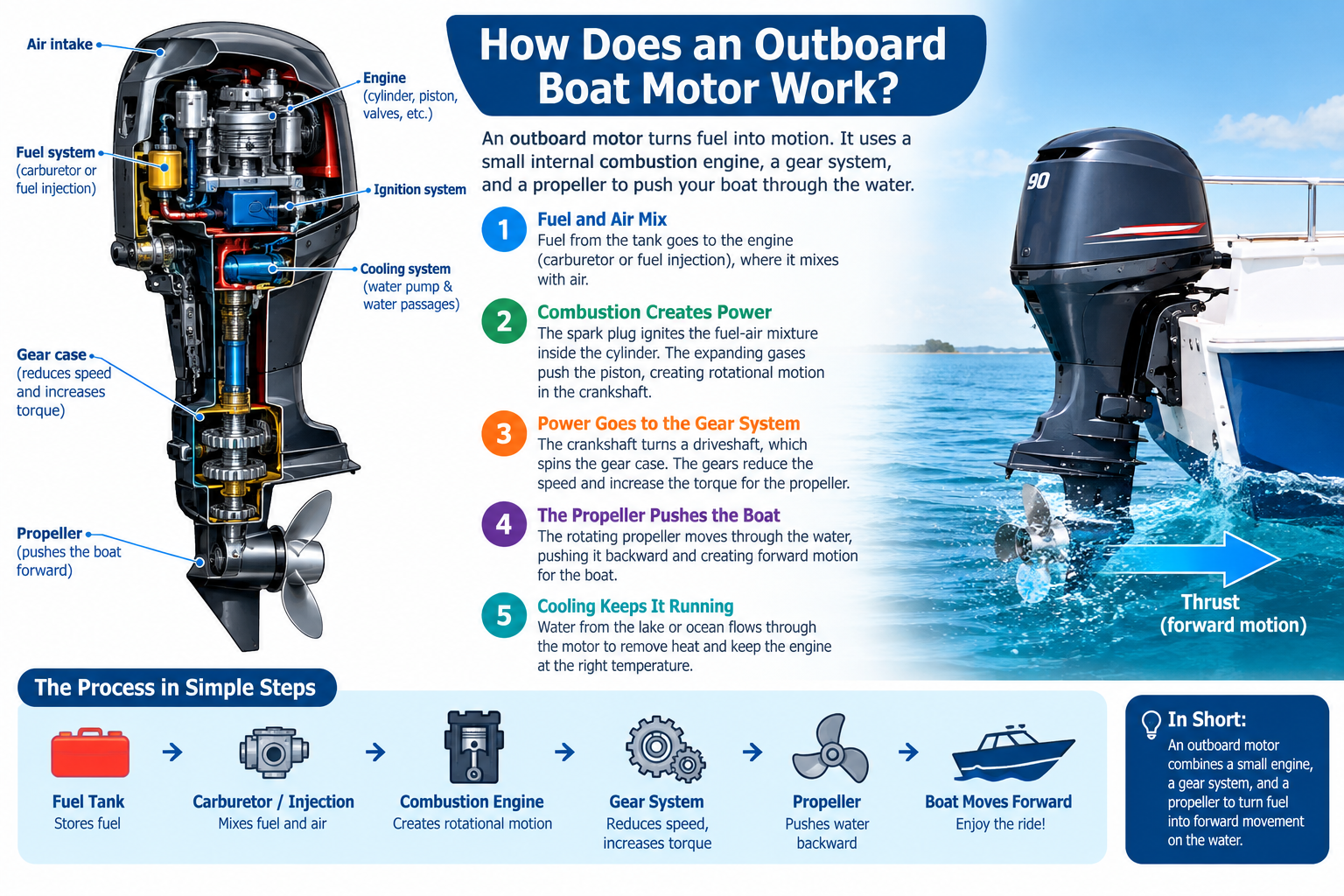
If you have ever watched a boat glide across a lake, river, or ocean, you may have wondered what makes it move so smoothly. One of the most common answers is an outboard boat motor. These compact engines are designed to provide propulsion, steering, and control from a single unit mounted on the outside of a boat.
But how does an outboard boat motor work? The basic idea is easier to understand than it may seem. An outboard motor burns fuel or uses electrical energy to create mechanical power. That power turns a propeller, and the spinning propeller pushes water backward. As the water moves backward, the boat is pushed forward.
Modern outboard motors can look complicated because they contain many individual components. However, each part has a specific job. The engine creates power, the cooling system controls temperature, the fuel system supplies energy, the gearbox transfers power, and the propeller converts that power into thrust.
Understanding how these systems work can help boat owners operate their boats more confidently. It can also make it easier to recognize basic maintenance needs and understand why an engine may lose power, overheat, or fail to start.
In this guide, we will explore how an outboard boat motor works from the moment you turn the key to the moment the boat begins moving through the water. We will also look at the major components, different types of outboards, maintenance requirements, common problems, fuel efficiency, and important facts every boat owner should know.
What Is an Outboard Boat Motor?
An outboard boat motor is a complete propulsion system mounted outside the hull of a boat. Unlike an inboard engine, which is installed inside the boat, an outboard motor is attached to the transom, usually at the rear.
One of the biggest advantages of this design is that the engine, transmission system, propeller, and steering mechanism are combined into one package.
This makes outboard motors popular for many types of boats. They are commonly found on fishing boats, pontoons, aluminum boats, small recreational boats, inflatable boats, and many larger vessels.
An outboard motor can also be tilted upward when the boat is not being used or when the boat is operating in shallow water, depending on the specific motor and manufacturer’s instructions.
The design is relatively compact, but it performs several important jobs at the same time.
An outboard motor must create mechanical power, transfer that power to the propeller, circulate cooling water, manage fuel or electrical energy, and help steer the boat.
How Does an Outboard Boat Motor Work?
The easiest way to understand an outboard motor is to follow the power from its source to the water.
In a traditional gasoline outboard, fuel and air enter the engine. The mixture is compressed inside the cylinders and ignited by spark plugs. The resulting combustion creates pressure that moves pistons.
The pistons are connected to a crankshaft. As the pistons move up and down, the crankshaft rotates.
That rotating motion is transferred through the engine’s driveshaft and gearbox. The gearbox then turns the propeller at a useful speed and direction.
The propeller has specially shaped blades. When it rotates, the blades push water backward. This produces thrust that moves the boat forward.
So, in simple terms, the process is:
Fuel + air → combustion → piston movement → crankshaft rotation → driveshaft → gearbox → propeller → thrust → boat movement
This process happens extremely quickly while the engine is running.
The Main Parts of an Outboard Motor
An outboard motor contains many components, but some are more important to understand than others.
Engine
The engine is the part that creates power. Most gasoline outboards use internal combustion engines, although electric outboard motors are becoming increasingly popular.
Gasoline engines may have one or more cylinders depending on their size and design.
The engine converts chemical energy stored in fuel into mechanical energy.
Pistons
Pistons move inside the engine cylinders. In a gasoline engine, combustion creates pressure that pushes the pistons.
The pistons are connected to connecting rods, which transfer their movement to the crankshaft.
Crankshaft
The crankshaft converts the pistons’ back-and-forth movement into rotational movement.
This rotation is essential because the propeller needs continuous spinning motion to create thrust.
Driveshaft
The driveshaft carries rotational power from the engine down toward the lower unit.
It is positioned inside the motor’s midsection and connects the engine to the gear system.
Gearbox
The gearbox, located in the lower unit, changes the speed and direction of rotation.
It allows the operator to select forward, neutral, or reverse on many traditional outboards.
Propeller
The propeller is one of the most visible and important parts of the system.
It converts rotational power into thrust by moving water.
Different propeller designs can affect acceleration, top speed, load-carrying ability, and overall performance.
Lower Unit
The lower unit houses important components such as the gears, driveshaft connection, propeller shaft, and other mechanical parts.
It is the section of the outboard that extends down into the water.
Cooling System
Engines create significant heat during operation. An outboard motor needs a cooling system to prevent excessive temperatures.
Most traditional marine outboards use water from the surrounding environment for cooling.
A water pump draws water into the cooling system and circulates it through passages around heated engine components.
The warmed water is then discharged.
Fuel System
The fuel system delivers gasoline from the fuel tank to the engine.
Depending on the motor, this system may include a fuel tank, fuel lines, filters, fuel pump, injectors, and other components.
Modern fuel-injected engines can precisely control how much fuel enters the engine.
Electrical System
The electrical system powers components such as the starter, ignition, gauges, sensors, lights, and electronic controls.
Many modern outboards also use electronic engine management systems that continuously monitor engine operation.
The Four-Stroke Outboard Engine Cycle
Many modern gasoline outboards use a four-stroke engine design.
The four-stroke cycle consists of intake, compression, power, and exhaust.
Intake Stroke
During the intake stroke, the piston moves downward while the intake valve opens.
Air and fuel enter the cylinder.
The exact fuel-delivery method depends on the engine. Older designs may use carburetors, while many modern engines use electronic fuel injection.
Compression Stroke
The intake valve closes as the piston moves upward.
The air-fuel mixture becomes compressed inside the cylinder.
Compression prepares the mixture for ignition.
Power Stroke
A spark plug ignites the compressed mixture.
The combustion process creates expanding gases that push the piston downward.
This is the stroke that produces useful engine power.
Exhaust Stroke
The exhaust valve opens as the piston moves upward again.
Burned gases are pushed out of the cylinder through the exhaust system.
The cycle then begins again.
This happens repeatedly while the engine is running.
How Does the Propeller Move the Boat?
The propeller is responsible for converting engine power into water movement.
It may look similar to a fan, but it operates in a different environment.
When the propeller rotates, its blades push water in a particular direction. The movement of water creates an opposite reaction that produces thrust.
This thrust pushes the boat forward.
Propeller size and design matter significantly. A propeller that is not properly matched to the boat and engine can reduce performance.
For example, the wrong propeller may cause poor acceleration, inefficient engine operation, or difficulty reaching the manufacturer’s recommended operating range.
That is why selecting the correct propeller is an important part of outboard performance.
How Does an Outboard Motor Steer a Boat?
An outboard motor does more than produce thrust. It can also help steer the boat.
On many boats, the entire outboard unit pivots from side to side.
When the operator turns the steering wheel or tiller, the motor changes direction.
Because the propeller’s thrust changes direction with the motor, the boat turns.
This is one of the major benefits of an outboard system. The propulsion and steering components are integrated into one unit.
Some modern boats use advanced electronic steering systems, while smaller boats may use mechanical steering or tiller steering.
How Does Reverse Work on an Outboard?
Reverse is created by changing the direction in which the propeller produces thrust.
On many conventional outboard motors, the gearbox allows the operator to select forward, neutral, or reverse.
The engine itself may continue rotating in the same general direction while the gears change how power reaches the propeller.
When reverse is selected, the propeller pushes water in the opposite direction.
This causes the boat to move backward.
Reverse should generally be used carefully because boats respond differently when moving backward than they do when moving forward.
Two-Stroke vs. Four-Stroke Outboard Motors
Outboard motors have historically been available in both two-stroke and four-stroke designs.
Two-Stroke Outboards
A traditional two-stroke engine completes its operating cycle in fewer piston movements than a four-stroke engine.
Older two-stroke outboards became popular because they could be relatively lightweight and mechanically simple.
They were also known for strong acceleration and a high power-to-weight ratio.
However, traditional carbureted two-stroke engines can produce more emissions and may consume more fuel than modern four-stroke alternatives.
Modern direct-injection two-stroke technologies improved efficiency and emissions compared with older designs.
Four-Stroke Outboards
Four-stroke outboards use the four-stage combustion cycle described earlier.
They are widely used because they can provide smooth operation, good fuel economy, and relatively quiet performance.
They are often heavier than comparable two-stroke designs, but modern engineering has reduced the weight difference in many engine classes.
For recreational boaters, four-stroke outboards are a common choice.
How Do Electric Outboard Motors Work?
Electric outboard motors operate differently from gasoline engines.
Instead of burning fuel inside cylinders, an electric motor uses electrical energy stored in a battery.
The battery supplies electricity to the motor controller and electric motor.
The electric motor creates rotational force that turns the propeller.
The basic process is:
Battery → controller → electric motor → driveshaft → propeller → thrust
Electric outboards can offer very quiet operation because they do not require traditional internal combustion.
They also produce no direct exhaust emissions at the point of use.
However, range depends on factors such as battery capacity, boat weight, speed, water conditions, propeller efficiency, and how much power is being used.
For short trips, fishing, small boats, and certain recreational applications, electric propulsion can be particularly attractive.
How Does the Cooling System Work?
Keeping an engine at an appropriate operating temperature is essential.
Gasoline combustion creates a great deal of heat. If that heat is not controlled, engine components can become excessively hot.
Many outboards use water from the surrounding body of water as part of their cooling system.
A water pump draws water into the motor.
The water travels through cooling passages around hot engine components.
After absorbing heat, the water exits the motor.
This is why boat owners often look for a visible stream of cooling water when the engine is running.
If the cooling-water flow becomes weak or disappears, the motor may have a cooling problem.
Possible causes can include debris, a blocked water intake, a damaged water pump, or another cooling-system issue.
An overheating engine should not simply be ignored.
How Does Fuel Reach the Engine?
Fuel begins its journey in the boat’s fuel tank.
From there, fuel travels through fuel lines toward the engine.
A fuel filter helps remove contaminants and water that could otherwise damage the fuel system.
A fuel pump moves fuel toward the engine.
In a fuel-injected engine, injectors deliver controlled amounts of fuel into the intake system or combustion chamber, depending on the engine design.
The engine’s electronic control system can adjust fuel delivery according to operating conditions.
This precise control helps modern engines operate efficiently.
What Does the ECU Do?
Many modern outboard motors use an electronic control unit, commonly called an ECU.
The ECU acts like the engine’s computer.
It receives information from sensors throughout the engine.
These sensors may monitor factors such as engine temperature, throttle position, air conditions, engine speed, and other operating parameters.
The ECU uses this information to control fuel injection, ignition timing, and other engine functions.
If a sensor detects an unusual condition, the system may trigger a warning.
Some engines can also enter a reduced-power operating mode to help protect the engine.
This is one reason modern outboards can be easier to monitor but sometimes more complex to diagnose than older mechanical engines.
How Does the Exhaust System Work?
A gasoline engine needs to remove combustion gases.
In an outboard motor, exhaust gases travel away from the cylinders through the engine’s exhaust system.
Marine outboards are designed differently from many automotive engines because the engine operates in a marine environment.
On many outboards, some exhaust gases are routed through areas around the driveshaft housing and lower unit before leaving the motor.
The design helps manage exhaust noise and temperature while fitting the compact marine package.
Because exhaust systems can become exposed to water and corrosion, regular inspection is important.
Why Is Gear Oil Important?
The lower unit contains gears and bearings that operate under demanding conditions.
Gear oil provides lubrication for these components.
Without proper lubrication, friction and heat can increase.
Water intrusion can also damage the lower-unit components.
For this reason, checking and changing the lower-unit lubricant according to the manufacturer’s maintenance schedule is important.
When gear oil is inspected, unusual color or signs of water contamination may indicate a problem that deserves professional attention.
How Does Trim and Tilt Work?
Many outboard motors include a trim and tilt system.
This system allows the operator to change the angle of the motor relative to the boat.
Tilt is commonly used to raise the motor out of the water when appropriate.
Trim is used while operating to adjust the motor’s angle and influence how the boat rides through the water.
Changing trim can affect acceleration, handling, fuel consumption, and overall ride characteristics.
The correct trim position depends on the boat, load, water conditions, speed, and engine setup.
There is no single trim position that is perfect for every situation.
Why Does an Outboard Motor Need Regular Maintenance?
An outboard motor operates in a demanding environment.
It is exposed to water, humidity, salt, vibration, heat, fuel, and changing operating conditions.
Saltwater can be especially challenging because salt can contribute to corrosion.
Regular maintenance helps protect the engine and reduce the chance of unexpected problems.
Maintenance schedules vary by engine, so the owner’s manual should always be the primary reference.
Common maintenance tasks can include:
- Inspecting fuel lines
- Checking engine oil on four-stroke models
- Replacing engine oil at recommended intervals
- Inspecting spark plugs
- Checking the cooling-water system
- Inspecting the propeller
- Checking lower-unit lubricant
- Inspecting electrical connections
- Checking steering components
- Inspecting anodes
- Following storage procedures
The exact service intervals depend on the engine and its operating environment.
Common Outboard Motor Problems
Even a well-maintained engine can eventually experience problems.
Understanding common symptoms can help boat owners recognize when professional service may be needed.
Engine Will Not Start
A motor that does not start could have several possible causes.
The battery may be weak, the fuel supply may be interrupted, the engine may have an electrical problem, or a safety switch may not be properly engaged.
Fuel quality can also matter.
Instead of repeatedly attempting to start an engine without understanding the problem, it is better to follow the manufacturer’s troubleshooting procedure.
Engine Overheating
Overheating is a serious warning sign.
A blocked water intake, damaged water pump, cooling-system restriction, or another mechanical problem could be responsible.
If the engine overheats, reduce operation and follow the manufacturer’s recommended procedure.
Poor Acceleration
Poor acceleration can result from several factors.
The propeller may be damaged or incorrectly selected.
The engine may not be producing full power.
Fuel delivery, ignition, airflow, or electronic-control problems can also affect acceleration.
Boat load and water conditions can make a major difference as well.
Excessive Vibration
Strong vibration may indicate a damaged propeller.
Even a small bend or deformation can affect balance.
A damaged propeller should be inspected rather than ignored.
Vibration can also originate from other mechanical issues, so persistent vibration deserves attention.
Loss of Power
Loss of power can have many causes.
The engine may be overheating, entering a protective operating mode, experiencing fuel-delivery problems, or suffering from an ignition or sensor issue.
Modern outboards may display warning indicators that can help identify the problem.
Modern outboard motors can look complicated because they contain many individual components. However, each part has a specific job. The engine creates power, the cooling system controls temperature, the fuel system supplies energy, the gearbox transfers power, and the propeller converts that power into thrust. For additional information about marine propulsion and boating safety, boat owners can also refer to the U.S. Coast Guard Boating Safety Resource Center.
How Can You Improve Outboard Motor Performance?
Good performance is not simply about choosing the biggest engine.
The boat, engine, propeller, load, and operating conditions all work together.
Choose the Correct Propeller
Propeller selection is one of the most important performance factors.
A propeller with the wrong pitch or design can affect acceleration and engine operating speed.
Always follow the engine manufacturer’s recommendations and consider the boat manufacturer’s guidance.
Avoid Unnecessary Weight
A heavily loaded boat requires more power to accelerate and maintain speed.
Carrying only the equipment you actually need can improve efficiency and handling.
Keep the Hull Clean
A dirty or heavily fouled hull can create additional resistance.
That means the engine may need to work harder to achieve the same speed.
Keeping the hull in appropriate condition can help the entire propulsion system work more efficiently.
Follow Maintenance Schedules
A well-maintained engine is more likely to deliver consistent performance.
Routine maintenance can also identify small issues before they become larger problems.
How Much Fuel Does an Outboard Motor Use?
Fuel consumption varies greatly.
Engine size is an important factor, but it is not the only factor.
Boat weight, hull design, speed, propeller selection, water conditions, engine condition, and throttle position all influence fuel consumption.
An engine operating at maximum power will generally use significantly more fuel than the same engine operating at a lower power setting.
This is why comparing fuel consumption without considering boat and operating conditions can be misleading.
If fuel economy is important, boat owners should monitor actual fuel use under their normal operating conditions.
Does a Bigger Outboard Always Make a Boat Faster?
Not necessarily.
A larger engine can provide more available power, but the final speed depends on the complete boat-and-engine setup.
Hull design places limits on performance.
Propeller selection also matters.
Additional engine weight can change the boat’s balance.
The boat manufacturer typically provides recommended horsepower ranges for a reason.
Using an engine that is not appropriate for the boat can create safety, handling, and mechanical concerns.
Always follow the boat manufacturer’s specifications and applicable local regulations.
What Is the Difference Between Horsepower and Thrust?
Horsepower describes the engine’s ability to produce mechanical power.
Thrust describes the force produced by the propulsion system that moves the boat.
The two are related, but they are not the same thing.
An engine’s horsepower, gear ratio, propeller design, boat hull, and operating conditions all influence the final amount of useful thrust.
This is why two boats with similar horsepower can perform differently.
Why Boat Speed Changes So Much
Boat speed can change depending on several conditions.
Wind, waves, current, water depth, boat load, hull condition, trim position, propeller selection, and engine condition can all make a difference.
A boat traveling with a favorable current may move faster over the ground even though its engine performance has not changed.
Likewise, traveling against current or strong wind can significantly reduce speed.
This is why speed should always be considered together with operating conditions.
How Long Can an Outboard Motor Last?
The lifespan of an outboard depends heavily on maintenance and usage.
A motor that receives regular service and is operated correctly can potentially remain useful for many years.
Poor storage, neglected maintenance, contaminated fuel, overheating, corrosion, and excessive wear can shorten its useful life.
Saltwater use can require additional attention because corrosion protection becomes especially important.
The number of operating hours can also be useful when evaluating an engine, but hours alone do not tell the complete story.
A well-maintained engine with more hours may be in better condition than a neglected engine with fewer hours.
How Should an Outboard Motor Be Stored?
Proper storage is important, especially when the boat will not be used for an extended period.
The exact procedure depends on the engine manufacturer and whether the motor is used in freshwater or saltwater.
Common storage considerations may include flushing the cooling system when appropriate, protecting the fuel system, checking lubrication, inspecting the propeller, and following the manufacturer’s long-term storage instructions.
Batteries may also require appropriate care.
Never assume that one storage procedure works for every engine.
The owner’s manual should always take priority.
Outboard Motor Safety Tips
Operating a boat requires more than understanding the engine.
Before using an outboard motor, make sure the boat and motor are appropriate for the intended use.
Wear an approved personal flotation device appropriate for the activity and local requirements.
Keep passengers seated safely and distribute weight properly.
Make sure the steering and throttle controls work correctly before departure.
Check fuel and electrical systems as appropriate.
Pay attention to weather and water conditions.
Keep clear of the propeller whenever the engine is running.
Never treat an engine that is running as harmless simply because the boat is stationary.
If the engine develops a serious warning condition, follow the manufacturer’s emergency and shutdown guidance.
How Technology Is Changing Outboard Motors
Outboard technology has changed dramatically over the years.
Modern engines can include electronic fuel injection, digital controls, computerized diagnostics, electronic steering, advanced trim systems, improved corrosion protection, and integrated monitoring.
These features can make engines easier to operate and monitor.
Electric propulsion is also becoming an increasingly important part of the marine industry.
As battery technology improves, electric outboards may become practical for a wider range of boats and applications.
At the same time, gasoline engines continue to evolve with improvements in efficiency, emissions, reliability, and electronic control.
FAQs
Can an outboard motor run without being in the water?
An outboard should not simply be operated out of water without an appropriate cooling-water supply.
The cooling system generally depends on water circulation.
Running an engine without proper cooling can cause serious damage.
Follow the manufacturer’s instructions for flushing and maintenance procedures.
Why does an outboard motor need water?
Water is used by many outboard cooling systems to remove heat from the engine.
The surrounding water is drawn into the cooling system and circulated through designated passages.
What makes an outboard motor move a boat?
The engine creates mechanical power, which is transferred to the propeller.
The rotating propeller pushes water and creates thrust.
That thrust moves the boat.
Are four-stroke outboards better than two-stroke outboards?
Neither is automatically better for every situation.
Four-stroke engines are widely valued for smooth operation and efficiency, while certain two-stroke designs have advantages in weight and power-to-weight ratio.
The best choice depends on the boat, intended use, regulations, budget, and available engine options.
How often should an outboard be serviced?
Service intervals depend on the engine model, operating hours, usage, and manufacturer’s recommendations.
The owner’s manual should be used to determine the correct maintenance schedule.
Can an outboard motor be used in saltwater?
Many outboards are designed for saltwater use, but saltwater requires careful maintenance.
Flushing, corrosion protection, anode inspection, and appropriate cleaning can be especially important.
Always follow the manufacturer’s saltwater-use recommendations.
Why is my outboard losing power?
Possible causes include fuel problems, overheating, propeller issues, ignition problems, sensor faults, or other mechanical conditions.
Modern engines may provide warning indicators that help identify the issue.
Persistent or serious power loss should be professionally diagnosed.
Final Thoughts
Understanding how an outboard boat motor works does not require you to become a professional marine mechanic. Once you understand the basic process, the entire system becomes much easier to follow. The engine creates power, the crankshaft and driveshaft transfer that power, the gearbox manages the rotation, and the propeller converts it into thrust that moves the boat through the water.
The cooling system, fuel system, electrical components, steering mechanism, and trim system all play equally important supporting roles. When these parts work together correctly, an outboard can provide smooth, reliable, and enjoyable performance.
For boat owners, knowing the basics is valuable because it makes routine maintenance easier to understand and helps you recognize unusual symptoms. However, complex mechanical or electrical problems should be handled according to the manufacturer’s service information or by a qualified marine professional.
The best way to keep an outboard running well is simple: follow the maintenance schedule, use the correct fuel and lubricants, inspect important components regularly, protect the motor from corrosion, and operate it according to the manufacturer’s instructions. With proper care, an outboard motor can provide dependable power and many enjoyable hours on the water.


One thought on “How Does an Outboard Boat Motor Work? Essential Facts Every Boat Owner Should Know”