
Buying a boat is exciting, but choosing the right engine can be a little confusing. The engine is one of the most important parts of any boat because it affects speed, fuel consumption, handling, reliability, and even how enjoyable your time on the water will be. Naturally, one of the first questions many boat owners ask is, how much are boat engines?
The honest answer is that boat engines can cost anywhere from a few hundred dollars for a small portable motor to tens of thousands of dollars for a powerful, premium engine. The final price depends on several things, including horsepower, engine type, brand, technology, condition, installation, and the kind of boat you own.
A small fishing boat does not need the same engine as a large pontoon boat. Likewise, someone who occasionally cruises around a calm lake has very different needs from a person who regularly takes a boat offshore. Choosing an engine is therefore about more than simply finding the cheapest option.
In this guide, we will break down boat engine prices in simple terms. You will learn about new and used engines, outboards and inboards, horsepower ranges, installation costs, maintenance expenses, and the factors that can make one engine considerably more expensive than another.
Most importantly, you will learn how to look beyond the initial price tag and choose an engine that offers the right balance of performance, reliability, and long-term value.
How Much Are Boat Engines?
Boat engine prices vary widely because marine engines come in many different sizes and designs. A small portable outboard may cost relatively little, while a large high-horsepower engine can represent a major investment.
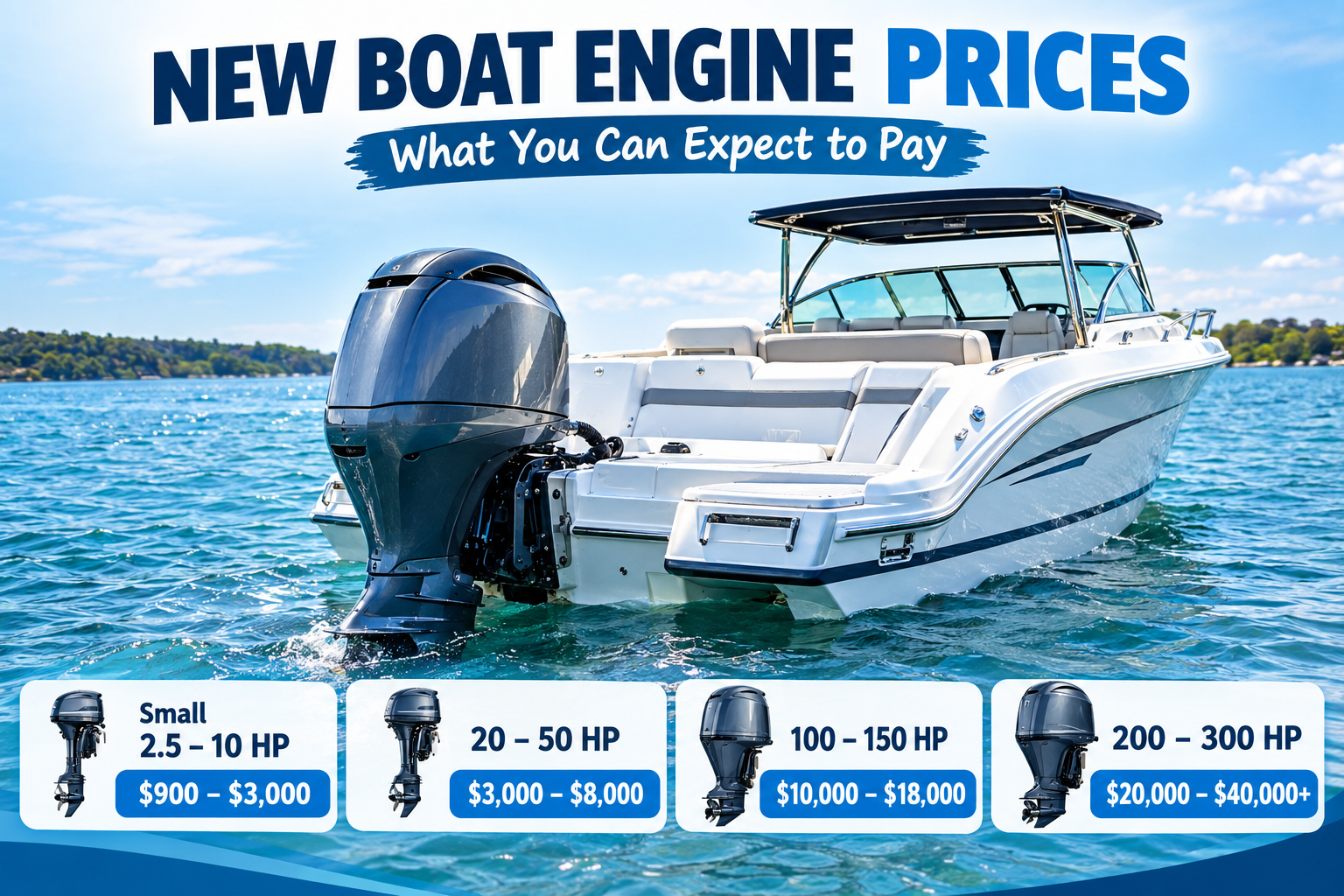
For a rough guide, small outboard engines can often start at under $1,000, while larger recreational outboards can reach well above $20,000. High-powered premium engines, especially when several engines are installed on one boat, can push the total investment much higher.
Used boat engines are usually less expensive than new ones, but the price depends heavily on age, operating hours, maintenance history, condition, and demand for that particular model.
There are also costs beyond the engine itself. Installation, controls, gauges, wiring, batteries, propellers, fuel-system components, and other equipment may all add to your final bill.
This is why asking only, “How much does the engine cost?” does not always give you a realistic picture of what you will spend.
A better question is, “How much will it cost to get my boat properly powered and ready for the water?”
That small change in perspective can help prevent unpleasant surprises later.
What Determines the Price of a Boat Engine?
Several factors influence the price of a marine engine. Understanding these factors makes it much easier to compare different options.
Horsepower
Horsepower is one of the biggest factors affecting engine price.
A small engine producing just a few horsepower is designed for lightweight boats and relatively simple applications. A larger engine producing 150, 200, or 300 horsepower requires more sophisticated engineering and components, so the price naturally increases.
However, bigger is not always better.
Putting an engine with excessive horsepower on a boat that is designed for a smaller motor can be unsafe and may violate the manufacturer’s specifications. Your boat should always be operated within its recommended power range.
Engine Type
The type of engine also makes a major difference.
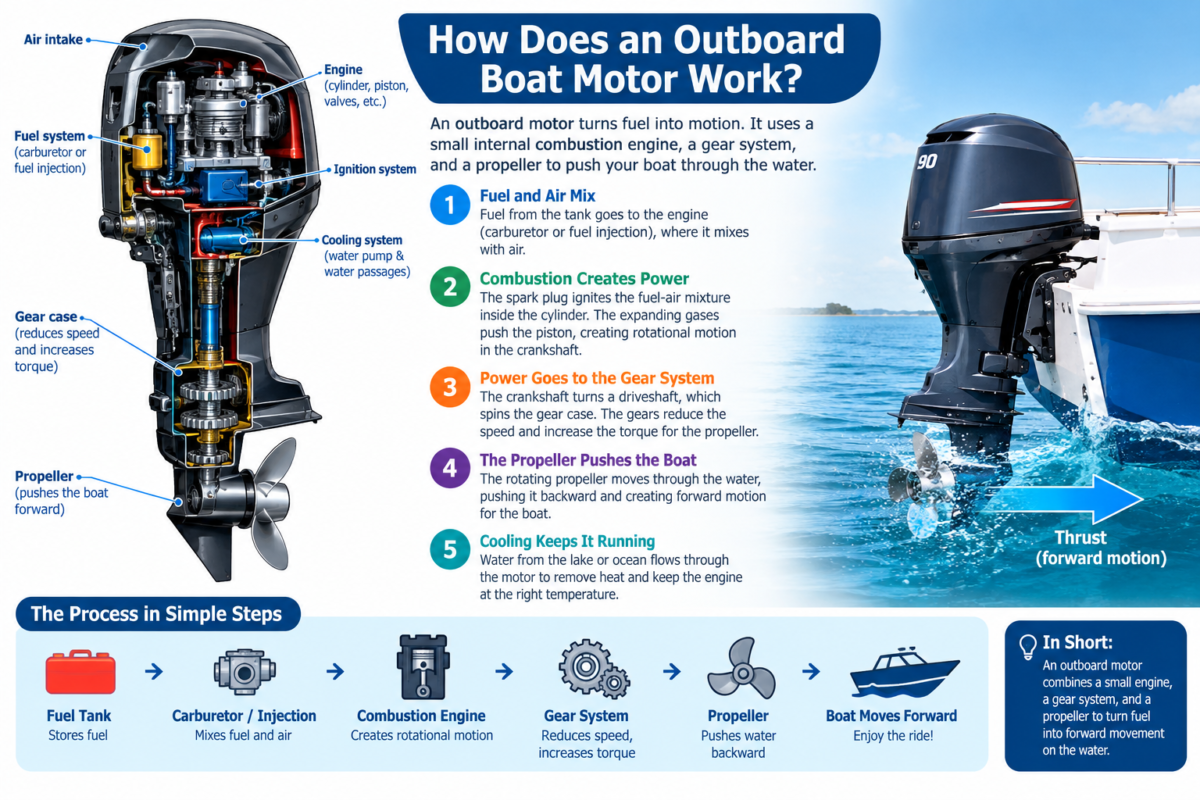
Outboard engines are mounted outside the boat and are extremely popular because they are relatively easy to service and replace. Inboard engines are installed inside the boat and are common on certain larger boats and specialized applications. Sterndrives combine characteristics of inboard and outboard systems.
Electric marine motors are another growing category. They can offer quiet operation and simple propulsion for certain applications, although the total cost depends heavily on battery capacity and the intended range.
Brand
The manufacturer can influence the purchase price significantly.
Established marine brands often charge more because buyers are paying for engineering, dealer networks, warranty support, replacement parts, and a proven reputation.
That does not automatically mean the most expensive engine is the best engine for you. A reasonably priced motor from a reputable manufacturer may be a much better choice than an expensive model that is difficult to service in your area.
New or Used Condition
A new engine gives you the advantage of modern technology and typically comes with manufacturer warranty coverage.
A used engine can save you a substantial amount of money, but it requires more research. Two used engines of the same model and age can have very different values depending on how they were maintained.
An engine that spent years in freshwater and received regular maintenance may be in considerably better condition than one that was heavily used in saltwater without proper care.
Technology
Modern engines can include advanced fuel systems, electronic controls, digital displays, integrated diagnostics, improved emissions systems, and other features.
These technologies can increase the initial purchase price, but they may also improve convenience, efficiency, and performance.
The important thing is to decide which features actually matter for your boating needs.
How Much Do Small Boat Engines Cost?
Small boat engines are generally the most affordable category.
Engines in the lower horsepower range are commonly used on small fishing boats, dinghies, tenders, inflatables, and lightweight recreational boats.
Depending on brand, features, and whether the engine is new or used, a small outboard may cost from several hundred dollars to a few thousand dollars.
One advantage of a small engine is simplicity. Many portable models are lightweight enough for relatively easy handling and transportation.
For someone who only needs basic propulsion on a small lake or river, buying a huge engine would make little sense. A smaller motor can provide adequate performance while keeping the initial cost, fuel consumption, and maintenance requirements under control.
Who Needs a Small Outboard?
Small engines can be useful for:
- Small fishing boats
- Inflatable boats
- Dinghies
- Small aluminum boats
- Boat tenders
- Lightweight recreational boats
- Low-speed utility applications
Before buying one, check your boat’s maximum recommended horsepower. The manufacturer’s rating should always be the starting point.
How Much Do Mid-Range Boat Engines Cost?
Mid-range engines are popular because they offer a useful balance between price and performance.
This category can include engines roughly in the 25- to 100-horsepower range, although the exact definition of “mid-range” varies by manufacturer and boat type.
Prices can range from several thousand dollars to well into five figures for some newer, higher-powered models.
A mid-range engine may be ideal for a family boat, fishing boat, aluminum boat, or medium-sized recreational craft.
The best choice depends on the weight and design of the boat. A 50-horsepower engine may be excellent for one boat but inadequate for another.
That is why horsepower should never be selected based purely on price.
How Much Do Large Boat Engines Cost?
Large boat engines can become expensive very quickly.
Modern outboards in the 150-horsepower-and-above category can cost many thousands of dollars. Premium engines with advanced electronics and high horsepower can cost considerably more.
Some larger boats use two, three, or even more engines. In that situation, the propulsion system can represent a major portion of the overall boat investment.
For example, a boat that uses twin engines does not simply have the cost of one engine doubled. There may also be additional rigging, controls, steering components, batteries, installation work, and other equipment.
Large engines are generally intended for boats that need substantial power, speed, carrying capacity, or offshore performance.
If your boat does not require that level of power, spending more money on a huge engine may provide little practical benefit.
How Much Do Outboard Boat Engines Cost?
Outboard engines are among the most common marine propulsion systems.
They are popular because the entire engine and propulsion unit is mounted outside the hull. This design makes them relatively accessible for maintenance and can make replacement easier compared with some inboard systems.
Outboard prices vary dramatically.
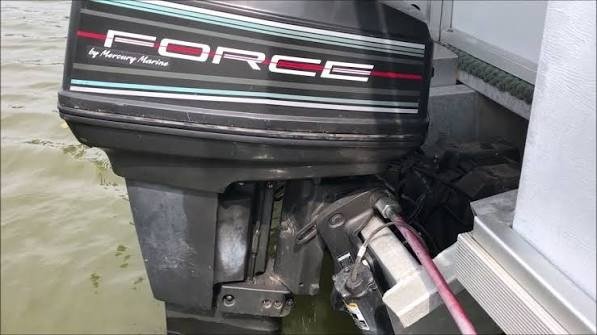
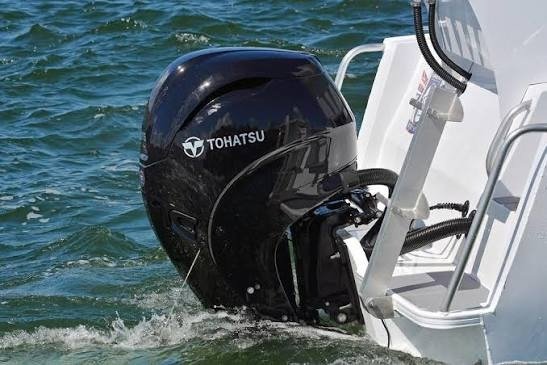
A small portable outboard can be relatively affordable, while a large modern outboard can cost tens of thousands of dollars.
Advantages of Outboard Engines
Outboards offer several advantages.
They are generally easy to access for servicing. They can provide strong performance without taking up as much interior space inside the boat. They can also be tilted out of the water when the boat is stored or transported, depending on the setup.
Another advantage is flexibility.
If you eventually upgrade your boat, an outboard may be easier to replace or repower than some other propulsion systems.
What Makes an Outboard More Expensive?
Several features can increase the price of an outboard.
These include:
- Higher horsepower
- Electronic fuel injection
- Digital controls
- Advanced steering systems
- Integrated displays
- Sophisticated engine management
- Lightweight construction
- Premium materials
- Advanced emissions technology
- Manufacturer warranty
It is worth remembering that you do not necessarily need every available feature.
A reliable engine that meets your actual needs may be a better investment than a premium model loaded with technology you rarely use.
How Much Are Inboard Boat Engines?
Inboard engines are installed inside the boat rather than hanging off the transom.
They are commonly found on certain larger boats, ski boats, wake boats, cruisers, and other vessels designed around an internal propulsion system.
The cost of an inboard engine can vary substantially depending on horsepower, configuration, manufacturer, and application.
In addition to the engine itself, installation can be complicated because the engine must work with the boat’s existing drivetrain, cooling system, exhaust system, fuel system, and other components.
That means replacing an inboard engine is not always as simple as removing one motor and installing another.
Why Can Inboard Replacement Be Expensive?
The engine is only one part of the system.
Depending on the boat, replacement may require modifications to mounting points, exhaust components, wiring, controls, cooling components, or drivetrain parts.
Labor can therefore become a significant part of the final bill.
If you are considering an inboard replacement, getting a professional estimate before purchasing the engine is a smart move.
How Much Are Used Boat Engines?
Used boat engines can be an attractive option for buyers who want to reduce their initial costs.
Depending on age and condition, a used engine may cost considerably less than a comparable new model.
However, there is a major difference between buying a used engine and buying a cheap engine.
A cheap engine with hidden problems can become expensive very quickly.
For example, an engine may look clean from the outside but have corrosion, cooling problems, electrical issues, worn components, or other concerns that are not immediately obvious.
What Determines the Price of a Used Engine?
Important factors include:
- Engine age
- Operating hours
- Maintenance history
- Freshwater or saltwater use
- Storage conditions
- Corrosion
- Previous repairs
- Propeller condition
- Lower-unit condition
- Compression results
- Availability of replacement parts
- Local demand
A well-maintained engine with complete service records can command a much higher price than an engine with an unknown history.
Should You Buy a Used Boat Engine?
A used engine can make sense when the buyer performs proper research.
Ask for maintenance records whenever possible. Find out how the engine was used and stored. Inspect it carefully, and consider having a qualified marine technician evaluate it before you commit to the purchase.
Saving money upfront is valuable only if the engine is capable of providing reliable service.
Boat Engine Installation Costs
One of the most commonly overlooked expenses is installation.
People sometimes see an engine advertised for a certain price and assume that is the total cost. In reality, getting the engine properly installed can add a significant amount.
When choosing an engine, horsepower should always match the boat manufacturer’s specifications. Rather than simply choosing the largest motor available, check your boat’s recommended power range and intended use. Yamaha also advises owners to read the appropriate owner’s manual and follow the specifications for their particular outboard. Yamaha Outboard Products & Specifications
Installation costs depend on the type of engine, boat, existing rigging, and amount of work required.
A straightforward outboard replacement may be relatively simple. A complex repower involving an inboard system can require substantially more labor.
What Can Be Included in Installation?
Depending on the project, installation may involve:
- Mounting the engine
- Connecting controls
- Connecting steering
- Electrical wiring
- Battery connections
- Fuel-system connections
- Installing gauges
- Installing a propeller
- Testing the engine
- Programming or configuring electronic systems
Always ask the dealer or installer what is included in the quoted price.
Two engines with apparently similar purchase prices can have very different final costs after installation.
Other Costs You Should Consider
The engine is rarely the only expense associated with repowering a boat.
Propeller Costs
The correct propeller is essential for proper engine performance.
Different boats and engines require different propeller specifications. Material, diameter, pitch, and design can all affect performance.
Battery and Electrical Costs
Modern engines may rely on sophisticated electrical systems.
If your existing battery or wiring is outdated, replacing the engine could reveal the need for additional electrical work.
Controls and Gauges
Some new engines require compatible controls or digital instrumentation.
If you are upgrading from an older engine to a modern system, your existing controls may not be compatible.
Fuel-System Costs
Depending on the engine and boat, fuel lines, filters, tanks, or other components may need inspection or replacement.
Steering Components
Some repower projects require changes to steering systems, especially when moving to a different type or size of engine.
How Much Does Boat Engine Maintenance Cost?
Buying an engine is only the beginning of ownership.
Every engine needs regular maintenance to remain dependable.
Maintenance costs vary based on engine type, size, age, usage, local labor rates, and the work being performed.
Routine maintenance may include oil and filter service, spark plug replacement on applicable engines, gearcase service, inspection of cooling systems, fuel-system maintenance, and general checks.
Older engines can require additional repairs as components wear.
Why Maintenance Matters
Regular maintenance can help identify problems before they become major failures.
It can also help protect performance and fuel efficiency.
For boat owners, preventive maintenance is usually easier to manage than dealing with an unexpected engine problem while away from home.
Following the manufacturer’s maintenance schedule is one of the simplest ways to protect your investment.
New vs. Used Boat Engines: Which Is Better?
There is no universal answer.
A new engine generally provides newer technology, warranty coverage, and a known starting point. You also avoid many of the uncertainties associated with an engine that has already been heavily used.
A used engine, on the other hand, can offer significant savings.
The right choice depends on your budget, how often you use your boat, how long you intend to keep it, and your willingness to deal with potential repairs.
Benefits of a New Engine
A new engine can provide:
- Manufacturer warranty
- Modern technology
- Better knowledge of its history
- Greater confidence in initial reliability
- Potentially improved fuel efficiency
- Access to current parts and support
Benefits of a Used Engine
A used engine may offer:
- Lower purchase price
- Lower depreciation in some cases
- Access to older models
- More affordable repowering
- Good value when properly inspected
The key is condition.
A carefully inspected used engine can be an excellent purchase. An unverified engine with a questionable history can turn into a frustrating and expensive project.
How to Choose the Right Boat Engine
Choosing an engine should begin with your boat rather than your budget.
Start by checking the boat manufacturer’s specifications.
Look at the recommended horsepower range and maximum permitted horsepower. Never assume that installing the largest engine available will automatically make the boat better.
Next, consider how you actually use the boat.
Do you primarily fish? Cruise with family? Pull water sports equipment? Travel long distances? Operate in shallow water? Use the boat in saltwater?
Your answers will help determine the type and size of engine that makes sense.
Think About Boat Weight
Boat weight has a major effect on performance.
A heavily loaded boat needs more power than a lightweight boat of similar length.
Remember to consider passengers, fuel, equipment, batteries, and other gear when thinking about your typical operating weight.
Consider Your Typical Speed
If you mainly cruise at moderate speeds, you may not need the same engine as someone who wants maximum acceleration and top-end performance.
Choosing an engine around your real-world needs can save money.
Think About Fuel Economy
Fuel costs can become substantial over years of boating.
An engine that costs slightly more initially but provides better efficiency may make financial sense for someone who spends many hours on the water.
On the other hand, if you only use your boat a handful of times each year, the calculation may be different.
How to Save Money When Buying a Boat Engine
You do not have to buy the cheapest engine to get a good deal.
Instead, focus on value.
Compare prices from several reputable dealers. Ask about installation packages and warranty coverage. Consider whether a previous model year offers the features you need at a lower price.
If buying used, compare several engines instead of choosing the first inexpensive listing you find.
Also remember that price negotiations are not always limited to the engine itself. Dealers may offer different installation packages, accessories, service plans, or other incentives.
Avoid Buying More Horsepower Than You Need
More horsepower usually means a higher purchase price and potentially greater fuel and maintenance costs.
If your boat is perfectly suited to a 90-horsepower engine, there may be little reason to spend significantly more on a 150-horsepower model.
Your boat’s specifications should guide the decision.
Are Expensive Boat Engines Worth the Money?
An expensive engine can absolutely be worth the money, but only when its advantages match your needs.
Premium engines may offer improved performance, sophisticated controls, quieter operation, advanced diagnostics, or other useful features.
But not every boat owner needs those benefits.
Someone who uses a small fishing boat on weekends may be perfectly satisfied with a simple, dependable engine.
Someone who spends hundreds of hours offshore each year may place much greater value on performance, reliability, service support, and advanced technology.
The best engine is therefore not necessarily the most expensive one.
It is the engine that gives you the features and performance you genuinely need without creating unnecessary expenses.
Common Mistakes to Avoid When Buying a Boat Engine
Buying a marine engine is a major decision, and a few common mistakes can make the experience more expensive.
Choosing Based Only on Price
The cheapest engine is not necessarily the best value.
Consider the total cost of ownership, including installation, maintenance, fuel, parts, and potential repairs.
Ignoring Boat Specifications
Never select an engine without checking the manufacturer’s recommendations.
Horsepower limits exist for important reasons.
Forgetting Installation Costs
Always ask how much it will cost to get the engine installed and operational.
Buying a Used Engine Without an Inspection
A professional inspection can reveal issues that are difficult for an inexperienced buyer to spot.
Ignoring Local Service Support
An engine may look attractive online, but if qualified technicians and replacement parts are difficult to find in your area, ownership could become frustrating.
Focusing Only on Horsepower
Horsepower matters, but it is not the only measurement of a good engine.
Weight, fuel economy, reliability, controls, serviceability, and compatibility with your boat all matter too.
How Long Does a Boat Engine Last?
The lifespan of a boat engine varies considerably.
Maintenance, operating conditions, storage, usage, engine design, and owner care all influence longevity.
An engine that receives regular servicing and is properly stored may provide many years of useful service.
Saltwater environments can be particularly demanding because corrosion can affect various components if the engine and related systems are not properly maintained.
Operating habits also matter.
Running an engine correctly, following recommended service intervals, and addressing small problems early can help protect its long-term condition.
Instead of asking only how many years an engine will last, it is better to consider its maintenance history and overall condition.
Electric Boat Engines: A New Option to Consider
Electric propulsion is becoming increasingly interesting for certain boating applications.
Electric motors can provide quiet operation and may require fewer traditional mechanical components than gasoline-powered engines.
However, the total cost involves more than the motor.
Battery capacity, charging equipment, range requirements, boat weight, and intended use all need to be considered.
Electric propulsion can be particularly attractive for smaller boats, short trips, calm-water applications, and users who prioritize quiet operation.
As technology develops, electric marine propulsion may become practical for a wider range of boats.
For now, buyers should carefully evaluate the complete system rather than comparing the price of an electric motor directly with the price of a gasoline engine.
Boat Engine Price by Horsepower
A general way to understand boat engine pricing is to divide engines into horsepower categories.
| Horsepower | Common Application | General Price Level |
|---|---|---|
| 2–6 HP | Small tenders and lightweight boats | Low |
| 8–20 HP | Small fishing and utility boats | Low to moderate |
| 25–60 HP | Small and medium recreational boats | Moderate |
| 75–150 HP | Larger fishing and family boats | Moderate to high |
| 175–300+ HP | Large and performance-oriented boats | High to premium |
These categories are only general guidelines.
Actual prices can vary substantially based on manufacturer, technology, dealer, location, promotions, and whether the engine is new or used.
What Is the Cheapest Way to Get a Boat Engine?
If your goal is to minimize the upfront cost, a properly inspected used engine may be one option.
Another possibility is choosing a smaller engine that is fully appropriate for your boat.
However, do not reduce the budget by purchasing an engine that does not meet your boat’s specifications.
It is better to buy a reliable, correctly sized engine than to save money on an unsuitable one.
You can also reduce costs by comparing installation quotes and avoiding unnecessary accessories.
The smartest savings come from reducing unnecessary spending without compromising safety, compatibility, or reliability.
What Is the Most Expensive Part of a Boat Engine?
The engine assembly itself is usually the biggest individual expense, especially for high-horsepower models.
However, a complete repowering project can involve many additional costs.
On larger boats, multiple engines, controls, steering equipment, electronics, rigging, and installation can collectively add a substantial amount to the final bill.
This is why professional estimates are useful.
A dealer or qualified marine technician can look at the complete setup and identify costs that might not be obvious from the engine’s advertised price.
FAQs
How much are boat engines on average?
Boat engines do not have one average price because the category includes everything from small portable motors to very large high-performance engines. Small engines can cost hundreds or a few thousand dollars, while large modern engines can cost tens of thousands.
What is the cheapest boat engine?
Small, low-horsepower portable outboards are generally among the least expensive new boat engines. Used engines can be cheaper, but condition and maintenance history should be carefully evaluated.
How much does a 50 HP boat engine cost?
A new 50-horsepower engine can cost several thousand dollars, with the exact price depending on manufacturer, technology, dealer, and included equipment. Installation and accessories can increase the total.
How much does a 100 HP boat engine cost?
A 100-horsepower engine can represent a significant investment. New models may cost several thousand dollars and can move into higher price ranges depending on features and manufacturer.
How much does a 150 HP boat engine cost?
A 150-horsepower engine is generally considered a substantial marine powerplant. New models can cost well into the thousands and may reach five-figure pricing depending on the model and specifications.
Are used boat engines worth buying?
They can be. A used engine with a good maintenance history and professional inspection can provide excellent value. However, an inexpensive engine with hidden mechanical or corrosion problems may cost more in the long run.
How much does it cost to install a boat engine?
Installation costs vary according to the engine, boat, location, and complexity of the project. Simple outboard installations may be relatively straightforward, while inboard repowers can require extensive labor and additional components.
Is an outboard engine better than an inboard engine?
Neither is automatically better. Outboards are popular for their accessibility and flexibility, while inboards can be well suited to specific boat designs and applications. Your boat and intended use should determine the choice.
How long does a boat engine usually last?
There is no guaranteed lifespan. Proper maintenance, operating conditions, storage, and usage all influence how long an engine remains reliable.
Should I buy the biggest engine my boat can handle?
Not necessarily. The best engine is one that fits the manufacturer’s specifications and meets your performance needs. The largest permitted engine may cost more than necessary and can increase fuel and operating expenses.
Final Thoughts
So, how much are boat engines? The answer depends on what you actually need. A small portable outboard may be relatively affordable, while a powerful modern engine for a larger boat can cost tens of thousands of dollars. Used engines can provide another path to savings, but their condition and maintenance history are extremely important.
The smartest way to choose an engine is to look beyond the advertised purchase price. Think about horsepower, boat size, engine type, installation, fuel consumption, maintenance, warranty coverage, and local service availability. A slightly more expensive engine may deliver better long-term value if it is reliable, efficient, and easy to maintain.
Before making a purchase, check your boat manufacturer’s recommended horsepower range and compare several suitable engines. If you are considering a used motor or a major repower, having a qualified marine technician inspect the setup can also be a wise investment.
Ultimately, the best boat engine is not necessarily the biggest or most expensive one. It is the engine that fits your boat, matches your boating lifestyle, stays within your budget, and gives you confidence every time you head out onto the water.

One thought on “How Much Are Boat Engines? Discover the Amazing Prices, Best Options & Smart Buying Guide”