

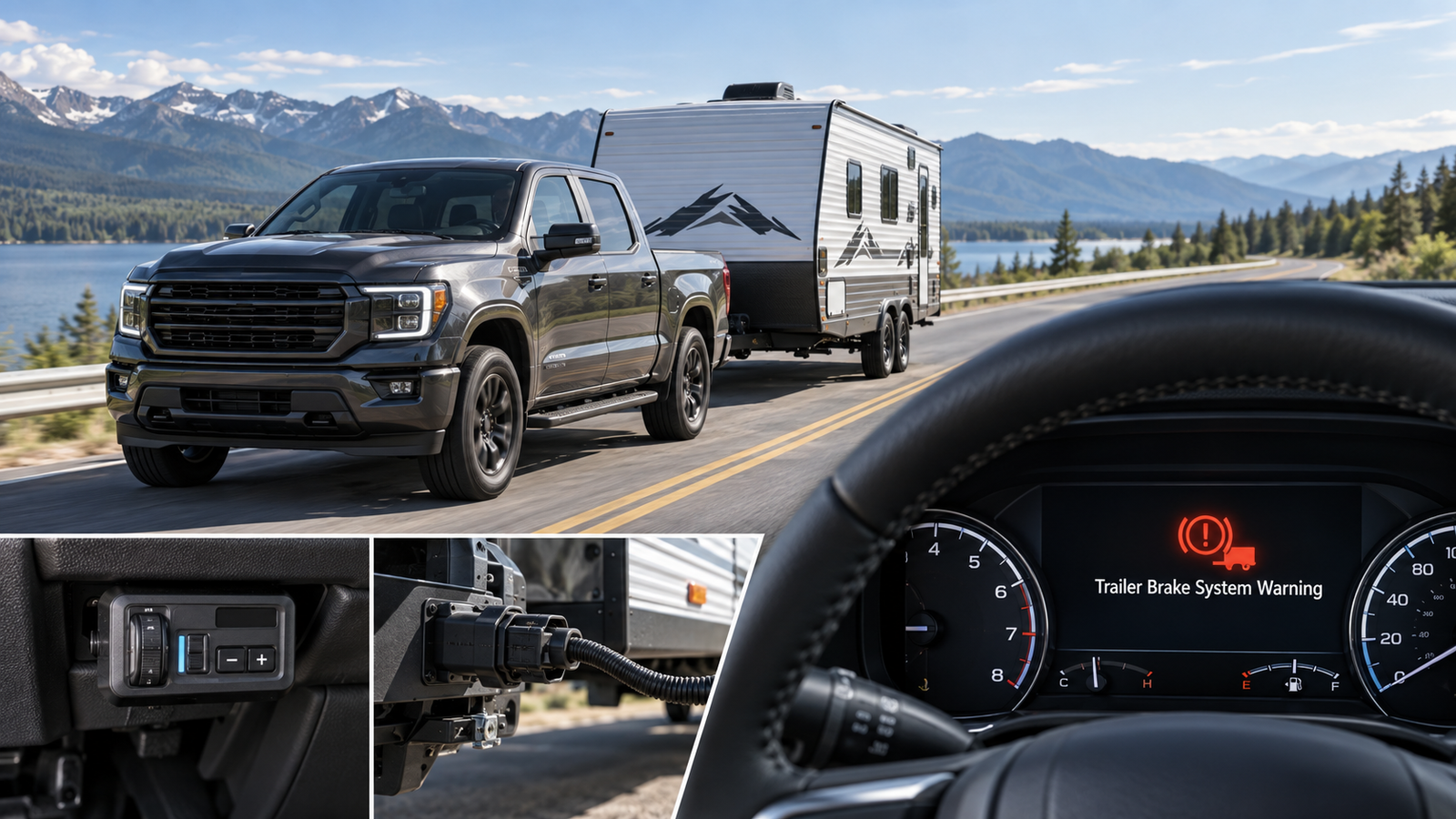
A trailer brake system warning means the vehicle has detected a possible problem with the trailer braking system, brake controller, wiring, or communication between the vehicle and trailer. In some cases, the warning comes from a loose trailer plug or poor ground. In other cases, it may point to a failed brake controller, damaged wiring, blown fuse, or a problem with the trailer brakes.
If you are wondering how to turn off trailer brake system warning, the safest approach is not to simply clear the message. First, find and correct the cause. The warning may disappear after the problem is fixed and the vehicle is restarted. Some vehicles, however, store a diagnostic trouble code and may require a compatible scan tool or professional diagnostic equipment.
This guide explains the common causes, basic checks, reset options, and situations where professional help is the better choice.
Important: Trailer brake systems vary by vehicle, trailer, brake controller, and model year. Always follow the instructions in your vehicle and trailer owner’s manuals. If the trailer brakes are not working properly, do not continue towing until the system has been checked.
What Does the Trailer Brake System Warning Mean?
A trailer brake warning is designed to alert the driver that the vehicle may have detected an issue with the trailer braking system. The exact message depends on the vehicle.
Some vehicles display messages such as:
- Trailer Brake System
- Check Trailer Brake System
- Trailer Brake Module Fault
- Trailer Brake Wiring Fault
- Trailer Connected
- Trailer Disconnected
- Trailer Brake Controller Error
The wording matters because a normal trailer connection indicator is different from a fault warning.
What the Warning Light Indicates
The trailer brake system helps the towing vehicle control electric or electronically controlled trailer brakes. When you press the brake pedal, the vehicle’s trailer brake controller can send an electrical signal to the trailer brakes.
This allows the trailer to contribute braking force rather than relying entirely on the tow vehicle.
A warning message can indicate a problem anywhere in that system. For example, the vehicle may detect unusual electrical resistance, loss of communication, an open circuit, a short circuit, or another fault.
If you are researching how to turn off trailer brake system warning, first determine whether the message is a true fault or simply a normal status indicator.
A normal indicator may appear when a trailer is connected. It does not necessarily mean something is wrong.
A warning message, however, usually means the vehicle has detected something that requires attention.
Is It Safe to Drive With the Warning On?
That depends on what the warning means and whether the trailer brakes are operating correctly.
If the vehicle says there is a trailer brake fault, you should treat it seriously. Trailer braking is important because a loaded trailer can add substantial weight to the combination.
Do not assume the trailer brakes are working simply because the trailer lights function.
If you notice any of these signs, stop towing and have the system inspected:
- Trailer brakes do not respond normally.
- The controller shows a fault.
- The warning appears repeatedly.
- The trailer brakes work unevenly.
- You smell burning electrical insulation.
- Wiring becomes unusually hot.
- A connector is damaged.
- A fuse repeatedly blows.
The safest answer to how to turn off trailer brake system warning is to repair the underlying fault before attempting to clear the warning.
Common Causes of a Trailer Brake System Warning
There are several possible causes. Start with simple external checks before assuming that an expensive component has failed.
Trailer Wiring Problems
Trailer wiring is exposed to water, road salt, dirt, vibration, and physical damage. This makes it one of the first things worth checking.
Common wiring problems include:
- Damaged wires
- Loose terminals
- Broken wires
- Pinched wiring
- Corroded connectors
- Poor ground connections
- Moisture inside the plug
- Incorrect trailer wiring repairs
A wire can look fine from the outside while having a damaged conductor inside. This is why persistent faults may require electrical testing.
If a warning appears immediately after connecting a particular trailer, inspect that trailer’s connector and wiring closely.
Faulty Trailer Brake Controller
The trailer brake controller manages the electrical braking signal sent to the trailer. Depending on the vehicle, it may be a factory-installed module or an aftermarket controller.
A controller problem can cause:
- Communication errors
- Incorrect brake output
- Controller error messages
- Loss of power
- Unusual braking behavior
- Stored diagnostic codes
Incorrect controller settings can also create problems, although settings alone do not always cause a system fault.
If your controller has a display, read the message carefully. The error code or description may provide a useful clue.
When learning how to turn off trailer brake system warning, checking the controller is important because it can help distinguish a trailer-side problem from a vehicle-side problem.
Blown Fuse or Electrical Issue
A fuse protects an electrical circuit from excessive current. If the trailer brake circuit loses power because a fuse has opened, the system may report a fault.
Possible electrical causes include:
- Blown trailer brake fuse
- Poor battery voltage
- Damaged power supply wiring
- Loose electrical terminals
- Poor grounding
- Short circuits
- Module power problems
Never replace a fuse with one that has a higher rating just to stop the warning.
Use the fuse rating specified by the vehicle manufacturer.
If the replacement fuse blows again, there may be an electrical fault that needs diagnosis.
Brake Magnet or Trailer Brake Problems
Many electric trailer brake assemblies use an electromagnet to operate the brakes. Problems in the brake assembly can affect the electrical load seen by the controller.
Potential issues include:
- Damaged brake wiring
- Worn brake components
- Faulty brake magnets
- Broken connections
- Short circuits
- Uneven brake adjustment
A trailer can have more than one brake assembly, so a problem at one wheel may affect the system.
If braking feels uneven or weak, do not focus only on clearing the dashboard warning. The trailer itself needs inspection.
Vehicle or Trailer Sensor Issues
Modern towing systems can use sensors and electronic control modules to monitor trailer connection and brake operation.
A faulty sensor or communication problem can produce a warning even when the visible wiring appears normal.
Possible causes include:
- Faulty sensors
- Damaged connectors
- Module communication problems
- Software-related faults
- CAN-bus communication errors
- Trailer detection problems
Because these systems differ between vehicles, the exact diagnostic procedure depends heavily on the make, model, and year.
How to Turn Off Trailer Brake System Warning
If you want to know how to turn off trailer brake system warning, start with basic checks. These steps can identify simple connection problems without immediately replacing parts.
Step 1: Stop Safely and Check the Trailer
Park the vehicle and trailer in a safe location.
Put the vehicle in park or neutral as appropriate, apply the parking brake, and follow normal towing safety procedures.
Look at the trailer connection.
Check for:
- Loose plugs
- Damaged pins
- Corrosion
- Dirt
- Moisture
- Broken wires
- Exposed conductors
- Damaged cable insulation
Also inspect the trailer-side wiring near the connector.
Do not pull hard on wires or attempt repairs while the electrical system is energized.
If the trailer is carrying a load, use extra caution and avoid working underneath it unless it is properly supported and secured.
Step 2: Disconnect and Reconnect the Trailer Plug
A poor connection can sometimes trigger a warning.
Turn the vehicle off before disconnecting the trailer connector.
Inspect the plug carefully. Look for corrosion, bent terminals, dirt, or moisture.
If the connector is dirty or damaged, it may need cleaning or replacement according to the manufacturer’s instructions.
Reconnect the plug firmly.
Make sure it is fully seated and secured.
Then restart the vehicle and check the message.
This basic step is often useful when investigating how to turn off trailer brake system warning, particularly when the warning began immediately after connecting the trailer.
Do not force a connector together if the terminals are damaged.
Step 3: Check the Trailer Brake Controller
Look at the trailer brake controller, if your vehicle has one.
Check whether it displays:
- A fault message
- An error code
- No power
- An unusual connection status
- An unexpected brake output reading
Check the controller’s settings against the vehicle and trailer manufacturer’s recommendations.
Do not increase the braking setting simply to compensate for a mechanical or electrical problem.
If the controller has no power when it should, the issue may be related to its fuse, wiring, power supply, or control module.
If the controller reports a specific fault, write down the message before attempting any reset.
That information can help a technician diagnose the problem faster.
Step 4: Inspect the Trailer Brake Fuse
Find the vehicle’s fuse information in the owner’s manual.
Identify the fuse associated with the trailer brake system or trailer brake controller.
Inspect the fuse.
If it is blown, replace it only with the correct type and rating specified by the manufacturer.
Do not install a larger fuse.
Do not bypass the fuse.
If the new fuse fails again, stop replacing fuses and investigate the circuit.
A repeatedly blown fuse can indicate a short circuit or another electrical fault.
This is an important part of learning how to turn off trailer brake system warning because the warning may return if the circuit still has an active problem.
Step 5: Check the Trailer Ground Connection
Grounding is essential for many trailer electrical circuits.
A poor ground can create strange electrical behavior, including intermittent trailer brake warnings.
Look for:
- Loose ground connections
- Corrosion
- Broken ground wires
- Damaged mounting points
- Poor contact between a ground terminal and its connection point
The exact grounding arrangement varies by trailer.
Follow the trailer wiring diagram when available rather than guessing which wire serves as ground.
If the ground connection is heavily corroded or damaged, repair it using the correct method for the trailer.
Step 6: Restart the Vehicle
After checking the connection and correcting any obvious issue, restart the vehicle.
Turn the ignition off.
Wait briefly.
Then restart the vehicle and allow the towing system to initialize.
If the vehicle now recognizes the trailer normally and the warning has disappeared, the issue may have been caused by a temporary connection or communication problem.
However, do not assume the problem is permanently solved if the warning returns later.
When researching how to turn off trailer brake system warning, remember that a restart can clear a temporary message, but it does not repair a continuing fault.
Step 7: Scan for Diagnostic Trouble Codes
If the warning remains, a compatible diagnostic scanner may help.
Basic OBD scanners do not always communicate with every trailer brake or body-control module. Some vehicles require manufacturer-specific or advanced diagnostic equipment.
A proper scan can reveal codes related to:
- Trailer brake control
- Communication
- Wiring
- Voltage
- Sensors
- Control modules
Write down the exact code before clearing anything.
A diagnostic code is a clue, not always a complete diagnosis.
For example, a communication code does not automatically prove that a control module has failed. Wiring, power, ground, or connector problems can also cause communication faults.
Why the Trailer Brake Warning May Not Turn Off
Sometimes you complete the basic checks and the warning remains. There are several reasons this can happen.
The Fault Is Still Present
The most common reason is simple: the original problem has not been fixed.
For example, if a trailer has a damaged brake wire, reconnecting the plug will not repair that wire.
Likewise, replacing a fuse will not solve the underlying problem if a short circuit is still present.
The warning may return immediately or after the trailer is connected again.
The System Needs a Diagnostic Reset
Some vehicles store faults in electronic control modules.
After the physical problem has been repaired, the warning may remain until the vehicle completes its own verification process or the stored code is cleared with suitable diagnostic equipment.
The exact behavior varies by manufacturer.
This is why there is no single universal answer to how to turn off trailer brake system warning for every vehicle.
Some systems reset automatically.
Others may require a scan tool.
The Warning Indicates a Larger Electrical Problem
A persistent warning can sometimes indicate a more complex electrical issue.
Possible examples include:
- CAN-bus communication problems
- Module communication faults
- Damaged wiring
- Power supply problems
- Ground faults
- Control module faults
- Trailer detection problems
Modern vehicles often have several electronic modules communicating with each other.
A fault in one part of the network can sometimes affect another system.
If the warning is accompanied by several unrelated electronic warnings, professional diagnosis is especially important.
How to Reset a Trailer Brake System Warning
Resetting a warning should come after troubleshooting, not instead of troubleshooting.
Can Disconnecting the Battery Reset the Warning?
Disconnecting the vehicle battery may reset some electronic systems, but it is not a universal solution.
It may also reset settings or cause other systems to require reinitialization.
Depending on the vehicle, battery disconnection can affect:
- Clock and radio settings
- Window initialization
- Stored vehicle settings
- Electronic modules
- Diagnostic information
- Other learned settings
Because of these differences, follow the vehicle manufacturer’s procedure.
Do not disconnect the battery simply because you want to erase a warning.
If the fault remains, the warning may return as soon as the vehicle detects the problem again.
Using an OBD Diagnostic Scanner
A compatible diagnostic scanner can sometimes clear a stored trailer brake fault.
The key word is compatible.
A basic code reader may only access the engine control module. The trailer brake system may be managed by another module.
An advanced scanner that supports the vehicle’s towing or body-control systems may be required.
The proper process is:
- Scan the vehicle.
- Record the stored codes.
- Diagnose the cause.
- Repair the fault.
- Clear the code if appropriate.
- Test the vehicle and trailer.
- Confirm that the warning does not return.
Clearing the code without repairing the fault is not a real solution.
If the warning comes back, the vehicle has likely detected the problem again.
Trailer Brake Warning vs. Trailer Brake Controller Error
These terms can sound similar, but they may refer to different things.
A trailer brake warning is a message or indicator from the vehicle’s towing system. It may be triggered by many different faults.
A trailer brake controller error is more specific and may indicate a problem detected by the controller itself.
For example, the vehicle could report a trailer brake system warning because:
- The trailer is not detected correctly.
- Wiring has high resistance.
- The brake circuit is open.
- The controller cannot communicate with another module.
- The trailer has an electrical problem.
A controller error could be associated with:
- Controller power
- Controller communication
- Output circuit faults
- Internal controller problems
- Incorrect system conditions
The exact meaning depends on the vehicle.
If your dashboard displays a specific error message, use the owner’s manual to identify what that message means before replacing components.
When to Take Your Vehicle or Trailer to a Professional
Basic inspections can identify simple problems, but some faults require specialized testing.
Professional diagnosis is recommended when:
- The warning remains after basic checks.
- Trailer brakes do not work correctly.
- Braking is uneven.
- A fuse repeatedly blows.
- Wiring is damaged.
- You smell burning insulation.
- Electrical components become unusually hot.
- Several electronic warnings appear.
- The controller shows an unknown error code.
- The warning keeps returning.
- You cannot identify the faulty circuit.
A technician can use wiring diagrams, electrical testing equipment, and manufacturer-level diagnostic tools.
This can be much safer than replacing parts based on guesswork.
If the trailer brakes are not functioning, avoid towing until the problem has been properly assessed.
How to Prevent Trailer Brake System Warnings
Prevention starts with regular inspection.
Inspect the Trailer Connector Regularly
Check the connector before towing.
Look for:
- Corrosion
- Bent terminals
- Damaged housing
- Loose connections
- Moisture
- Dirt
Keep the connector protected when the trailer is not connected.
A damaged connector should be repaired or replaced rather than repeatedly forced into service.
Keep Wiring Protected
Trailer wiring should be protected from rubbing, sharp edges, heat, and moving parts.
Inspect areas where the wiring passes around the frame, suspension, axles, and other components.
Look for damaged insulation or wires that have become loose.
Repair wiring using methods and components appropriate for trailer electrical systems.
Check Trailer Brake Components
Regularly inspect the trailer’s braking components according to the manufacturer’s maintenance schedule.
Look for signs of:
- Uneven braking
- Reduced braking performance
- Damaged wiring
- Worn components
- Abnormal noise
- Overheating
Mechanical brake problems can exist even when the vehicle’s electrical system appears normal.
Maintain Proper Ground Connections
A reliable ground helps electrical systems work as designed.
Inspect ground connections during trailer maintenance.
Clean or repair corroded connections as appropriate.
Make sure connections remain secure and protected from moisture.
Follow the Vehicle and Trailer Manufacturer’s Instructions
Different towing systems use different wiring, controllers, modules, and diagnostic procedures.
Do not assume that a procedure used on one vehicle will work on another.
Use the owner’s manuals and service information for your specific vehicle and trailer.
This is especially important when working with electronic trailer brake controllers.
FAQ
Final Thoughts
If you are searching for how to turn off trailer brake system warning, the best solution is to diagnose the cause rather than simply erase the message.
Start by stopping safely and checking the trailer connection. Inspect the plug, wiring, brake controller, fuse, and ground connection. Restart the vehicle after correcting any obvious issue. If the warning remains, use a compatible diagnostic scanner or have a qualified technician inspect the system.
Remember that a warning message can indicate anything from a simple connection problem to a more serious electrical or control-module fault. Clearing the warning without fixing the cause may only make the message disappear temporarily.
So, the practical answer to how to turn off trailer brake system warning is: find and repair the underlying fault, then allow the vehicle to reset the warning or clear the stored code with the correct diagnostic equipment when necessary. If the trailer brakes are not working properly, stop towing and have the system checked before continuing.
