

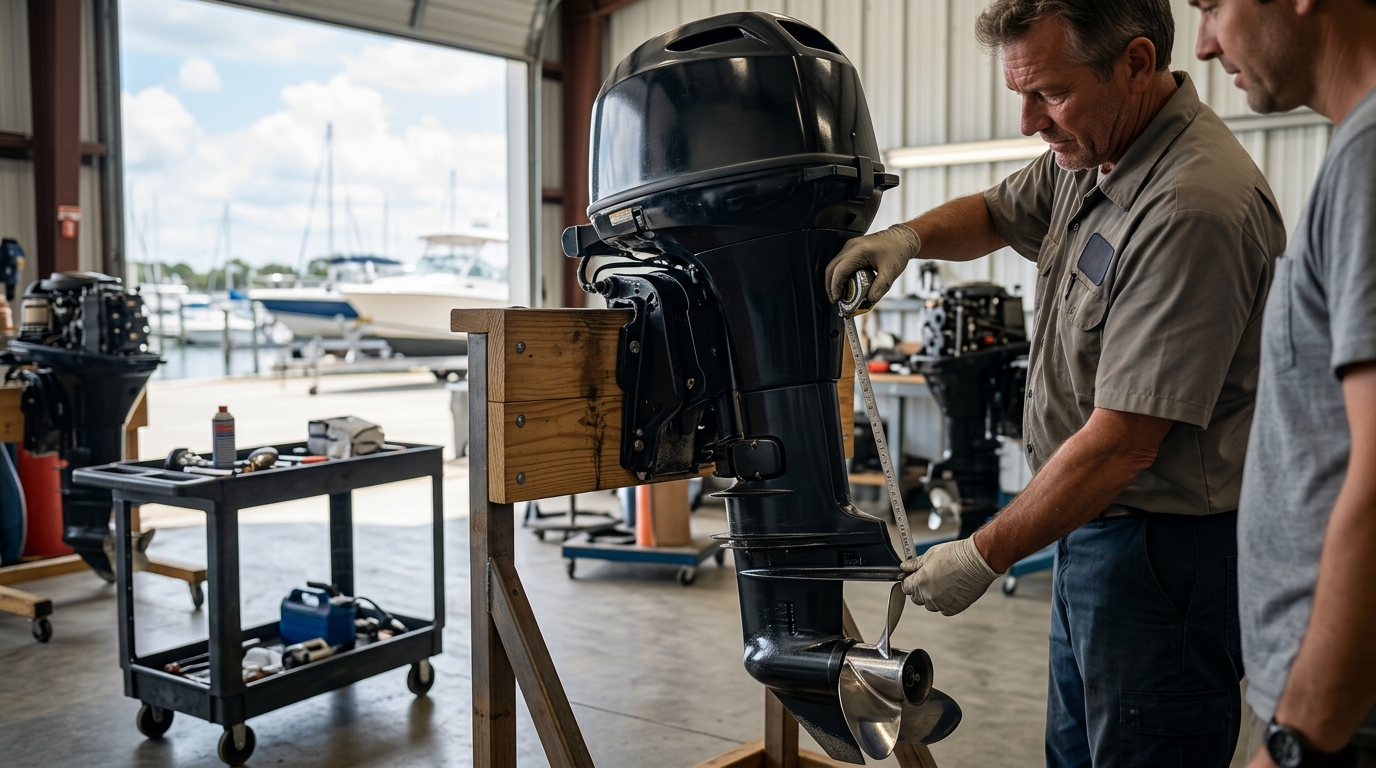
If you are wondering how do you measure outboard motor shaft length, the basic method is simple: measure vertically from the top of the outboard’s transom mounting surface to the anti-ventilation plate above the propeller. This measurement helps identify the motor’s shaft category and determine whether it fits the boat’s transom. Mercury documentation, for example, uses 15-inch, 20-inch, and 25-inch transom-height categories on certain outboard models.
Outboard shaft length matters because the motor must place the propeller at the proper depth in the water. If the shaft is too short, the propeller can operate too close to the surface. That can increase ventilation and reduce thrust. If the shaft is too long, the lower unit may sit deeper than intended, increasing underwater drag and affecting performance.
The correct shaft length can influence propeller position, thrust, acceleration, handling, and fuel efficiency. It also helps the engine operate in the position intended by the boat and outboard manufacturers. Mercury installation guidance, for example, states that the boat bottom should be aligned with or within about 1 inch above the anti-ventilation plate on certain installations.
Common shaft categories include short shaft, long shaft, and extra-long shaft. Around 15 inches is commonly described as short, 20 inches as long, and 25 inches as extra-long. Some specialized outboards use 30-inch or even longer configurations, depending on the model and application. Yamaha, for instance, lists 25-, 30-, and 35-inch shaft options on some larger outboards.
However, these categories are only a starting point. The right size depends on your boat’s transom height, hull design, motor model, and manufacturer specifications.
What Is Outboard Motor Shaft Length?
Shaft length is the vertical distance between the motor’s mounting area and the lower part of the outboard, which determines how far the propeller and lower unit extend below the boat.
In simple terms, it tells you how much vertical reach the outboard has below its mounting bracket. It does not describe the total height of the engine from the propeller to the top of the cowling.
What Does “Shaft Length” Mean?
When discussing an outboard, shaft length is closely related to the boat’s transom. The transom is the rear section of the boat where the outboard is mounted. The motor’s mounting bracket sits against the transom, while the shaft extends downward toward the lower unit and propeller.
For measurement purposes, the mounting surface provides the upper reference point and the anti-ventilation plate provides the commonly used lower reference point.
The anti-ventilation plate is the horizontal plate located above the propeller. Its position is important because it helps establish the relationship between the motor and the bottom of the boat.
Shaft length should not be confused with the complete physical height of the motor. The engine cowling, powerhead, steering components, and mounting hardware
how do you measure outboard motor shaft length
all contribute to the motor’s overall dimensions.
Common Outboard Shaft Lengths
Common categories include:
These are common categories, not universal measurements for every manufacturer. Mercury documentation lists 15-inch, 20-inch, and 25-inch transom-height specifications for certain models, while other outboards may use different configurations.
Always check the exact motor’s specifications before assuming its shaft length from the horsepower rating or appearance.
Why Is Outboard Motor Shaft Length Important?
Outboard shaft length determines how the engine’s lower unit sits relative to the boat’s hull. That position affects how deeply the propeller operates and how effectively it can convert engine power into forward thrust.
Getting the measurement right is important because an outboard works best when its propeller and lower unit are positioned according to the boat and engine manufacturer’s installation requirements.
If the Shaft Is Too Short
A shaft that is too short can leave the propeller too close to the water’s surface. As the boat moves, the propeller may not remain fully submerged under the conditions for which the motor was designed.
This can increase the chance of ventilation, where air reaches the propeller and reduces its ability to produce consistent thrust.
Possible symptoms include:
- Reduced acceleration
- Less effective thrust
- Higher engine speed without matching boat speed
- Unpredictable handling
- Poor performance in rougher water
The exact effect depends on the hull, motor, propeller, loading, and operating conditions.
If the Shaft Is Too Long
A shaft that is too long can position the lower unit deeper in the water than necessary.
That may increase underwater drag. The additional drag can reduce performance and may affect fuel consumption because the engine has to overcome greater resistance.
A deeper position is not automatically wrong, however. Some boats are specifically designed for longer-shaft or specialized outboard installations.
Correct Shaft Length
The goal is not simply to choose the longest or shortest available option. The goal is to match the outboard to the boat.
Boat manufacturers provide transom and engine recommendations, while outboard manufacturers provide installation specifications. Those instructions should take priority over general shaft-length rules.
How Do You Measure Outboard Motor Shaft Length?
Knowing how do you measure outboard motor shaft length correctly starts with using the right reference points. The process is straightforward, but small measurement errors can lead to choosing the wrong motor.
Step 1: Secure the Outboard
Before measuring, make sure the outboard is stable and safely supported.
If the motor is mounted on a boat, keep the boat stable and work from a safe position. Do not attempt to move, lift, or reposition an unsecured outboard simply to take a measurement.
If the motor has already been removed, place it in a stable position where the mounting area and anti-ventilation plate are easy to identify.
Safety comes first. A marine dealer or qualified technician should handle an outboard that requires lifting or repositioning.
Step 2: Identify the Transom Mounting Surface
Next, locate the upper mounting surface of the outboard.
This is the surface where the motor’s mounting bracket sits against the boat’s transom. It is the starting reference point for the basic shaft-length measurement.
Do not start at the top of the engine cowling. The cowling is not the correct reference point.
Also avoid measuring from a random point on the mounting bracket. Use the manufacturer’s intended mounting reference.
Step 3: Locate the Anti-Ventilation Plate
Look below the engine and find the horizontal plate positioned immediately above the propeller.
This is commonly called the anti-ventilation plate. It is an important reference point when discussing outboard shaft length and mounting height.
Mercury installation documentation specifically identifies the anti-ventilation plate when explaining the relationship between boat transom height and outboard installation.
Make sure you identify the correct plate rather than another section of the lower unit.
Step 4: Measure Vertically
Use a rigid measuring tape or suitable measuring tool.
Measure from the top of the motor’s transom mounting surface straight down to the anti-ventilation plate.
Keep the measurement as vertical as possible.
Do not follow the shape of the engine or lower unit. Do not measure along an angled surface. You want the vertical distance between the two reference points.
For example, if the measurement is approximately 15 inches, the motor may fall into the common short-shaft category. A measurement around 20 inches generally corresponds to the long-shaft category, while around 25 inches commonly corresponds to an extra-long shaft.
However, use those numbers as general categories rather than as a substitute for the exact manufacturer’s specification.
Step 5: Record the Measurement
Write down the measurement immediately.
You can record it in inches or centimeters, depending on the specifications used by your boat and engine manufacturer.
If you measure 50.8 cm, for example, that is approximately 20 inches. Mercury documentation lists 51 cm (20 inches) as a long transom-height specification on certain models.
Do not round aggressively if your measurement falls between common categories. A small difference can matter when matching a motor to a specific boat.
Step 6: Measure the Boat’s Transom
Measuring the motor alone is not enough.
You should also measure the boat’s transom height. This tells you how high the mounting surface sits above the bottom of the hull.
A boat’s transom measurement helps determine which shaft configuration is appropriate. Mercury’s installation guidance instructs users to measure the boat’s transom height and provides a relationship between the boat bottom and the outboard’s anti-ventilation plate.
Measure the boat at the appropriate centerline location and follow the boat manufacturer’s instructions if its hull design requires a different reference point.
Step 7: Confirm the Correct Size
Finally, compare your measurements with the manufacturer’s specifications.
Check:
- The boat manufacturer’s recommended transom height.
- The boat’s recommended shaft length.
- The exact outboard model’s shaft options.
- The manufacturer’s installation requirements.
- The motor’s mounting-height requirements.
If your measurements do not match the available shaft sizes, do not simply choose the closest option without checking.
An authorized marine dealer can help determine whether the boat requires a different motor configuration or a specific mounting setup.
The key point is simple: measure the motor, measure the boat, and compare both measurements with the manufacturer’s specifications.
How to Measure Outboard Shaft Length on an Installed Motor
You can measure an outboard shaft while it is still mounted on a boat. In many cases, this is easier than removing the motor.
First, make sure the boat and motor are securely positioned. You should be able to access the mounting area and lower unit without putting yourself in an unsafe position.
Locate the top of the transom mounting surface. This is the upper reference point for the measurement.
Next, locate the anti-ventilation plate above the propeller. This provides the lower reference point.
Place the measuring tape between these two points and measure vertically.
Avoid measuring from the top of the cowling. The cowling shows the engine’s overall height, not its shaft length.
Also avoid measuring the entire motor from top to bottom. That measurement includes components that have nothing to do with the shaft-length category.
The goal is to identify the vertical distance associated with the motor’s mounting and lower-unit position.
Once you have the measurement, compare it with the specifications for the exact outboard model.
This matters because two motors with similar horsepower can have different shaft options. Mercury’s current small-outboard listings, for example, show 15-inch and 20-inch shaft choices on some models.
If the motor is already installed and the reference points are difficult to access, avoid guessing. Take clear measurements from accessible reference points or ask a qualified marine professional to verify the setup.
How to Measure Boat Transom Height
Outboard shaft length and boat transom height are related, but they are not the same measurement.
Shaft length describes the motor’s vertical reach below its mounting surface.
Transom height describes the vertical distance on the boat between the appropriate top of the transom and the bottom of the hull.
Measurement Process
Start by positioning the boat securely.
Then identify the centerline of the transom. Measuring near the center is important because some hulls have different shapes or features across the transom.
Find the top surface where the outboard mounting bracket will sit.
Next, measure vertically from that surface down to the bottom of the hull.
Record the result.
You can then compare the transom measurement with the outboard manufacturer’s shaft-length recommendations.
The exact method can vary because boats have different hull shapes, steps, brackets, pods, and transom designs.
For example, a conventional flat transom may have a simple measurement path, while a boat with a setback or specialized transom may require closer attention to the manufacturer’s installation instructions.
Mercury’s installation information illustrates why transom height matters: its guidance describes the relationship between the boat bottom and the outboard anti-ventilation plate rather than treating shaft length as an isolated number.
Do not assume that a measured 20-inch transom automatically means every 20-inch outboard will be correct.
The boat manufacturer may specify a particular motor mounting height or shaft configuration.
If your boat has unusual transom construction, consult the boat manual or an authorized marine dealer before selecting an engine.
Outboard Shaft Length vs. Transom Height
These two measurements are often confused, but they describe different things.
Think of the relationship this way: the boat provides the transom height, while the outboard provides the shaft length.
The two must work together.
A boat with a low transom generally requires a shorter shaft. A boat with a taller transom generally needs a longer shaft.
However, this is a general principle rather than a universal rule.
The boat’s hull design, engine model, mounting height, propeller, and intended use can all influence the correct setup.
That is why simply measuring one component is not enough.
A useful approach is to:
- Measure the motor’s shaft length.
- Measure the boat’s transom height.
- Read the boat manufacturer’s recommendations.
- Read the outboard manufacturer’s installation specifications.
- Confirm the final configuration before buying or installing the motor.
The anti-ventilation plate is especially important because its position provides a practical reference for how the lower unit relates to the hull.
Mercury’s installation documentation states that the boat bottom should be aligned with or within approximately 25 mm (1 inch) above the anti-ventilation plate for the referenced installation.
That illustrates why shaft length and mounting height should be considered together rather than independently.
how do you measure outboard motor shaft length
Short Shaft vs. Long Shaft Outboard Motors
The most familiar outboard shaft categories are short, long, and extra-long.
Short Shaft
A short-shaft outboard is commonly around 15 inches.
It is generally intended for boats with lower transoms. Small fishing boats, dinghies, and other compatible vessels may use this configuration.
For example, Mercury lists 15-inch shaft options on several smaller outboards.
Long Shaft
A long-shaft outboard is commonly around 20 inches.
This is one of the most widely encountered shaft sizes. Mercury documentation lists 20 inches as a long transom-height specification on certain models.
However, “most common” does not mean “correct for every boat.”
The boat’s transom height still determines the appropriate setup.
Extra-Long Shaft
An extra-long shaft is commonly around 25 inches.
This configuration is useful for boats with taller transoms and certain specialized hull designs.
Some larger outboards offer even longer shaft configurations. Yamaha, for example, lists 25-, 30-, and 35-inch shaft lengths on certain large outboard models.
These categories are industry conventions rather than guarantees that every manufacturer uses exactly the same measurements.
Always check the specifications for the exact model you plan to use.
What Happens If Your Outboard Shaft Is Too Short?
A shaft that is too short can place the propeller too close to the surface.
The propeller needs sufficient immersion to produce consistent thrust. If it operates too near the surface, air can interfere with propeller operation.
This condition is commonly called ventilation.
When ventilation occurs, the propeller may lose its normal grip on the water. The engine can increase speed without producing the expected increase in boat speed.
Possible symptoms include:
- Reduced acceleration
- Lower effective thrust
- Unstable or inconsistent propulsion
- Poor performance when the boat is loaded
- Handling changes
- Reduced overall efficiency
The severity depends on the boat, engine, propeller, water conditions, and mounting setup.
A short shaft is not inherently bad. It is only a problem when it does not match the boat’s transom and installation requirements.
That is why the question is not simply “Is a 15-inch shaft good?”
Instead, ask whether the 15-inch shaft is appropriate for the specific boat.
If the propeller is positioned incorrectly, changing the propeller alone may not solve the underlying installation problem.
Check the transom height and manufacturer’s recommendations first.
What Happens If Your Outboard Shaft Is Too Long?
A shaft that is too long can position the lower unit deeper in the water than intended.
When the lower unit sits too deep, it can create additional underwater drag.
That extra resistance may reduce speed and increase the power needed to maintain a given cruising speed. Depending on the boat and operating conditions, this can also affect fuel efficiency.
Possible effects include:
- Increased drag
- Reduced performance
- Less efficient operation
- Changes in handling
- Lower speed potential
- Increased resistance through the water
Again, the exact result depends on the complete installation.
A longer shaft is not automatically wrong. Some boats require long, extra-long, or specialized shaft configurations.
Yamaha’s larger outboard lineup demonstrates this point by offering shaft lengths up to 35 inches on certain models.
Never shorten or modify an outboard shaft simply to make it fit a boat. If the selected motor does not match the transom, verify the correct model or installation configuration with a qualified marine professional.
Does Horsepower Determine Outboard Shaft Length?
No. Horsepower and shaft length are separate specifications.
Horsepower describes the engine’s power output. Shaft length describes the motor’s vertical reach and its relationship to the boat’s transom.
A higher-horsepower engine does not automatically require a longer shaft.
Likewise, a lower-horsepower engine does not always require a short shaft.
The correct shaft length primarily depends on the boat’s transom height, hull design, motor configuration, and manufacturer requirements.
For example, Mercury’s 20-horsepower outboard is available in both 15-inch and 20-inch shaft configurations, showing that horsepower alone does not determine shaft length.
Horsepower should be selected separately according to the boat manufacturer’s maximum rating and intended use.
Motor weight also matters. A boat designed for a lightweight outboard may not safely accommodate a much heavier engine even if the horsepower appears suitable.
When choosing an engine, consider horsepower, shaft length, weight, mounting requirements, and boat specifications as separate but related factors.
How to Choose the Right Outboard Shaft Length Before Buying
Choosing the correct shaft before purchasing an outboard is easier when you follow a consistent process.
Step 1: Measure the Boat’s Transom Height
Start with the boat, not the engine.
Measure the transom according to the boat manufacturer’s instructions. Record the measurement carefully.
Step 2: Check the Boat Manufacturer’s Recommended Shaft Length
The boat manual may specify a shaft length or a suitable range.
Use that information as your primary guide because the boat manufacturer understands the hull’s intended geometry.
Step 3: Check the Exact Outboard Model Specifications
Do not rely only on the brand or horsepower.
Look up the exact model and check its available shaft options.
Manufacturers may offer different shaft lengths within the same horsepower range. Mercury’s smaller FourStroke models illustrate this with both 15- and 20-inch options.
Step 4: Compare Available Shaft Options
Compare your transom measurement with the manufacturer’s listed shaft lengths.
Do not automatically select the nearest number if the measurements do not align.
Step 5: Confirm Horsepower and Motor Weight Requirements
After determining shaft length, make sure the engine also meets the boat’s horsepower and weight limits.
A correctly sized shaft does not make an otherwise unsuitable engine appropriate.
Step 6: Ask an Authorized Dealer if Needed
If your measurements fall between categories, or if the boat has an unusual transom, ask a qualified marine dealer to verify the setup.
This is especially important for high-powered engines, specialized hulls, and non-standard mounting arrangements.
A few minutes of verification can prevent an expensive installation mistake.
Common Mistakes When Measuring Outboard Shaft Length
Even though the basic measurement is simple, several mistakes can lead to an incorrect result.
Measuring the Entire Motor
The total motor height is not the shaft length.
Do not measure from the top of the cowling to the bottom of the lower unit.
Starting at the Wrong Point
The upper reference point should be the appropriate transom mounting surface.
Starting several inches above or below it can produce a misleading result.
Measuring Diagonally
Shaft length is a vertical measurement.
Do not follow the angle of the lower unit or measure along the motor’s shape.
Confusing Shaft Length With Transom Height
The motor and boat have different measurements.
Measure both separately.
Ignoring the Anti-Ventilation Plate
The anti-ventilation plate is a key reference point for the motor’s lower position.
Assuming All Outboards Use Identical Measurements
Manufacturers and models can differ.
Some Yamaha outboards, for example, use specialized 30- and 35-inch configurations, while many smaller engines use 15-, 20-, and 25-inch categories.
Choosing an Engine Based Only on Horsepower
Horsepower does not determine shaft length.
Failing to Check Boat Specifications
The boat manufacturer’s recommendation should always be part of the decision.
If the motor measurement and boat measurement do not seem to match, stop and verify the installation requirements before purchasing.
How Shaft Length Affects Boat Performance
Shaft length affects where the propeller and lower unit operate in relation to the hull.
That position influences several aspects of boat performance.
Propeller Depth
The propeller must operate at an appropriate depth.
If it is too high, ventilation may occur. If it is unnecessarily deep, the lower unit can create additional drag.
Thrust
A properly positioned propeller can maintain better contact with the water.
Incorrect positioning can reduce effective thrust and make acceleration less consistent.
Ventilation
A shaft that is too short can increase the risk of air reaching the propeller.
This can cause the engine to rev without producing the expected thrust.
Drag
A shaft that places the lower unit too deep can increase resistance.
That resistance can affect speed and efficiency.
Acceleration
Correct propeller depth helps the engine transfer power effectively to the water.
An incorrect setup may result in slower acceleration.
Handling
The motor’s position can affect how the boat responds during acceleration, turning, and other operating conditions.
Fuel Efficiency
Fuel efficiency depends on many factors, including hull design, engine condition, propeller selection, load, speed, and sea conditions.
Shaft length is only one factor. However, an incorrect shaft can create unnecessary drag or reduce propulsion efficiency.
The best approach is to use the shaft length and mounting height specified for the boat and engine rather than trying to optimize one measurement in isolation.

how do you measure outboard motor shaft length
FAQ
How do you measure outboard motor shaft length?
Measure vertically from the top of the outboard’s transom mounting surface to the anti-ventilation plate above the propeller. Then compare the measurement with the exact manufacturer’s shaft-length specification.
You should also measure the boat’s transom height before buying an engine. The two measurements work together to determine whether the motor is suitable for the boat.
What is the easiest way to measure an outboard shaft?
The easiest method is to identify the two reference points first. Find the top mounting surface and the anti-ventilation plate, then measure straight down between them with a tape measure.
Avoid measuring the entire motor or following the shape of the lower unit.
What is the most common outboard shaft length?
A 20-inch shaft is a common long-shaft size. However, that does not mean it is correct for every boat.
Mercury lists 20 inches as a long transom-height specification for certain outboard models.
The boat’s transom height and manufacturer’s recommendations should determine your final choice.
How do I know whether I need a short or long shaft?
Start by measuring your boat’s transom height.
A lower transom may suit a short-shaft motor, while a taller transom may require a long-shaft motor. The exact recommendation depends on the boat and motor.
What is a short-shaft outboard?
A short-shaft outboard is commonly associated with a 15-inch shaft.
It is generally intended for boats with lower transoms. Mercury lists 15-inch short-shaft configurations on several smaller outboards.
What is a long-shaft outboard?
A long-shaft outboard is commonly around 20 inches.
It is generally designed for boats with taller transoms than those using short-shaft engines.
What is an extra-long-shaft outboard?
An extra-long shaft is commonly around 25 inches.
It is intended for boats with taller transoms or specific installation requirements. Some large outboards also use 30-inch and 35-inch shaft configurations.
Is shaft length the same as transom height?
No.
Shaft length describes the outboard’s vertical measurement, while transom height describes the boat’s vertical measurement.
The two measurements must be matched appropriately.
Can I measure an outboard shaft while it is mounted?
Yes.
You can usually measure an installed motor by locating the top mounting surface and anti-ventilation plate and measuring vertically between them.
Make sure the boat and motor are stable before taking the measurement.
Does shaft length affect performance?
Yes.
Incorrect shaft length can affect propeller depth, ventilation, drag, thrust, acceleration, and handling.
However, performance also depends on propeller selection, hull design, engine power, boat loading, and operating conditions.
Can I use a longer shaft on a shorter transom?
Do not assume that you can.
A longer shaft can place the lower unit deeper than intended and increase drag. Only use a configuration when the boat and outboard manufacturers specifically support it.
If you are uncertain, check the installation manual or ask an authorized marine dealer.
Conclusion
Understanding how do you measure outboard motor shaft length is important when choosing or replacing an outboard. The basic measurement is straightforward: measure vertically from the top of the motor’s transom mounting surface to the anti-ventilation plate above the propeller.
However, measuring the motor is only part of the process.
You should also measure the boat’s transom height and compare both measurements with the boat and outboard manufacturer’s specifications. This helps ensure that the propeller and lower unit sit at the intended height.
The common categories are approximately 15 inches for short shafts, 20 inches for long shafts, and 25 inches for extra-long shafts. Some specialized outboards use 30-inch or longer configurations, so never assume that every engine follows the same range.
Correct shaft length matters because it affects propeller depth, thrust, ventilation, drag, acceleration, handling, and overall operating efficiency. A shaft that is too short may place the propeller too close to the surface, while an unnecessarily long shaft can put the lower unit too deep.
The safest approach is to measure the motor, measure the boat’s transom, and verify the combination against the manufacturer’s specifications before buying or installing an outboard
