

how far can i drive with reduced engine power is an important question when your dashboard suddenly shows a reduced-power warning. This message means the vehicle has detected a problem that may affect engine performance. In response, the vehicle’s computer may limit power, throttle response, or engine speed. Some vehicles may enter a protective condition commonly called limp mode or reduced-power mode.
There is no universal number of miles that you can safely drive after this warning appears. The answer depends on the cause of the problem, how much power has been lost, whether the engine is running smoothly, and whether other warning lights or serious symptoms are present. A vehicle that feels normal with a mild warning may behave very differently from one that is shaking, overheating, or losing significant power.
In this guide, you will learn what reduced engine power means, how far you may be able to drive, common causes, serious warning signs, highway-driving concerns, diagnostic steps, repair costs, prevention tips, and answers to common questions.
How far can i drive with reduced engine power?
There is no specific mileage limit that applies to every vehicle. how far can i drive with reduced engine power depends mainly on why the vehicle entered reduced-power mode and how the vehicle is behaving.
A vehicle may continue operating for a short distance when the problem is relatively limited. Another vehicle may have a serious fault that makes continued driving unsafe. This is why mileage alone cannot determine whether driving is appropriate. how far can i drive with reduced engine power
Is There a Specific Number of Miles You Can Drive?
No. There is no reliable rule such as 10, 20, or 50 miles.
The vehicle might be able to travel a short distance to a safe location or repair facility, but that does not mean it is safe to continue driving for a long journey. how far can i drive with reduced engine power
The most important factors include:
- The cause of the warning
- Amount of power loss
- Engine temperature
- Other dashboard warnings
- Engine noise
- Vehicle stability
- Steering and braking behavior
- Whether the engine is running smoothly
If the vehicle cannot accelerate normally, maintaining traffic speed may become difficult. That can create a safety concern even when the engine itself is not overheating. how far can i drive with reduced engine power
When a Short Drive May Be Possible
A short trip to a repair facility may sometimes be possible if:
- The vehicle is running smoothly.
- There is no overheating.
- There is no smoke.
- No serious warning light is flashing.
- Steering and braking feel normal.
- The vehicle responds predictably.
- The reduced power is not severe.
Even in this situation, driving should not be treated as guaranteed safe. The warning indicates that the vehicle has detected a problem that needs diagnosis.
If the repair facility is far away, professional assistance may be a better option than attempting a long journey.
When You Should Not Continue Driving
You should take the situation much more seriously if reduced engine power occurs with:
- Severe loss of acceleration
- Engine shaking
- Overheating
- Smoke
- Burning smells
- Serious engine noises
- Flashing warning lights
- Difficulty controlling vehicle speed
- Major changes in vehicle operation
If these symptoms appear, safely move away from traffic when possible and arrange professional assistance.
What Does Reduced Engine Power Mean?
The reduced engine power message means that the vehicle’s computer has detected a condition that may affect normal engine operation.
Modern vehicles use electronic systems to monitor many parts of engine operation. If the computer receives information that indicates a problem, it may limit engine output.
Understanding the Reduced Engine Power Message
When a vehicle limits power, you may notice that the accelerator does not produce the response you normally expect.
The vehicle may:
- Accelerate slowly
- Limit engine speed
- Respond slowly to the accelerator
- Feel weaker on hills
- Have difficulty maintaining speed
The exact behavior depends on the vehicle and the fault that caused the warning.
The reduced-power strategy may be intended to protect certain systems or allow the vehicle to operate in a restricted condition until the problem can be diagnosed.
What Is Limp Mode?
Limp mode is a general term used for a restricted operating condition.
Depending on the vehicle, limp mode may limit:
- Engine power
- Throttle response
- Engine speed
- Transmission behavior
Not every vehicle uses the same strategy. Some may display a specific reduced-power message, while others may show a check engine light or another warning.
Because of these differences, the owner’s manual is an important source for understanding the exact warning displayed by your vehicle.
Why Does the Vehicle Reduce Power?

The computer may detect a fault involving:
- Engine management
- Electronic throttle control
- Accelerator-pedal sensors
- Airflow sensors
- Fuel delivery
- Electrical systems
- Transmission operation
- Drivetrain systems
The warning message itself does not identify the exact failed component.
A diagnostic scan can help identify the system where the vehicle detected a problem, but further testing may be required to determine the actual cause.
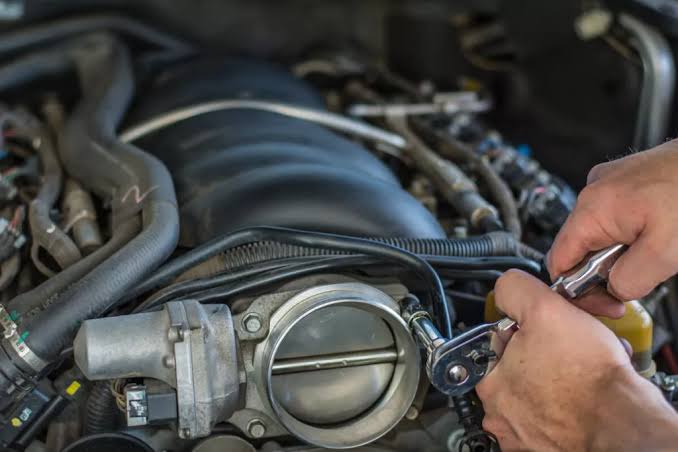
Throttle Body Problems
Modern vehicles commonly use electronic throttle control. The throttle system controls how much air enters the engine based on signals from the vehicle’s computer and accelerator-pedal input.
If the throttle body, its sensors, wiring, or related control system develops a fault, the vehicle may limit throttle operation.
You may notice slow acceleration or reduced response from the accelerator pedal.
A throttle-related diagnostic code does not automatically prove that the entire throttle body needs replacement. Proper diagnosis is important.
Accelerator Pedal Sensor Problems
The vehicle needs to know how much the driver is pressing the accelerator.
Electronic accelerator-pedal sensors send this information to the vehicle’s computer. If the computer receives an unexpected or conflicting signal, it may limit engine output.
This can result in reduced acceleration or a warning message.
Mass Airflow Sensor Problems
The mass airflow sensor measures air entering the engine.
The engine computer uses this information to help manage engine operation. If the airflow information is incorrect, engine performance may change.
A faulty sensor is one possible cause, but wiring, connectors, air leaks, or other conditions can also affect the readings.
Electronic Control System Faults
Modern vehicles depend on multiple electronic control modules and communication networks.
Problems involving:
- Wiring
- Connectors
- Sensors
- Control modules
- Electrical signals
can sometimes cause a reduced-power condition.
These problems can be difficult to identify through visual inspection alone.
Fuel Delivery Problems
The engine needs an appropriate supply of fuel to operate correctly.
Problems affecting fuel pressure or fuel delivery can cause poor engine performance.
However, reduced power does not automatically mean the fuel system is responsible. A diagnostic process is needed to identify the actual cause.
Transmission or Drivetrain Problems
Some vehicles may reduce engine output when a transmission or drivetrain problem is detected.
This means the warning does not always indicate that the engine itself has failed.
A proper diagnosis can determine whether the problem is related to engine management, transmission operation, drivetrain components, or another system.
Severe Loss of Acceleration
Major power loss can make it difficult to:
- Merge into traffic
- Climb hills
- Maintain speed
- Pass another vehicle
- Respond quickly to changing traffic conditions
If your vehicle cannot accelerate predictably, continuing to drive may be unsafe. how far can i drive with reduced engine power
Engine Shaking or Rough Running
An engine that suddenly shakes or runs very roughly should not be ignored. how far can i drive with reduced engine power
Rough operation can have several causes, including engine-management or ignition-related problems. how far can i drive with reduced engine power
If the shaking is severe, avoid continuing to drive simply because the vehicle still moves. how far can i drive with reduced engine power
Overheating
Engine temperature is another major factor.
If the temperature gauge rises into an unsafe range or a temperature warning appears, stop driving when it is safe to do so.
Continuing to operate an overheating engine can result in serious damage.
Smoke or Burning Odor
Smoke or a strong burning smell can indicate a mechanical, electrical, or fluid-related problem.
If reduced power occurs at the same time as smoke or a strong burning odor, professional assistance is appropriate.
Multiple Warning Lights
Pay attention to all dashboard warnings. how far can i drive with reduced engine power
A reduced-power message combined with an oil-pressure, temperature, battery, or other critical warning can change the situation significantly. how far can i drive with reduced engine power
Do not assume that all warning lights are caused by one simple problem. how far can i drive with reduced engine power
Why Highway Driving Can Be Risky

Highway traffic often requires quick and predictable acceleration.
Reduced engine power can make it harder to:
- Merge
- Maintain speed
- Climb an incline
- Change lanes safely
- Respond to traffic changes
Even if the engine sounds normal, severe power loss can make highway driving difficult.
When You Should Avoid Highway Driving
Avoid highway driving when the vehicle has:
- Major power loss
- Difficulty maintaining speed
- Rough engine operation
- Overheating
- Flashing warning lights
- Serious mechanical symptoms
If you are already on a highway when the warning appears, avoid aggressive acceleration and move toward a safe location when practical.
What to Do If Reduced Power Appears While Driving
Stay calm and focus on safety.
Reduce speed smoothly and avoid sudden acceleration. If the vehicle can safely reach a suitable location, move away from heavy traffic.
Follow local traffic laws and use appropriate warning signals.
If the vehicle cannot operate safely, arrange professional assistance rather than trying to force it to continue. how far can i drive with reduced engine power
Check the Dashboard
Look for additional warning lights.
Pay particular attention to:
- Check engine light
- Engine temperature warning
- Oil-pressure warning
- Battery or charging warning
Also check the temperature gauge if your vehicle has one.
Pay Attention to Vehicle Behavior
Ask yourself:
- Is the engine shaking?
- Is acceleration severely limited?
- Is the engine overheating?
- Are there unusual noises?
- Is there smoke?
- Is there a burning smell?
These details can be very useful when speaking with a technician. how far can i drive with reduced engine power
Turn the Vehicle Off and Restart It?
On some vehicles, restarting the engine may temporarily remove the reduced-power condition.
However, restarting is not a repair.
If the warning disappears and then returns later, the original problem may still be present.
Do not repeatedly restart the vehicle as a substitute for diagnosis.
Get the Vehicle Scanned
An OBD-II diagnostic scan can retrieve diagnostic trouble codes stored by the vehicle’s computer.
These codes can help narrow down the affected system. how far can i drive with reduced engine power
For example, a code may point toward the throttle, airflow, ignition, or another system. how far can i drive with reduced engine power
However, a code does not always mean that the named component itself has failed. Testing may be needed to identify the actual cause. how far can i drive with reduced engine power
Have the Vehicle Professionally Diagnosed
Professional diagnosis may include:
- Reading diagnostic codes
- Checking live sensor information
- Inspecting wiring
- Testing components
- Checking related systems
- Comparing symptoms with diagnostic data
This is more reliable than replacing parts based only on a code.
Temporary Electrical or Sensor Issues
If the vehicle computer stops detecting the condition that triggered reduced power, normal operation may return.
This can happen with some intermittent electrical or sensor-related faults.
However, the fact that the vehicle is driving normally again does not prove that everything is fixed.
Does the Warning Disappearing Mean the Problem Is Fixed?
No.
The underlying condition may return later.
Diagnostic information may also remain stored in the vehicle’s computer.
If reduced engine power repeatedly appears and disappears, have the vehicle checked rather than ignoring the pattern.
Why You Should Not Rely on a Temporary Reset
Restarting the vehicle can sometimes change the warning temporarily.
But the restart does not repair damaged wiring, a faulty sensor, a mechanical problem, or another underlying fault.
Treat a temporary improvement as a reason to investigate the problem, not as proof that it has disappeared permanently.
How to Diagnose Reduced Engine Power
A proper diagnosis is important because many different problems can produce similar symptoms. how far can i drive with reduced engine power
Read Diagnostic Trouble Codes
The first step may be retrieving diagnostic trouble codes.
These codes can help identify the system where the computer detected an abnormal condition.
They are useful clues, but they are not always a complete diagnosis.
Inspect Sensors and Wiring
Accessible wiring and connectors may sometimes be inspected for obvious damage.
However, inexperienced drivers should avoid unsafe electrical testing or disassembling components without proper knowledge.
Modern vehicle electrical systems can be complex.
Check for Related Symptoms
Diagnostic information should be considered alongside symptoms such as:
- Rough running
- Poor acceleration
- Warning lights
- Unusual noises
- Overheating
A technician can compare these symptoms with diagnostic data to narrow down the possible causes.
Professional Diagnostic Testing
Professional technicians may use manufacturer-specific equipment and testing procedures.
This can be especially important when the problem involves electronic throttle systems, communication between control modules, or intermittent electrical faults.
If reduced power continues, professional diagnosis is generally the most reliable approach.

How Much Does Reduced Engine Power Repair Cost?
There is no single repair price for a reduced-power warning.
The cost depends on the actual cause.
Important factors include:
- Vehicle make and model
- Fault causing the warning
- Required replacement parts
- Labor rates
- Diagnostic time
- Location
- Additional repairs
For example, a simple sensor-related issue may require a very different repair than a complicated drivetrain or electronic control problem.
The diagnostic cost is also separate from the repair cost in many cases.
An OBD system can provide diagnostic information about vehicle faults and help technicians identify systems that may need further testing. EPA Vehicle OBD Resources
Before approving major work, ask for a clear written estimate explaining the diagnosed problem, recommended repair, parts, labor, and other expected charges.
Avoid choosing a repair based only on the cheapest estimate. Proper diagnosis and suitable parts are important.
How to Prevent Reduced Engine Power Problems
There is no way to prevent every reduced-power warning, but good vehicle maintenance can reduce some avoidable problems. how far can i drive with reduced engine power
Follow the Manufacturer’s Maintenance Schedule
Use the maintenance schedule provided for your specific vehicle. how far can i drive with reduced engine power
Regular maintenance can help keep the engine and related systems operating as designed. how far can i drive with reduced engine power
Do not rely on a generic schedule if your vehicle manufacturer provides more specific recommendations. how far can i drive with reduced engine power
Address Warning Lights Early
Do not repeatedly ignore warning messages.
If a warning disappears but keeps returning, arrange a diagnostic check.
Early attention can help identify problems before they become more complicated.
Maintain Electrical Connections
Modern vehicles rely heavily on electronic systems.
Wiring, connectors, sensors, and control modules all need to work correctly.
If you notice electrical problems or recurring warnings, professional inspection may be appropriate.
Use the Correct Fuel and Fluids
Follow the manufacturer’s specifications for fuel and vehicle fluids.
Using the correct products helps ensure that the vehicle operates according to its design.
Reduced Engine Power and Driving Safety
Reduced engine power can affect acceleration and vehicle control. how far can i drive with reduced engine power
This is especially important in traffic, where drivers may need predictable acceleration to merge, change lanes, or respond to changing road conditions. how far can i drive with reduced engine power
When deciding how far can i drive with reduced engine power, consider more than the warning message.
Look at:
- Warning-light behavior
- Engine temperature
- Amount of power loss
- Overall vehicle performance
- Additional warning lights
- Unusual noises
- Smoke or unusual smells
A vehicle that has mild reduced power and otherwise operates normally is different from one that is overheating or shaking severely.
If reduced power persists, professional diagnosis is recommended. how far can i drive with reduced engine power
FAQ :
There is no universal mileage limit. how far can i drive with reduced engine power depends on the cause, severity of power loss, warning lights, engine temperature, and vehicle symptoms. A short trip to a repair facility may sometimes be possible when the vehicle operates normally, but serious symptoms require greater caution.
You may sometimes be able to drive a short distance if the vehicle remains stable, runs smoothly, does not overheat, and has no serious warning signs. However, reduced engine power should be diagnosed rather than ignored.
It can be, depending on the cause. Severe power loss, overheating, smoke, engine shaking, serious noises, or multiple warning lights are signs that the vehicle may need immediate attention.
Highway driving can be risky when acceleration is severely limited. The vehicle may have difficulty merging, maintaining speed, or responding to traffic. If the power loss is significant, avoid continuing on the highway and seek a safe solution.
Possible causes include electronic throttle problems, accelerator-pedal sensors, airflow sensors, electrical faults, fuel-delivery problems, transmission issues, and other engine-management faults. A diagnostic scan can help identify where the vehicle detected the problem.
Electrical or voltage problems can affect modern vehicle systems. However, the battery may not be the actual cause. The charging system, wiring, connections, or another electronic component could also be involved. Proper testing is needed. how far can i drive with reduced engine power
Restarting can sometimes temporarily clear the warning on certain vehicles, but it does not necessarily repair the underlying problem. If the warning returns, the vehicle should be diagnosed. how far can i drive with reduced engine power
Yes. An OBD-II scan can retrieve diagnostic trouble codes and help identify the system where a fault was detected. Further testing may still be required to find the exact cause.
Conclusion :
So, how far can i drive with reduced engine power? There is no guaranteed number of miles because the answer depends on the cause and severity of the problem.
If the vehicle has mild power loss, runs smoothly, does not overheat, and has no serious warning signs, a short trip to a repair facility may sometimes be possible. However, this is not a guarantee that the vehicle is safe to drive for a longer distance.
If you notice severe power loss, engine shaking, overheating, smoke, burning smells, serious noises, or multiple warning lights, continuing to drive can be risky. In those situations, safely stopping and arranging professional assistance is the better approach.
A diagnostic scan can provide useful trouble codes, but those codes should be treated as clues rather than automatic instructions to replace a specific part. Professional diagnosis can help identify the real cause.
Ultimately, how far can i drive with reduced engine power should be answered by the vehicle’s symptoms, warning signals, and the cause of the fault—not by a fixed mileage number.
