

Choosing the correct outboard motor shaft length is an important part of setting up a boat. The engine may have the right horsepower and features, but it still needs the correct shaft length for the boat’s transom. A mismatch can affect propeller position, performance, handling, and the way the motor sits in the water.
If you are searching for how to measure shaft length outboard motor, you can usually get a useful measurement with a measuring tape and a few simple steps. The key is knowing which points to measure and understanding how the motor’s shaft relates to the boat’s transom height.
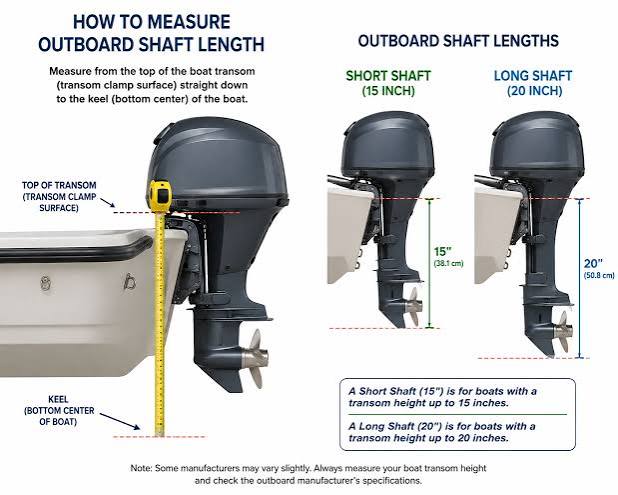
Outboard motors commonly come in short-, long-, and extra-long-shaft configurations. Common reference sizes include 15 inches for a short shaft, 20 inches for a long shaft, and 25 inches for an extra-long shaft. However, these measurements are general categories. Different manufacturers and motor models can have different specifications.
Shaft length is important because it helps determine where the lower unit and propeller sit in relation to the boat. A shaft that is too short may place the propeller higher than intended. A shaft that is too long may position the lower unit deeper than intended and potentially create additional drag.
This guide explains how to measure shaft length outboard motor in a simple, practical way. You will learn how to identify the measurement points, measure the boat’s transom, understand common shaft sizes, compare short and long shafts, recognize common mistakes, and check whether your measurement is appropriate.
The most important rule is simple: use general measurements as a starting point, but always verify the final result with the manufacturer’s documentation for your exact outboard and boat.
What Is Outboard Motor Shaft Length?
Outboard motor shaft length is a measurement used to describe the distance associated with the motor’s mounting area and lower section. It helps determine how the outboard sits on the boat and where the lower unit and propeller are positioned in the water.
One important point is that shaft length is not the same as the overall height of the engine. An outboard motor has a powerhead, cowling, mounting bracket, controls, and other components above the mounting area. Those parts are not simply added together to determine shaft length.
When learning how to measure shaft length outboard motor, you need to focus on the correct reference points rather than measuring the entire engine.
Understanding Outboard Shaft Length
The shaft is part of the outboard’s structure between the upper engine section and the lower unit. Its length affects how far the lower portion of the motor extends below the boat’s mounting area.
Manufacturers use specific reference points when describing shaft length. These reference points can vary slightly between products, so it is important to check the owner’s manual or official specifications for the exact motor.
A common mistake is to measure from the top of the engine to the propeller. How to Measure Shaft Length Outboard Motor That measurement represents a much larger dimension and should not be confused with standard shaft length.
The correct outboard motor shaft length is associated with the mounting and lower reference points specified by the manufacturer. How to Measure Shaft Length Outboard Motor
Common Outboard Shaft Lengths
Many outboard motors are offered in common shaft categories.
| Shaft Type | Common Reference Length | General Application |
|---|---|---|
| Short Shaft | 15 inches | Lower-transom boats |
| Long Shaft | 20 inches | Many standard setups |
| Extra-Long Shaft | 25 inches | Taller-transom boats |
These measurements are useful for understanding the basic terminology.
A short shaft is often used with boats designed around a lower transom. A long shaft is common on many boats with a taller transom. An extra-long shaft may be used where additional length is required.
However, you should never choose an outboard based only on this table. Manufacturer specifications, boat design, transom height, mounting brackets, and the exact motor model can all affect the correct setup.
Why Shaft Length Matters
Correct shaft length helps position the propeller at an appropriate depth. This can affect:
- Propeller position
- Thrust
- Boat performance
- Handling
- Drag
- Ventilation
- Overall motor setup
If the propeller is positioned too high, it may not maintain the intended contact with the water in all conditions. If it is positioned too deep, additional drag may occur.
This is why understanding how to measure shaft length outboard motor is useful before buying a new motor or replacing an existing one.
What You Need Before Measuring an Outboard Motor
The measurement process does not require complicated equipment. Most people can start with a few basic tools.
You may need:
- Measuring tape
- Straight ruler or measuring stick
- Pen and paper
- Calculator or phone
- Owner’s manual
- Manufacturer specification sheet
A measuring tape is useful because it can reach between the reference points easily. However, it needs to be positioned correctly.
Before you begin, make sure the boat and motor are stable and that you can safely reach the mounting area.
Prepare the Motor for Measurement
Take a moment to identify the motor’s mounting bracket and lower section. How to Measure Shaft Length Outboard Motor: Do not immediately start measuring from the top of the engine.
If the motor is already installed, make sure you have enough room to position the measuring tape vertically.
If you own a Mercury motor, check the manufacturer’s Mercury outboard specifications and documentation before confirming the correct shaft length. Mercury Marine
Try to avoid:
- Measuring around curved surfaces
- Holding the tape at an angle
- Measuring from the top of the cowling
- Measuring to the propeller tip
- Guessing the measurement visually
If possible, take the measurement twice. If you get different results, check the reference points and repeat the process.
The manufacturer’s instructions should always be considered the most reliable source for the exact motor.
How to Measure Shaft Length Outboard Motor
Learning how to measure shaft length outboard motor is easier when you divide the process into seven steps. Each step helps reduce the chance of selecting the wrong shaft length.
Remember that the exact measurement points can differ between manufacturers. If your owner’s manual provides a diagram or specific procedure, follow that information. How to Measure Shaft Length Outboard Motor
Step 1 : Locate the Correct Starting Point
The first step is finding the correct upper measurement point.
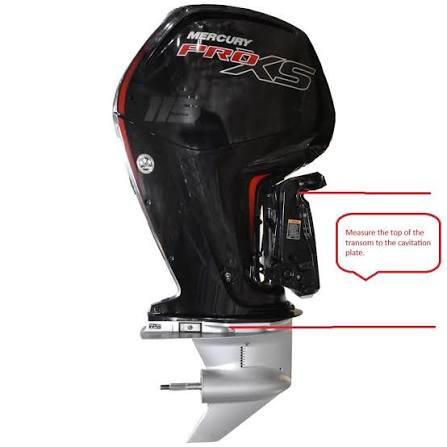
Look at the area where the outboard attaches to the boat. The manufacturer’s shaft-length measurement normally uses a reference point associated with the mounting bracket or transom-mounting area.
Do not start at the top of the engine.
The powerhead and cowling are much higher than the shaft and are not part of the standard shaft-length measurement.
This is one of the most important things to understand when learning how to measure shaft length outboard motor.
If your owner’s manual provides a shaft-length diagram, use it to identify the exact starting point. If there is no diagram, check the manufacturer’s official specifications before relying on a general measurement.
Step 2 : Find the Lower Measurement Point
Once you identify the upper reference point, find the appropriate lower reference point.
The goal is to measure the motor’s shaft dimension rather than the total distance to the propeller.
This means you should not simply place a measuring tape at the top of the motor and extend it all the way to the propeller.
The lower unit contains several components, and its overall length is not necessarily the same as the motor’s advertised shaft length.How to Measure Shaft Length Outboard Motor
If you are uncertain about the lower reference point, stop and check the manufacturer’s documentation.
Step 3 : Keep the Tape Straight
Place the measuring tape between the two reference points.
Keep it straight and as close to vertical as possible.
Do not bend the tape around the shape of the motor. Do not follow a curved surface.
An angled or curved measurement can produce a result that does not accurately represent the intended shaft dimension.
If possible, have someone hold one end of the tape while you position the other end. This can make the measurement easier and more consistent.
For an installed motor, try to keep the tape in a straight vertical line.
Step 4 : Record the Measurement
Write down the result as soon as you take the measurement.
Outboard shaft lengths are commonly discussed in inches, so recording your result in inches can make comparison easier.
Your result may be close to a common category such as:
- 15 inches
- 20 inches
- 25 inches
Do not assume that the nearest number automatically determines the correct motor.
The manufacturer’s measurement method may be slightly different, and the boat’s transom can also affect the final choice.
Take the measurement a second time. If both measurements are similar, record the result and continue to the transom measurement.
Step 5 : Measure the Boat’s Transom
The fifth step is measuring the boat.
The transom is the rear part of the boat where the outboard is mounted. Its height is an important factor in determining the appropriate shaft length. How to Measure Shaft Length Outboard Motor
This is why how to measure shaft length outboard motor is not only about measuring the engine. You also need to understand the boat.
A motor that is correct for one boat may not be correct for another boat, even if both boats use similar horsepower.
Measure the transom using the appropriate reference points recommended by the boat or motor manufacturer.
Step 6 : Compare the Results
Now compare your motor and transom measurements with the manufacturer’s recommendations.
Suppose your boat requires a long-shaft configuration. A 20-inch long-shaft motor may be a possible match.
However, do not stop there.
Check:
- Boat specifications
- Outboard specifications
- Motor model
- Transom height
- Mounting arrangement
- Recommended installation position
The manufacturer’s information should take priority over a generic online chart.
Step 7 : Confirm the Correct Shaft Size
The final step is confirming the shaft category.
You may be considering:
- Short shaft
- Long shaft
- Extra-long shaft
The correct choice depends on the entire boat-and-motor combination.
If your measurement is unclear or does not seem to match the manufacturer’s recommendation, do not guess.
Contact the manufacturer, an authorized dealer, or a qualified marine technician.
The purpose of how to measure shaft length outboard motor is not simply to find a number. It is to determine whether the motor is a suitable match for the boat.

How to Measure Transom Height for an Outboard Motor
Transom height is one of the most important measurements to understand when selecting an outboard motor.
What Is Transom Height?
The transom is the rear section of the boat where the outboard motor is mounted.
Transom height describes the relevant vertical dimension of this mounting area.
The height helps determine how the motor should sit relative to the boat and water.
A lower transom may be designed for a short-shaft motor, How to Measure Shaft Length Outboard Motorwhile a taller transom may require a long- or extra-long-shaft configuration.
However, this is a general relationship rather than an automatic rule.
Where Should You Measure?
Use the reference points recommended for your boat.
Keep the measuring tape straight and vertical.
Avoid measuring at an angle because an angled measurement can be longer than the actual vertical distance.
If your boat has a special mounting bracket or unusual transom design, check the manufacturer’s documentation.
Why Transom Height Matters
The relationship can be summarized as:
Transom height → shaft length → propeller position
The objective is to position the motor correctly so the lower unit and propeller operate at the intended depth.
If the motor is too high or too low, the propeller’s position can change. How to Measure Shaft Length Outboard Motor
That is why transom measurement is an important part of understanding how to measure shaft length outboard motor.
Simple Measurement Example
Imagine you measure your boat’s transom and determine that the boat is designed around a long-shaft outboard.
You might begin by looking at a 20-inch long-shaft model.
However, before buying the motor, check the boat manufacturer’s information and the outboard manufacturer’s specifications.
If both recommend the same shaft category, you have much stronger evidence that the motor is appropriate.
This example demonstrates why you should consider both the boat and the motor rather than relying on one measurement.
Outboard Motor Shaft Length Chart
A shaft-length chart can help you understand the most common categories.
| Shaft Type | Common Reference | General Application |
|---|---|---|
| Short Shaft | 15 inches | Lower-transom boats |
| Long Shaft | 20 inches | Many standard setups |
| Extra-Long Shaft | 25 inches | Taller-transom boats |
These measurements are general reference points.
They should not be treated as a universal standard for every outboard.
Some manufacturers may offer different configurations. Some boats may also have special transoms or mounting systems that require different considerations. How to Measure Shaft Length Outboard Motor
When researching outboard motor shaft length, use the chart to understand terminology and then verify the exact requirement using official documentation.
If you are purchasing a motor, check its specifications before completing the purchase.
Short Shaft vs Long Shaft Outboard
Short- and long-shaft motors are not interchangeable simply because they have similar horsepower.
Short Shaft Outboard
A short-shaft outboard is commonly associated with boats that have lower transoms. How to Measure Shaft Length Outboard Motor
The common reference length is around 15 inches. How to Measure Shaft Length Outboard Motor
A short shaft can be useful when the boat’s design calls for a lower mounting position. How to Measure Shaft Length Outboard Motor
However, if the boat has a taller transom, a short shaft may place the propeller higher than intended. How to Measure Shaft Length Outboard Motor
That can affect the propeller’s interaction with the water under certain conditions. How to Measure Shaft Length Outboard Motor
Long Shaft Outboard
A long-shaft outboard is commonly associated with boats that have taller transoms.
A 20-inch shaft is a common reference point for this category. How to Measure Shaft Length Outboard Motor
Long shafts are widely used, but that does not mean a long How to Measure Shaft Length Outboard Motor shaft is suitable for every boat.
If the boat is designed for a short shaft, installing a longer motor may position the lower unit deeper than intended.
Which Shaft Length Is Right?
The right shaft length depends on several factors.
Transom height is one of the most important.
Boat design also matters because boats can have different mounting arrangements.
Motor model matters because manufacturers can have model-specific recommendations.
Manufacturer documentation should always be checked.
Intended use may also influence the setup.
There is no universal answer to which shaft length is best.
The best shaft is the one that matches the boat and motor according to reliable specifications.
What Happens If the Outboard Shaft Is Too Short?
A shaft that is too short can position the propeller higher than intended.
One possible problem is ventilation. Under some operating conditions, the propeller may not remain properly engaged with the water.
This can affect thrust and acceleration.
You may also notice changes in boat handling or performance.
However, the exact symptoms depend on the motor, boat, load, mounting position, and operating conditions.
If you suspect your shaft is too short, verify the measurement before making changes.
Check the manufacturer’s recommended mounting position and shaft length.
Do not assume that poor performance automatically means the shaft is too short. Other factors can also affect boat performance.
Understanding how to measure shaft length outboard motor correctly is a useful first step in identifying whether the shaft is appropriate.
What Happens If the Outboard Shaft Is Too Long?
A shaft that is too long can position the lower unit and propeller deeper than intended.
One possible result is additional drag.
The boat’s performance may change, and handling characteristics can also be affected.
However, the exact effect depends on the boat and motor combination.
A longer shaft is not automatically better.
If you are replacing an existing outboard, compare the old motor’s specifications with the boat’s recommended setup.
Do not assume that a longer shaft will provide better performance simply because it places the propeller deeper.
The correct depth is the important factor.
Measuring the Entire Engine
The overall engine height is not the shaft length.
The powerhead, cowling, controls, and upper components are not included in the same way as the shaft measurement. How to Measure Shaft Length Outboard Motor
Always use the correct measurement points. How to Measure Shaft Length Outboard Motor
Measuring From the Wrong Point
Starting from the top of the engine can produce an incorrect result.
The same is true if you use the wrong lower endpoint.
Check the manufacturer’s instructions before measuring.
Forgetting to Measure Transom Height
A motor measurement alone is not enough.
You need to understand the boat’s transom because the shaft must work with the boat’s mounting height.
Guessing the Shaft Length
It can be tempting to look at an outboard and estimate whether it is short or long.
This is not a reliable method.
Use a measuring tape and official specifications instead.
Depending Only on a Generic Chart
A chart showing 15, 20, and 25 inches is helpful for understanding common categories.
But it cannot account for every manufacturer, model, or boat. How to Measure Shaft Length Outboard Motor
Always check the specific motor and boat documentation.
Confusing Shaft Length With Transom Height
These are two different measurements.
Shaft length relates to the outboard.
Transom height relates to the boat.
They work together to determine the appropriate motor setup.
This distinction is essential when learning how to measure shaft length outboard motor.
How to Know If Your Outboard Shaft Length Is Correct
After completing your measurements, use a simple verification process.
First, measure the motor using the correct reference points.
Second, measure the boat’s transom.
Third, check the manufacturer’s specifications.
Fourth, compare the shaft category with the boat’s requirements.
Fifth, consider the motor’s mounting position and propeller location.
Use this checklist:
- Measure the boat’s transom.
- Measure the outboard correctly.
- Record the measurement.
- Repeat the measurement.
- Check the owner’s manual.
- Check official manufacturer specifications.
- Confirm the motor model.
- Compare the shaft category.
- Consider the propeller position.
- Seek professional assistance if uncertain. How to Measure Shaft Length Outboard Motor
A correct outboard motor shaft length is based on the complete setup rather than one number.
If your boat has a custom bracket, unusual transom, or special mounting arrangement, professional advice can be especially useful.
FAQs :
How do I measure shaft length outboard motor?
To learn how to measure shaft length outboard motor, identify the correct upper and lower measurement points specified by the manufacturer. Place a measuring tape between those points, keep it straight, record the measurement, and repeat it for confirmation. Then compare the result with the boat’s transom height and manufacturer’s recommendations.
What is the most common outboard shaft length?
A 20-inch shaft is a common long-shaft category and is used on many boats. However, it is not the correct choice for every boat. How to Measure Shaft Length Outboard Motor The appropriate shaft length depends on the boat’s transom, motor model, and manufacturer’s recommendations.
How do I know what shaft length I need?
Start by measuring the boat’s transom height. Then check the manufacturer’s recommended shaft length for the specific outboard model. Compare the measurements instead of relying only on a general 15-, 20-, or 25-inch chart.
Is a 15-inch or 20-inch shaft better?
Neither is automatically better. A 15-inch short shaft may be appropriate for a lower-transom boat, while a 20-inch long shaft may be appropriate for a taller transom. The correct option depends on the specific boat and motor.
Can I use a long-shaft outboard on a short transom?
It may not be suitable. A long shaft can position the lower unit deeper than intended and may increase drag or affect performance. Always check the boat and motor manufacturer’s requirements first.
Can I use a short-shaft outboard on a tall transom?
A short shaft may position the propeller too high on a tall transom. This can contribute to ventilation or reduced thrust in some conditions. Verify the required shaft length before installation.
Does outboard shaft length affect performance?
Yes. Shaft length can influence the propeller’s position in the water. This can affect thrust, drag, handling, and overall performance. How to Measure Shaft Length Outboard Motor The exact effect varies with the boat, motor, mounting height, and operating conditions.
What is the difference between shaft length and transom height?
Shaft length is a measurement associated with the outboard motor. Transom height is a measurement associated with the boat’s rear mounting area. Both are important when determining the correct outboard setup.
Can I measure shaft length without removing the outboard motor?
In many cases, you can take a useful measurement while the motor is installed if you can safely access the correct reference points. However, the manufacturer’s measurement procedure should be followed because the appropriate points may be easier to identify with the motor removed.
Should I use a shaft-length chart to choose an outboard?
A chart can help you understand common shaft categories, but it should not be your only source. Use it as a general guide and confirm the exact requirement with the boat and outboard manufacturer’s specification
Conclusion :
Learning how to measure shaft length outboard motor is an important skill when choosing, replacing, or installing an outboard engine. The process is relatively simple, but accuracy matters because shaft length affects how the motor sits on the boat and where the propeller operates in the water.
Start by identifying the correct upper and lower measurement points. Keep your measuring tape straight, record the measurement, and repeat it to confirm the result. Then measure the boat’s transom height and compare both measurements with the manufacturer’s recommendations.
Common categories such as 15-inch short shafts, 20-inch long shafts, and 25-inch extra-long shafts are useful for understanding the basic differences. However, these numbers should not be treated as universal rules. Different manufacturers, motor models, boats, and mounting arrangements can require different solutions.
Avoid common mistakes such as measuring the entire engine, guessing the shaft length, or relying only on a generic chart. The most reliable approach is to combine accurate measurements with official manufacturer information. How to Measure Shaft Length Outboard Motor
Once you understand how to measure shaft length outboard motor, you can make a much more informed decision about your boat’s setup. If the motor or transom has an unusual configuration, consult the manufacturer, an authorized dealer, or a qualified marine technician before making changes.
