

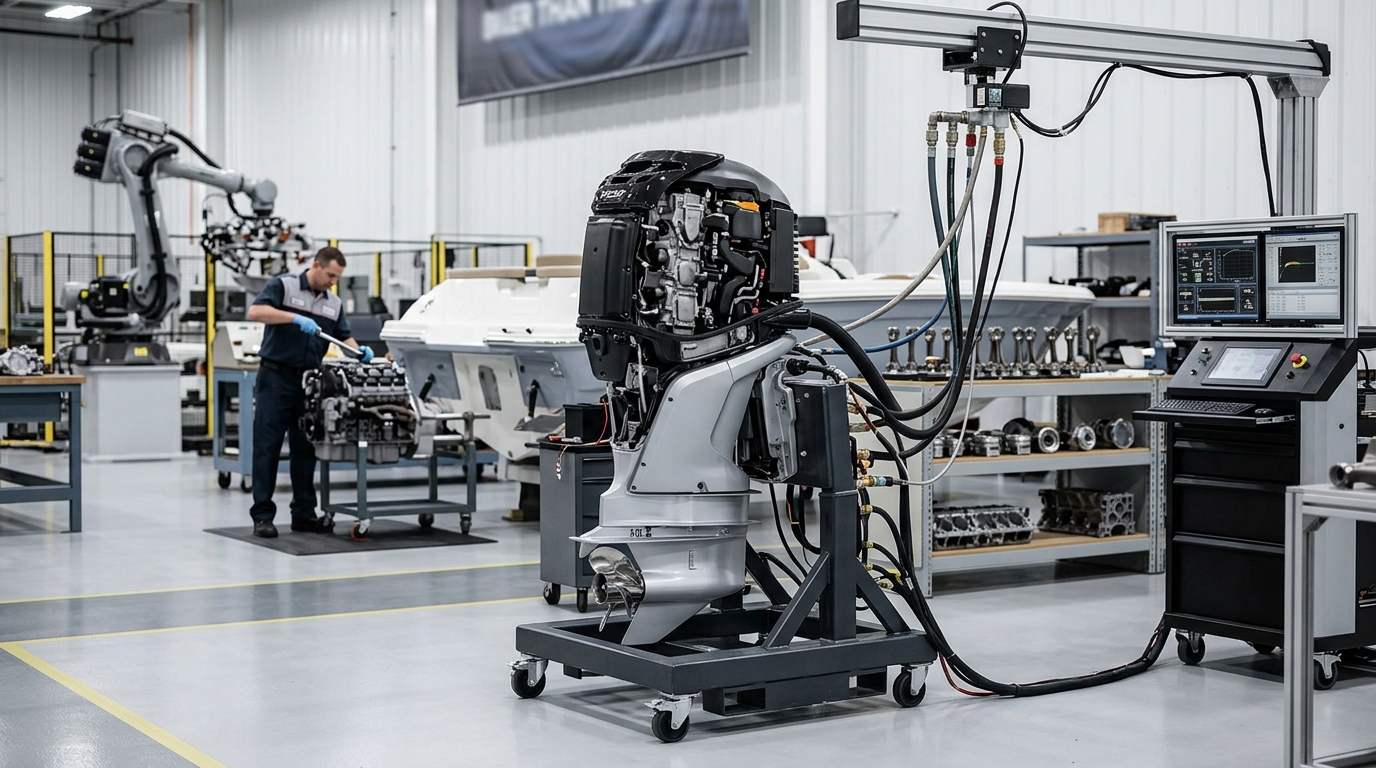
Mercury outboard motors are manufactured at different production facilities, and the exact manufacturing location can vary depending on the specific model and engine series. Mercury Marine is a major manufacturer of outboard engines, producing a broad range of motors for recreational boaters, fishing, commercial applications, and performance-focused users. Mercury Marine is part of Brunswick Corporation, one of the major companies in the global marine industry.
Because Mercury produces different types and sizes of outboards, there is not one single country where every Mercury motor is manufactured. Production facilities may handle different models, components, or stages of manufacturing. As a result, buyers who want to know where a particular Mercury outboard was made should check the official information for that specific engine rather than assuming all Mercury motors have the same country of origin.
Knowing where an outboard motor is manufactured can be useful when comparing engines. Manufacturing location may matter to buyers who are researching manufacturing quality, engineering standards, parts availability, warranty coverage, and dealer support. It can also help buyers understand the motor’s country of origin and determine whether local dealers or authorized service centers can provide appropriate support.
However, the country of manufacture alone does not determine the overall quality of a Mercury outboard. Engineering, quality-control procedures, specifications, dealer service, and manufacturer support are also important factors.
Key takeaway: The manufacturing location of a Mercury outboard can vary by model, so buyers should check official Mercury information for the specific engine they are considering.
Where Are Mercury Outboard Motors Manufactured?
Mercury outboard motors are manufactured in multiple locations rather than in a single country. Mercury Marine’s official corporate information lists manufacturing locations in Fond du Lac, Wisconsin; St. Cloud, Florida; Juárez, Mexico; Komagane, Japan; Petit-Rechain, Belgium; and Suzhou, China. The exact location associated with an outboard can depend on its model, production requirements, and market.
Mercury Marine Manufacturing
Mercury Marine is the marine-engine business responsible for Mercury-branded outboards and other marine propulsion products. Its current outboard range includes families such as Verado, FourStroke, Pro XS, and SeaPro.
The company combines manufacturing with engineering, product development, testing, distribution, and technical support. Mercury’s worldwide operations include multiple manufacturing plants and dedicated testing facilities, allowing the company to develop and produce marine engines for different applications and markets.
Manufacturing in the United States
The United States has a long and important connection with Mercury Marine. The company’s global headquarters is in Fond du Lac, Wisconsin, which has become a major center for Mercury’s manufacturing and operations. Brunswick states that the Wisconsin campus contains about 3 million square feet of manufacturing facilities and is home to much of Mercury’s design, manufacturing, and distribution activity.
Fond du Lac is important not only because engines are manufactured there, but also because it supports engineering, product development, testing, and other operations. Mercury also operates testing facilities in Fond du Lac, Oshkosh, and Panama City, Florida.
where are mercury outboard motors manufactured
Manufacturing Outside the United States
Mercury also maintains manufacturing operations outside the United States. Its official locations include facilities in Mexico, Japan, Belgium, and China. Historical Brunswick filings specifically documented Mercury outboard production in China and Japan, while current company information confirms that Mercury continues to operate manufacturing facilities in multiple countries.
This global manufacturing network means buyers should not assume that every Mercury outboard is manufactured in the United States. Production can vary by model and market. For the most accurate country-of-origin information, buyers should check the documentation and identification information for the specific Mercury engine they are considering.
Who Owns Mercury Marine?
Mercury Marine
Mercury Marine is a major marine propulsion business headquartered in Fond du Lac, Wisconsin. It produces Mercury outboard engines as well as other marine propulsion products, parts, and related technologies. Mercury is also responsible for engineering, manufacturing, product development, and customer support associated with its marine products.
Brunswick Corporation
Mercury Marine is a division of Brunswick Corporation, meaning Brunswick is its parent company. Brunswick is a large marine-industry company with multiple businesses and brands. Its relationship with Mercury provides the corporate structure and resources behind Mercury’s global operations, manufacturing investments, research, and product development.
Mercury vs. Brunswick
The names can be confusing, but they refer to different things:
- Mercury Marine: The marine-engine business that develops, manufactures, markets, and supports Mercury marine products.
- Mercury outboard motors: The actual outboard engines sold under the Mercury brand, including different model families and horsepower ranges.
- Brunswick Corporation: The parent company that owns Mercury Marine and oversees a broader portfolio of marine businesses.
Understanding this distinction makes it easier to research Mercury’s manufacturing locations, ownership, warranty information, and company history without confusing the engine brand with its parent corporation.
Mercury Marine’s Manufacturing History
Mercury Marine’s manufacturing history began in 1939, when E. Carl Kiekhaefer purchased the bankrupt Cedarburg Manufacturing Company in Wisconsin. The purchase unexpectedly led him into the outboard-engine business after he rebuilt and improved abandoned outboard motors. The Mercury brand was introduced soon afterward, establishing the foundation for a company that would become one of the major names in marine propulsion.
Early Growth and Expansion
As demand for Mercury outboards increased, the company needed a larger production facility. In 1946, Kiekhaefer purchased the former Corium Farms property in Fond du Lac, Wisconsin, and converted its dairy facilities into a manufacturing operation. That location became central to Mercury’s long-term development and remains part of the company’s Fond du Lac campus today.
During the following decades, Mercury expanded its outboard lineup and manufacturing capabilities. The company introduced increasingly powerful engines, including the six-cylinder Mercury Mark 75 in 1956 and the 100-horsepower Mercury 1000 in 1962. Later innovations included electronic fuel injection and direct fuel injection, showing how Mercury’s production evolved alongside changes in engine technology and boating requirements.
Modern Four-Stroke Development
Mercury’s product development eventually placed greater emphasis on modern four-stroke outboard technology, fuel efficiency, emissions performance, durability, and electronic controls. The company also continued investing in engineering and testing facilities to develop and validate newer generations of marine engines. Mercury says its testing network includes facilities in Fond du Lac and Oshkosh, Wisconsin, as well as Panama City, Florida.
Growth of Global Manufacturing
Mercury’s manufacturing footprint also expanded beyond the United States. Today, Mercury lists manufacturing locations in Fond du Lac, Wisconsin; St. Cloud, Florida; Juárez, Mexico; Komagane, Japan; Petit-Rechain, Belgium; and Suzhou, China. This global network allows Mercury to support different products and markets while maintaining engineering, manufacturing, testing, and distribution operations in multiple regions.
Modern Marine-Engine Production
Today, Mercury Marine operates a global manufacturing network supported by engineering, product development, testing, and distribution. Its history shows that manufacturing methods and facilities are not fixed; they can change as technology, product lines, production requirements, and global markets evolve. Therefore, the manufacturing location of a particular Mercury outboard should be verified for the specific model rather than assumed from the company’s historical production location.
5. What Is Made at Mercury’s Fond du Lac, Wisconsin Facility?
Mercury Marine’s Fond du Lac, Wisconsin operation is one of the most important locations in the company’s global marine-engine network. However, it is useful to distinguish between manufacturing and the other activities performed there. The facility is not simply a factory where every Mercury outboard is produced from start to finish. It also supports engineering, product development, testing, distribution, and other functions.
Fond du Lac has a long connection with Mercury Marine. The company moved its operations to the area in the 1940s, and the Wisconsin location eventually developed into Mercury’s headquarters and a major manufacturing campus. Brunswick describes the Fond du Lac campus as containing approximately 3 million square feet of manufacturing facilities.
Engineering and Product Development
Engineering is an important part of Mercury’s Wisconsin operations. Engineers and product-development teams work on marine propulsion technologies, including engine performance, durability, fuel efficiency, emissions, electronic systems, and other technologies used in modern outboards.
This means a Mercury engine can be associated with Fond du Lac engineering even when every manufacturing step for that particular model does not take place there.
Manufacturing and Assembly
Fond du Lac is also a significant manufacturing location. Mercury produces marine engines and components at its Wisconsin operations, with manufacturing activities supported by specialized equipment, production processes, quality control, and assembly operations.
The exact products manufactured or assembled at the facility can change as Mercury updates its product portfolio and manufacturing strategy. Therefore, it would be inaccurate to assume that every Mercury outboard model is completely manufactured and assembled in Fond du Lac.
Testing
Testing is another major part of Mercury’s operations. The company lists testing facilities in Fond du Lac and Oshkosh, Wisconsin, as well as Panama City, Florida. These facilities help engineers evaluate marine engines and technologies under controlled and real-world conditions.
Research, Development, and Product Support
The Wisconsin operation also contributes to research and development, technical activities, distribution, and product support. These functions help Mercury introduce new engines, improve existing products, and support dealers and customers.
In short: Fond du Lac is a major Mercury engineering, manufacturing, testing, and support center, but it should not automatically be considered the manufacturing location of every Mercury outboard.
6. Does Mercury Manufacture All Outboard Motors in the USA?
No. Not every Mercury outboard motor should automatically be assumed to be manufactured in the United States. Mercury Marine has a global manufacturing network, and the production location can vary according to the specific model, production requirements, and market.
Mercury’s connection with the United States is substantial. Its headquarters and a major manufacturing operation are located in Fond du Lac, Wisconsin, which has been closely associated with Mercury Marine for decades. However, Mercury also lists manufacturing locations outside the United States, including facilities in Mexico, Japan, Belgium, and China.
Why Manufacturing Locations Differ
Mercury produces a wide range of outboard motors, from portable engines to high-horsepower models designed for larger boats. Different products can require different manufacturing processes, facilities, equipment, and supply chains.
Manufacturing origins can also change over time. A particular model produced several years ago may not have the same production origin as a newer version. Mercury can adjust manufacturing arrangements as product generations change, demand shifts, technology develops, or production is reorganized between facilities.
Global production also means that an engine’s manufacturing story can be more complicated than simply identifying one country. Components, materials, and technologies may come from different locations before an engine reaches its final assembly or production facility.
How to Confirm a Specific Motor
If you need to determine where a particular Mercury outboard was manufactured, do not rely only on the Mercury brand name. Instead, check:
- Model information
- Serial number
- Identification plate
- Owner’s manual
- Manufacturer documentation
- An authorized Mercury Marine dealer
The identification plate and serial number can be particularly useful because they help identify the exact engine and its production information. An authorized dealer can also help interpret model and serial-number information when the country of origin is not obvious from the engine itself.
The Bottom Line
Mercury is an American marine-engine brand with significant U.S. manufacturing operations, but Mercury outboards are not all manufactured in the USA. Production can occur across Mercury’s international manufacturing network. For an accurate answer about a particular engine, verify the model and serial information rather than assuming its origin from the brand alone.
7. Where Are Mercury Small Outboard Motors Made?
Mercury Marine produces a broad range of smaller outboard motors designed for applications such as portable boating, fishing boats, tenders, small recreational boats, and other lightweight marine uses. However, there is no single manufacturing country that applies to every small Mercury outboard.
Small Mercury engines include portable models designed to be relatively easy to transport and install. These engines are commonly used by anglers and recreational boaters who need dependable propulsion without the size and weight of a high-horsepower outboard. Mercury’s smaller four-stroke range includes engines intended for different boat sizes and applications.
Manufacturing Origin Can Vary
The important point for buyers is that the manufacturing origin of a small Mercury outboard depends on the specific model and production period. Mercury operates manufacturing facilities in several countries, so the location associated with one model should not automatically be applied to another.
Mercury’s current corporate information lists manufacturing operations in locations including Fond du Lac, Wisconsin; St. Cloud, Florida; Juárez, Mexico; Komagane, Japan; Petit-Rechain, Belgium; and Suzhou, China.
That global network means a small portable outboard may have a different production origin from a larger Mercury engine. It is also possible for manufacturing arrangements to change when Mercury introduces a new generation of an engine or reorganizes production.
Why the Exact Model Matters
Buyers researching a small Mercury motor should avoid statements such as “all small Mercury outboards are made in the USA” or “all portable Mercury engines are made in one country.” Such generalizations can be misleading.
Instead, identify the exact model, horsepower, serial number, and production information. The engine’s identification plate, owner’s documentation, or Mercury’s official records can provide more useful information about its origin.
An authorized Mercury Marine dealer can also help verify information for a specific engine.
Final Answer
So, where are Mercury small outboard motors made? The answer depends on the specific model and production details. Mercury’s small outboard range is part of a global manufacturing system, and buyers should verify the country of manufacture for the exact engine they are considering rather than relying on general information about the Mercury brand.
8. Where Are Mercury 4-Stroke Outboard Motors Made?
Mercury Marine’s four-stroke outboard range covers a wide range of engine sizes, from compact portable motors to powerful engines designed for larger recreational and fishing boats. Because the range includes many different models, Mercury 4-stroke outboards are not necessarily manufactured in one country or one facility.
Small Four-Stroke Outboards
Mercury’s smaller four-stroke engines are designed for portable boating, fishing, tenders, and other lightweight applications. These engines are part of Mercury’s global product range, and their manufacturing origin can depend on the particular model and production arrangement.
For this reason, buyers should verify the exact engine rather than assuming that every small four-stroke is produced at Mercury’s Wisconsin facility.
Mid-Range Four-Stroke Outboards
Mercury also produces mid-range four-stroke engines for a variety of recreational and fishing applications. These engines use modern technologies designed to provide a combination of performance, fuel efficiency, reliability, and ease of operation.
Different models can be associated with different manufacturing facilities. Mercury’s global production network allows the company to manufacture products for different markets while maintaining engineering and quality-control processes across its operations.
High-Horsepower Four-Strokes
Mercury’s high-horsepower four-stroke lineup includes advanced engines designed for larger and more demanding boats. These products involve sophisticated engineering, electronics, fuel systems, and manufacturing processes.
The engineering location and final manufacturing location do not necessarily have to be the same. Mercury can develop technologies and products through its engineering operations while manufacturing particular components or engines at another facility.
Global Supply Chains
Modern outboard production also involves global supply chains. An engine may contain components, materials, or technologies sourced from multiple locations before the finished product reaches its final manufacturing or assembly facility. Therefore, “made in” information generally refers to the applicable manufacturing or country-of-origin designation rather than suggesting that every individual component originated in the same country.
Mercury currently identifies manufacturing operations in the United States and several other countries, including Mexico, Japan, Belgium, and China.
How to Find the Origin of a Specific 4-Stroke
If you want to know exactly where a particular Mercury four-stroke was made, check its model information, serial number, identification plate, owner’s manual, and manufacturer documentation. An authorized Mercury Marine dealer can also help verify the production information.
The key point: Mercury four-stroke outboards come from a global manufacturing network. The specific production location depends on the model and production details, so buyers should verify the exact engine rather than assuming that every four-stroke Mercury is made in the USA.
How Mercury Outboard Motors Are Manufactured
Mercury outboard motors are produced through a combination of engineering, component manufacturing, assembly, testing, and quality-control processes. The exact process can vary by model and manufacturing facility, so a general overview is more accurate than assuming every Mercury engine follows an identical factory procedure. Mercury currently operates multiple manufacturing locations and dedicated testing facilities around the world. (Mercury Marine)
Engineering and Design
The manufacturing process begins well before an engine reaches an assembly line. Product-development and engineering teams work on engine architecture, performance, durability, fuel systems, electronics, weight, and other requirements. Computer-aided engineering and digital design tools can be used to develop and evaluate components before production.
Testing is also part of product development. Mercury says its Product Development & Engineering operations include testing facilities in Fond du Lac and Oshkosh, Wisconsin, along with its indoor test center in Fond du Lac. (Mercury Marine)
Component Production
An outboard consists of many individual components and systems. Depending on the model, these can include:
- Engine blocks
- Pistons and internal engine components
- Fuel-system components
- Electrical and electronic components
- Driveshafts and gearcases
- Lower-unit components
- Propulsion and cooling-system components
Mercury has documented its use of die-casting operations to produce components such as engine blocks, driveshafts, and gearcases. Its Fond du Lac casting operations include high-pressure die casting and other manufacturing capabilities. (Mercury Marine)
Assembly
After components are manufactured or sourced, they move through appropriate production and assembly processes. Workers and automated equipment combine major components into complete engine systems. Assembly can include installing internal engine parts, fuel and electrical systems, cooling components, gearcases, controls, and other model-specific parts.
Testing and Quality Control
Completed engines must be checked to ensure they meet applicable specifications. Mercury states that it rigorously tests new engines, propellers, parts, and accessories, including both laboratory and on-water testing. (Mercury Marine)
Quality checks can include dimensional inspection, leak testing, assembly verification, performance evaluation, and traceability processes, although the exact checks can vary by product and facility. Mercury has also described manufacturing traceability connecting casting, machining, leak-test, and assembly information with an engine’s serial number. (Mercury Marine)
Are Mercury Outboard Motors Good Quality?
Mercury outboard motors have a long history in the marine industry, but it is better to discuss their quality in terms of engineering, manufacturing, maintenance, and operating conditions rather than making an absolute claim that every Mercury engine is equally reliable.
Mercury operates multiple manufacturing facilities and testing locations, and the company says its Product Development & Engineering teams conduct extensive testing of its engines and other products. (Mercury Marine) However, the quality and reliability experienced by an individual owner can depend on much more than the manufacturer’s name.
What Affects Outboard Quality and Reliability?
Several factors can influence how well an outboard performs over time:
- Manufacturing and quality-control standards
- Engine design and technology
- Maintenance history
- Operating conditions
- Storage practices
- Corrosion protection
- Fuel quality
- Proper installation and setup
- Service history
Even a well-designed engine can develop problems if it is poorly maintained, exposed to severe corrosion, stored incorrectly, or operated outside recommended conditions.
where are mercury outboard motors manufactured
New vs. Used Mercury Outboards
When comparing a new Mercury outboard with a used one, the purchase decision should go beyond the brand name.
For a new motor, consider the manufacturer’s warranty, dealer support, recommended maintenance schedule, parts availability, and local service network.
For a used Mercury, maintenance records can be particularly valuable. Buyers should also consider engine hours, corrosion, previous use, storage conditions, service history, and the condition of major components. A used engine that has been properly maintained may be a better choice than another engine with an unknown or neglected history.
Dealer support is another practical consideration. Mercury has a broad international dealer and distribution network, but the availability of technicians and parts can vary by location. (Mercury Marine)
Ultimately, Mercury’s manufacturing origin does not by itself determine the condition of a used motor. The individual engine’s age, maintenance, operating environment, and service history can be just as important—or more important—when evaluating a used outboard.
Does Manufacturing Location Affect Mercury Outboard Quality?
The country where a Mercury outboard is manufactured does not automatically determine whether the engine is good or bad quality. Mercury operates a global manufacturing network, with manufacturing locations listed in the United States, Mexico, Japan, Belgium, and China. (Mercury Marine)
For buyers, a more useful approach is to consider the engineering, manufacturing standards, quality-control processes, testing, maintenance, and service support associated with the specific engine.
Mercury’s manufacturing operations include specialized production capabilities. For example, the company has described its Fond du Lac operations for producing complex aluminum components, including engine blocks, driveshafts, and gearcases. (Mercury Marine) Mercury also says its engines and other products undergo extensive testing through its Product Development & Engineering operations and testing facilities. (Mercury Marine)
Global Components and Supply Chains
Modern marine engines can involve international supply chains. Components and materials may come from different locations before reaching a manufacturing or assembly facility. Consequently, the country associated with the finished engine does not necessarily mean every individual component was produced there.
This is important when comparing Mercury engines from different production periods. Manufacturing arrangements can change as new models are introduced, production is reorganized, or market requirements change.
Maintenance Still Matters
Manufacturing location is only one part of the reliability equation. Proper maintenance, suitable fuel, corrosion protection, correct storage, and appropriate operating conditions can have a significant effect on an outboard’s long-term performance.
Therefore, buyers should avoid assuming that an engine made in one particular country is automatically better or worse than another Mercury engine. The specific model, production details, condition, maintenance history, and available service support provide a much better basis for evaluating an outboard.
How to Find Where Your Mercury Outboard Was Made
If you want to determine where a particular Mercury outboard was manufactured, start with the engine’s identifying information. Mercury has multiple manufacturing locations, so identifying the exact engine is more useful than relying on the Mercury brand name alone. (Mercury Marine)
Step 1: Find the Model Number
Look for the engine’s model information. Depending on the engine and documentation, model information may be shown on the identification label or associated paperwork.
The model helps identify the engine family, horsepower, configuration, and production specifications. Write down the information exactly as shown.
Step 2: Find the Serial Number
Next, locate the serial number on the engine. The serial number is particularly useful because it identifies the individual motor rather than simply identifying its general product family.
Keep the serial number available when contacting Mercury or a dealer. It can help them identify the correct engine and relevant production information.
Step 3: Check Manufacturer Documentation
Review documents supplied with the motor, including:
- Owner’s manual
- Product documentation
- Warranty information
- Original purchase documents
- Identification information
These documents may provide useful details about the engine’s specifications, warranty, and identification.
Step 4: Contact Mercury Marine or an Authorized Dealer
If the available markings do not clearly identify the manufacturing origin, the safest approach is to contact Mercury Marine or an authorized Mercury Marine dealer with the model and serial number.
Mercury operates a global dealer and distribution network, and its company information notes that its distribution business provides dealer-support services in numerous countries. (Mercury Marine)
A dealer can help interpret the engine’s identification information and determine what production or country-of-origin information is available for that particular motor.
Important: Do not assume that the location of the dealer, the place where you purchased the engine, or the Mercury headquarters in Fond du Lac is automatically the manufacturing country. Verify the specific engine.
Mercury Outboard Motors vs. Other Major Brands
Mercury competes with several major outboard manufacturers, including Yamaha, Suzuki, Honda, and Tohatsu. When comparing these brands, manufacturing country is only one factor. Buyers should also consider the particular engine model, dealer network, parts availability, warranty, technology, and suitability for their boat.
Mercury
Mercury has a large global manufacturing network. Its current corporate information lists manufacturing locations in Fond du Lac, Wisconsin; Juárez, Mexico; Komagane, Japan; Petit-Rechain, Belgium; St. Cloud, Florida; and Suzhou, China. It also has dedicated testing facilities in Wisconsin and Florida. (Mercury Marine)
Mercury’s range covers portable engines through high-horsepower outboards, giving buyers numerous choices within one brand.
Yamaha
Yamaha also uses a global manufacturing strategy. Yamaha Motor states that it produces outboards at four production bases, including facilities in Japan, Thailand, and Brazil, with different locations producing different size ranges. (Yamaha Motor Global Site) This illustrates why manufacturing location alone is not a reliable way to rank one marine brand against another.
Suzuki, Honda, and Tohatsu
Suzuki, Honda, and Tohatsu are also established names in the outboard market. Like Mercury and Yamaha, their product ranges, production arrangements, dealer networks, and parts availability can differ between markets and models.
For that reason, a buyer in one country may have a different experience with dealer support or parts availability than a buyer elsewhere.
What Should Buyers Compare?
Instead of asking which brand is “best” based only on manufacturing country, compare specific models with similar horsepower and intended use. Look at warranty terms, local dealer coverage, service availability, parts access, fuel economy, weight, features, and the engine’s suitability for the boat.
The best choice is often the motor that fits the boat correctly and has strong service support in the owner’s area—not simply the one manufactured in a particular country.
What to Consider When Buying a Mercury Outboard
Choosing a Mercury outboard should begin with the requirements of the boat and the way you intend to use it. Manufacturing origin can be useful information, but it should not be the only factor in the buying decision.
Horsepower
Choose an engine that is appropriate for the boat. More horsepower is not automatically better. The boat manufacturer’s specifications should determine the appropriate power range.
Boat Size and Transom Height
The engine needs to match the boat’s size, design, and transom height. The correct shaft length is important for proper installation and operation.
New vs. Used
A new engine offers the benefit of current specifications and applicable warranty coverage. With a used engine, pay closer attention to service records, engine hours, corrosion, previous use, storage conditions, and overall condition.
Dealer Support and Warranty
Before buying, check whether authorized Mercury service is available in your area. A nearby dealer can make maintenance, troubleshooting, warranty service, and parts procurement easier.
Warranty terms should also be reviewed for the exact model and market because coverage can vary.
Parts Availability
Consider how easily you can obtain genuine replacement parts and routine maintenance items locally. A motor that is convenient to service can be more practical over the long term.
Fuel Economy and Weight
Fuel consumption and engine weight can affect operating costs, boat balance, towing, and handling. Compare these specifications between similar models rather than looking only at horsepower.
Intended Use
Think about whether the engine will primarily be used for fishing, recreational cruising, transportation, or another application. Different Mercury models are designed with different performance characteristics and features.
Local Service Availability
Local technical support can be just as important as the engine’s specifications. A strong dealer and service network can make routine maintenance and repairs easier.
Important Safety Point
Always stay within the boat manufacturer’s rated capacity and specifications. Do not install an engine that exceeds the boat’s permitted horsepower, weight, transom, or other manufacturer requirements. When in doubt, follow the boat manufacturer’s documentation and consult a qualified marine professional.
where are mercury outboard motors manufactured
FAQ
Where are Mercury outboard motors manufactured?
Mercury outboard motors are manufactured through a global production network, rather than at one single factory. Mercury Marine lists manufacturing locations in the United States and other countries, including facilities in Wisconsin, Florida, Mexico, Japan, Belgium, and China. The exact manufacturing location depends on the specific model, production arrangements, and market.
Are Mercury outboards made in the USA?
Yes, Mercury has significant manufacturing operations in the United States. Fond du Lac, Wisconsin, is particularly important to the company and includes major manufacturing and engineering operations. However, this does not mean every Mercury outboard is manufactured in the USA. Mercury also operates manufacturing facilities internationally, so buyers should verify the origin of the specific engine.
Are Mercury outboards made in Wisconsin?
Some Mercury outboard manufacturing takes place in Wisconsin, and Fond du Lac is one of Mercury’s most important locations. The site also supports engineering, product development, testing, distribution, and other operations. Therefore, it is important to distinguish between an engine being manufactured at a facility and being designed, engineered, tested, or supported there.
Who manufactures Mercury outboard motors?
Mercury Marine is the marine-engine business responsible for Mercury-branded outboard motors. Mercury Marine operates as part of Brunswick Corporation, its parent company. Mercury handles activities such as product development, engineering, manufacturing, testing, distribution, and product support for its marine products.
Where are small Mercury outboards made?
The answer depends on the specific small outboard model. Mercury produces portable and smaller engines through its global manufacturing network, so it would be inaccurate to state that all small Mercury outboards are made in one particular country. The model number, serial number, identification information, and manufacturer documentation are better sources for determining the origin of a specific motor.
Are Mercury four-stroke outboards made in the USA?
Some Mercury four-stroke outboards are associated with U.S. manufacturing operations, but not every Mercury four-stroke should be assumed to be U.S.-manufactured. Mercury produces different models through multiple facilities. Manufacturing arrangements can also change between model generations, so the exact engine should be checked rather than relying on a general statement about the Mercury four-stroke range.
Are Mercury outboards reliable?
Mercury outboards can provide dependable service when properly selected, installed, maintained, and operated. However, reliability depends on more than the brand name. Maintenance history, operating conditions, storage, corrosion protection, fuel quality, engine hours, and service records can all affect an engine’s condition. These factors are especially important when purchasing a used Mercury outboard.
Does Mercury manufacture its own engines?
Mercury Marine operates its own manufacturing facilities and produces marine engines and components, while also participating in a global supply chain. Modern outboard production can involve components and materials sourced from different locations. Therefore, manufacturing a Mercury engine does not necessarily mean every individual component originated in the same factory or country.
How can I tell where my Mercury outboard was made?
Start by finding the engine’s model number and serial number. Check the identification plate, owner’s manual, warranty information, and other manufacturer documentation. If these sources do not clearly identify the manufacturing origin, contact Mercury Marine or an authorized Mercury dealer with the engine’s identification information. A dealer can help determine what production information is available for that particular motor.
Is Mercury a good outboard brand?
Mercury is an established global outboard manufacturer with a broad range of engines and extensive engineering, manufacturing, and testing operations. However, whether a particular Mercury outboard is a good choice depends on the specific model, boat, intended use, maintenance requirements, warranty, parts availability, and local dealer support. Rather than judging the entire brand by its manufacturing country, buyers should compare individual models and consider the support available in their area.
Conclusion
So, where are Mercury outboard motors manufactured? The answer is that Mercury outboards are manufactured through a global production network, not at one single facility or in one country. Mercury Marine has a long history of manufacturing marine engines in the United States, with Fond du Lac, Wisconsin, remaining one of the company’s most important locations. The Wisconsin operation supports major manufacturing activities as well as engineering, product development, testing, distribution, and other functions.
At the same time, Mercury Marine has expanded its manufacturing footprint beyond the United States. The company lists manufacturing operations in several international locations, including Mexico, Japan, Belgium, and China, alongside its U.S. facilities. This global network allows Mercury to support different engine models, production requirements, and markets.
For buyers, the most important point is that the manufacturing location of a Mercury outboard can depend on the specific model and production period. A Mercury engine manufactured several years ago may have a different production origin from a newer model. Similarly, different engine families may be produced at different facilities.
If you need to determine where a particular Mercury outboard was made, check the engine’s model number, serial number, identification plate, owner’s manual, warranty information, and official manufacturer documentation. An authorized Mercury Marine dealer can also help verify information for a specific engine.
Finally, manufacturing origin should not be the only factor when choosing an outboard. Horsepower, boat compatibility, engine condition, maintenance history, fuel economy, warranty, parts availability, dealer support, and intended use can all be important. Whether you are buying a new or used Mercury outboard, evaluating the specific engine and the support available in your area will give you a more useful picture than judging the motor solely by its country of manufacture.
