

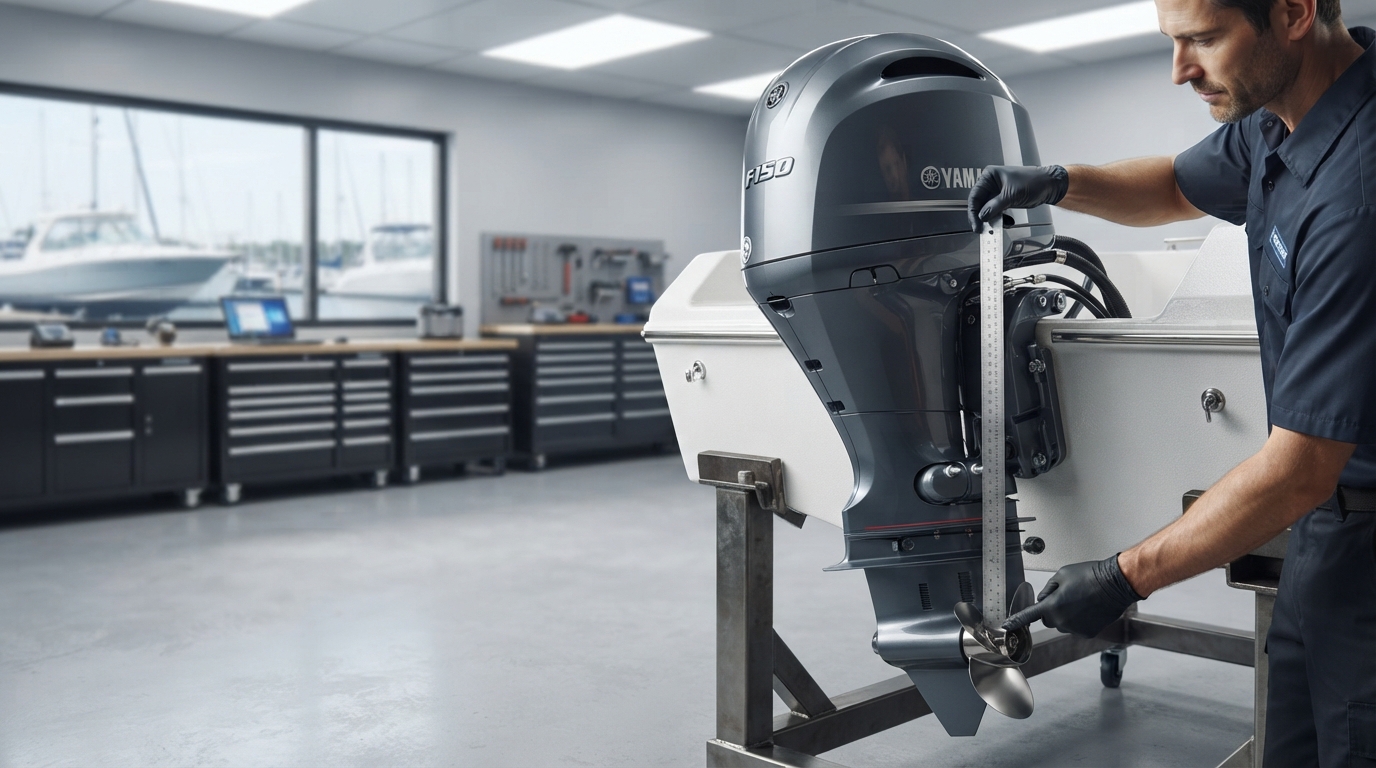
Learning how to measure shaft length on outboard motor is important before buying, replacing, or installing an outboard engine. The correct shaft length helps place the propeller at the right depth below the boat. It also helps the engine receive cooling water correctly and allows the boat to perform as designed.
An outboard with the wrong shaft length can create several problems. A shaft that is too short may leave the propeller too close to the surface. This can increase ventilation and reduce thrust. A shaft that is too long may place the propeller deeper than necessary, increasing drag and affecting handling.
The good news is that how to measure shaft length on outboard motor is fairly simple when you use the correct reference points. You normally measure from the motor’s mounting surface to the manufacturer’s specified lower reference point on the lower unit. You should then compare that measurement with your boat’s transom height.
Before measuring, gather a tape measure, a straight edge if needed, and something to record the result. Keep the motor secure and make the measurement as straight and accurate as possible.
The key is to measure both sides of the setup: the outboard and the boat. Knowing how to measure shaft length on outboard motor gives you a useful starting point, but the manufacturer’s specifications should always have the final say.
What Is Outboard Motor Shaft Length?
Outboard shaft length describes the distance between the engine’s mounting surface and the lower unit’s specified measurement point. It helps determine how far the propeller and water intake sit below the boat’s transom.
Many buyers hear terms such as “short shaft,” “long shaft,” and “extra-long shaft.” These terms describe different shaft-length categories. They do not describe the total physical height of the entire engine.
What Does “Shaft Length” Mean?
A short-shaft outboard is designed for boats with relatively low transoms. A long-shaft model is designed for taller transoms. Extra-long versions are available for boats that require even more vertical reach.
The exact dimensions can vary between manufacturers and models. For this reason, how to measure shaft length on outboard motor should never be based only on a generic chart or the name printed on an engine listing.
When measuring, use the manufacturer’s defined mounting surface and lower reference point. This prevents you from accidentally measuring the total height of the engine, which is not the same thing as shaft length.
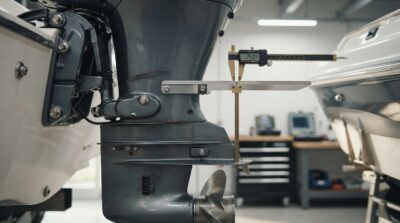
how to measure shaft length on outboard motor
Why Shaft Length Matters
Shaft length affects where the propeller sits in relation to the hull. The propeller needs enough water around it to produce efficient thrust without sitting unnecessarily deep.
Correct positioning can support:
- Better propulsion efficiency
- More predictable steering
- Proper cooling-water flow
- Better acceleration
- Reduced ventilation
- More consistent boat handling
Understanding how to measure shaft length on outboard motor therefore helps you avoid a mismatch between the engine and boat.
The measurement is especially important when replacing an existing outboard. A replacement engine may have the same horsepower as the old one but a different shaft configuration. Horsepower alone does not determine the correct shaft length.
How to Measure Shaft Length on Outboard Motor
The most useful way to learn how to measure shaft length on outboard motor is to follow a consistent process. The goal is to measure the manufacturer’s specified distance without confusing it with the overall motor height.
Step 1: Turn Off and Secure the Motor
Start by making the area safe. Turn the engine off and make sure it cannot move while you measure.
If the outboard is mounted on a boat, keep the boat stable. If it is removed from the boat, position it securely according to the manufacturer’s instructions.
Do not measure a loose motor while it can shift or fall. A stable setup gives you a more accurate result and reduces the chance of damaging the engine.
Step 2: Identify the Measurement Starting Point
Find the top mounting surface where the outboard rests against or attaches to the transom. This is the starting reference used for the shaft-length measurement on many conventional outboards.
Do not start at the top of the engine cover. The engine cowling, handles, brackets, and other components can extend well above the actual mounting reference.
Knowing how to measure shaft length on outboard motor starts with identifying this correct reference point.
Step 3: Measure Down the Centerline
Place the tape measure at the correct mounting surface and extend it vertically downward.
Try to keep the tape straight. Measuring diagonally can produce a result that is longer than the actual vertical distance.
If access is difficult, a straight edge can help establish a clear vertical reference. Take your time rather than estimating the distance by eye.
Step 4: Find the Correct Lower Reference Point
This is the most important part of how to measure shaft length on outboard motor.
The lower reference point is not simply the bottom-most piece of the engine. Different outboard designs can use different measurement references. The manufacturer’s documentation should identify the correct point.
On many conventional outboards, the measurement is associated with the distance from the transom mounting surface to the anti-ventilation plate area. However, do not assume that every engine uses exactly the same reference.
The anti-ventilation plate is located above the propeller and is an important reference area for engine installation. Depending on the manufacturer’s design and instructions, the exact measurement method can vary.
Step 5: Record the Measurement
Write down the measurement in inches or centimeters.
For example, if your measurement is close to a standard shaft category, record the exact number rather than rounding immediately. A small difference can matter when comparing the result with the manufacturer’s specifications.
Take a photo of the measurement if helpful. This can make it easier to compare the result with product specifications later.
Step 6: Compare the Measurement With Manufacturer Specifications
The final step in how to measure shaft length on outboard motor is checking the manufacturer’s information.
Look in the owner’s manual, installation guide, product specification sheet, or official manufacturer’s documentation. Confirm the shaft-length category and the recommended transom height.
If your measurement does not appear to match a standard category, do not automatically choose the closest option. Contact the manufacturer or a qualified marine technician for guidance.
This process is more reliable than choosing a shaft based on engine horsepower, boat length, or a seller’s generic description.
What Tools Do You Need to Measure an Outboard Shaft?
You do not need a large collection of equipment for how to measure shaft length on outboard motor. In most cases, basic measuring tools are enough.
Useful items include:
- Measuring tape
- Straight edge
- Marker
- Notebook
- Phone or camera
- Manufacturer’s manual or specification sheet
A measuring tape should be long enough to cover the expected distance without stretching or bending excessively. A straight edge can help when you need to establish a clear vertical line.
A marker can help identify the measurement starting point if the mounting surface is difficult to see.
Your phone can also be useful for recording the measurement and photographing the relevant parts of the motor.
Accuracy becomes particularly important when your measurement falls near the boundary between shaft categories. In that situation, do not rely on memory or visual estimates.
The goal of how to measure shaft length on outboard motor is not simply to get a number. The goal is to obtain a reliable measurement that can be compared with the manufacturer’s installation requirements.
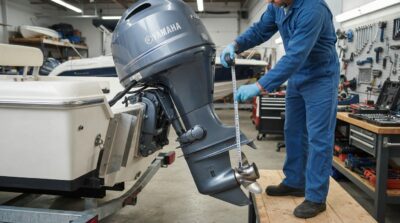
how to measure shaft length on outboard motor
How to Measure Your Boat’s Transom Height
Knowing how to measure shaft length on outboard motor is only half of the job. You should also measure the boat’s transom because the transom height determines how the outboard will sit in relation to the hull.
The transom is the rear section of the boat where the outboard is mounted.
Step-by-Step
1. Locate the centerline of the transom.
Find the central area where the outboard will be mounted. Avoid measuring far to one side if the transom design changes across its width.
2. Find the bottom of the hull.
Identify the appropriate bottom reference directly below the mounting location. Hull shapes can vary, so the manufacturer’s recommendations are important.
3. Measure vertically to the top of the transom.
Use a measuring tape and keep it as vertical as possible. Do not measure along the angle of the transom.
4. Record the result.
Write down the measurement in inches or centimeters. If possible, take more than one measurement to confirm the result.
5. Compare the result with the motor specification.
Use the outboard manufacturer’s recommended transom-height range to determine the appropriate shaft category.
When learning how to measure shaft length on outboard motor, remember that the boat and engine must be treated as one installation system.
A boat may have a non-standard transom, a stepped hull, a jack plate, or another feature that changes the normal relationship between the mounting surface and waterline. In such cases, generic shaft charts may not be enough.
Always check the specific boat and motor manufacturer’s guidance before installation.
Common Outboard Shaft Length Sizes
Common outboard shaft categories include short, long, and extra-long. The exact dimensions vary by manufacturer, so these labels should be treated as general categories rather than universal measurements.
Short Shaft
Short-shaft outboards are commonly used on boats with lower transoms. They are often found on smaller portable outboards and certain small fishing or utility boats.
The shorter configuration allows the propeller and lower unit to reach the correct operating depth without unnecessarily extending below the hull.
Long Shaft
Long-shaft outboards are common on many recreational and fishing boats. They are designed for taller transoms than typical short-shaft applications.
A long shaft can help position the propeller correctly when a short shaft would leave the engine too high.
Extra-Long Shaft
Extra-long shaft models provide additional vertical reach. They may be used on certain larger boats, specialized hulls, sailboats, and applications with unusually tall transoms.
The exact terminology varies. Some manufacturers may use different labels or offer several shaft-length options.
Important Note
Do not choose an outboard simply because a listing says “long shaft.” Two manufacturers may use different specifications or measurement methods.
The safest approach to how to measure shaft length on outboard motor is to measure the actual setup and compare it with the official specifications for the specific engine.
Short Shaft vs. Long Shaft Outboard
The difference between short- and long-shaft outboards mainly concerns the height of the boat’s transom and the desired position of the lower unit.
A short shaft is not automatically better for a small boat, and a long shaft is not automatically better for a large boat. Boat design and transom height matter more than a simple size assumption.
This is why how to measure shaft length on outboard motor should be part of your buying process.
For example, a lightweight fishing boat with a taller transom may require a long-shaft engine. Conversely, a compact utility boat may require a short-shaft configuration.
If you are replacing an existing engine, measure the current setup and compare it with the new engine’s official specifications. Do not assume that the replacement must have the same shaft category simply because the horsepower is similar.
What Happens If the Outboard Shaft Is Too Short?
A shaft that is too short can place the propeller and water-intake system too high in the water.
One possible result is increased ventilation. Ventilation occurs when the propeller loses solid water around its blades and begins drawing in air or aerated water. This can reduce thrust and cause inconsistent propulsion.
Other possible issues include:
- Reduced acceleration
- Reduced propulsion efficiency
- Poor handling
- Increased propeller ventilation
- Improper water-intake positioning
- Reduced overall performance
The exact symptoms depend on the boat, hull shape, engine, propeller, load, and operating conditions.
This is why how to measure shaft length on outboard motor matters before installation. A shaft that appears only slightly too short can still create an important difference in propeller depth.
If you suspect the shaft is too short, do not immediately modify the engine or change components. First verify the measurement and compare the installation with the manufacturer’s specifications.
A qualified marine technician can also inspect the engine position and determine whether the issue is actually shaft length or another setup problem.
What Happens If the Outboard Shaft Is Too Long?
A shaft that is too long can place the propeller deeper in the water than intended.
This may increase drag and change the boat’s handling characteristics. The engine may also operate differently because the lower unit and propeller are positioned farther below the hull.
Potential concerns include:
- Increased drag
- Reduced efficiency
- Changes in handling
- Reduced performance
- Increased underwater clearance concerns
- An unsuitable engine position
A longer shaft is not necessarily safer or better. The goal is to place the engine at the correct height for the boat.
When considering how to measure shaft length on outboard motor, avoid the common assumption that extra length provides better performance. Too much length can be just as unsuitable as too little.
If a long-shaft engine is installed on a transom designed for a shorter configuration, the lower unit may sit deeper than necessary. That can affect the boat’s overall operating characteristics.
Always compare the actual transom height with the manufacturer’s recommended shaft length rather than choosing the longest available model.
How to Choose the Correct Outboard Shaft Length
Choosing the correct shaft length starts with measurements rather than assumptions. The following process can make the decision easier.
Measure the Transom
Start by measuring the boat’s transom height at the intended mounting location.
This gives you the most important boat-side measurement.
Check the Motor Specification
Next, find the shaft-length information for the exact outboard model.
Do not rely only on a retailer’s short description. Use the official specification whenever possible.
Consider the Boat Type
Different boat designs can require different configurations.
Examples include:
- Jon boats
- Fishing boats
- Aluminum boats
- Inflatable boats
- Bass boats
- Pontoons
- Sailboats
The boat category provides useful context, but it does not replace an actual measurement.
Check Manufacturer Recommendations
Manufacturer documentation should take priority over generic online charts.
The manufacturer knows the exact design of the engine, lower unit, mounting system, and available shaft configurations.
This is an essential part of how to measure shaft length on outboard motor because the measurement method can vary between models.
Consider the Intended Use
Think about how you use the boat.
Fishing, cruising, trolling, watersports, and utility use can place different demands on the boat and propulsion system. However, the intended use does not override the basic shaft-length requirement.
If you are installing a new motor, verify the complete setup before purchasing.
How to Measure Shaft Length on Different Types of Outboards
The basic concept behind how to measure shaft length on outboard motor is similar across many engines, but the exact reference points can vary.
Small Portable Outboards
Portable outboards often have simple mounting arrangements. Their shaft categories are commonly associated with smaller boats and lower transoms.
Still, use the manufacturer’s measurement instructions because compact engine designs can differ.
Larger Outboards
Larger engines may have more complex mounting brackets, steering systems, and lower-unit designs. The measurement should follow the manufacturer’s specified reference points.
Electric-Start Outboards
Electric-start features do not automatically change the shaft-length measurement. The relevant factor is the engine’s physical mounting and lower-unit configuration.
High-Horsepower Outboards
High-horsepower engines often offer multiple shaft-length options. Choosing the correct one is particularly important because these engines can produce substantial thrust.
Electric Outboard Motors
Electric outboards can have different structural designs from conventional gasoline-powered models. Do not automatically apply a gasoline outboard’s measurement method to an electric motor.
The safest approach to how to measure shaft length on outboard motor is to use the documentation for the exact make and model.
E-E-A-T tip: Manufacturer manuals and official technical documentation are stronger sources for installation measurements than generic charts. When the documentation is unclear, consult a qualified marine professional.
Common Mistakes When Measuring Outboard Shaft Length
Even a simple measurement can go wrong if you use the wrong reference point.
Measuring Total Motor Height
The total height of the outboard is not the same as shaft length. The engine cover and upper components can make the motor appear much taller.
Starting From the Wrong Mounting Point
The tape should begin at the manufacturer’s specified mounting surface. Starting above or below that point changes the result.
Measuring at an Angle
A diagonal measurement can be longer than the true vertical distance. Keep the measuring tool straight.
Forgetting to Measure Transom Height
The engine measurement alone does not tell you whether the motor matches the boat.
Assuming All Long Shafts Are Identical
“Long shaft” is a category, not a guarantee that every engine has exactly the same dimensions.
Ignoring Manufacturer Specifications
Generic charts are useful for orientation, but they should not override official specifications.
Choosing Based Only on Horsepower
Horsepower describes engine output, not shaft length. Two engines with the same horsepower can have different shaft configurations.
Using an Old Measurement
Boat modifications, jack plates, replacement transoms, and changes in the mounting setup can affect the required configuration.
Careful measurement prevents many of these mistakes.
How to Know if Your Outboard Shaft Length Is Correct
Once you understand how to measure shaft length on outboard motor, you also need to know how to verify the final setup.
A properly matched installation should place the propeller at an appropriate depth for the boat and engine. The cooling-water intake should also remain correctly positioned during normal operation.
Potential signs of an appropriate setup include:
- Correct propeller position
- Stable handling
- Good acceleration
- Consistent engine operation
- Efficient propulsion
- Proper water-intake position
However, performance symptoms should not be used alone to diagnose shaft length.
For example, poor acceleration can result from propeller selection, engine condition, boat loading, trim settings, hull condition, or other factors.
Likewise, ventilation does not automatically prove that the shaft is too short.
The best verification method is to combine the actual measurements with the manufacturer’s installation requirements.
If your measurements and the manufacturer’s specifications agree, you have a much stronger basis for confirming the setup.
Can You Change an Outboard From Short Shaft to Long Shaft?
Some outboards may support an approved conversion from one shaft configuration to another. However, not every engine is designed for an easy or practical conversion.
A conversion may involve manufacturer-specific components or procedures. In some cases, the cost and complexity may make replacement with the correct factory configuration a better option.
If you are considering a conversion, check the official documentation for your exact model first.
Do not assume that a conversion kit designed for one outboard will work with another. Engine generations, mounting systems, driveshafts, shift systems, and lower-unit components can differ.
For complex modifications, consult a qualified marine technician.
The purpose of how to measure shaft length on outboard motor is to help you choose the correct configuration before installation, reducing the need for unnecessary modifications later.

how to measure shaft length on outboard motor
FAQ
How do you measure shaft length on an outboard motor?
To understand how to measure shaft length on outboard motor, start at the manufacturer’s specified mounting surface and measure vertically toward the specified lower reference point. Keep the tape straight and record the measurement.
Then compare the result with the exact engine manufacturer’s specifications. Do not use total engine height as the shaft-length measurement.
You should also measure the boat’s transom height because the engine must match the boat’s mounting requirements.
What is the easiest way to measure an outboard shaft?
The easiest approach is to use a measuring tape and follow the manufacturer’s reference points.
Secure the engine, locate the mounting surface, extend the tape vertically to the specified lower reference point, and record the result.
If the measurement is close to a standard category, verify it against the official specification instead of guessing.
How do I measure my boat transom for an outboard?
Measure vertically from the appropriate bottom-of-hull reference to the top of the transom at the intended engine mounting location.
Keep the tape straight and record the measurement.
Because transom shapes differ, the manufacturer’s recommendations should be checked before selecting an engine.
What is a short shaft outboard?
A short-shaft outboard is designed for applications with a relatively low transom.
The shorter configuration helps place the lower unit and propeller at an appropriate operating depth.
The exact shaft dimension varies between manufacturers, so use the model’s specifications rather than assuming every short shaft is identical.
What is a long shaft outboard?
A long-shaft outboard has a longer vertical distance between the mounting surface and the lower unit’s relevant reference point.
It is commonly used with taller transoms.
The correct choice depends on the boat’s transom height and the manufacturer’s recommendations.
What happens if an outboard shaft is too short?
A shaft that is too short may place the propeller too high. This can increase the risk of ventilation and reduce propulsion efficiency.
The cooling-water intake may also be positioned incorrectly.
However, the exact symptoms vary by boat and engine, so verify the measurement before assuming shaft length is the problem.
What happens if an outboard shaft is too long?
A shaft that is too long may place the propeller too deep. This can increase drag and affect efficiency and handling.
It may also create clearance concerns depending on the hull.
The solution is not automatically to choose a shorter shaft. Measure the transom and follow the manufacturer’s installation requirements.
How do I know what shaft length my boat needs?
Measure the boat’s transom height first. Then compare that measurement with the shaft-length recommendations for the exact outboard you plan to install.
Boat type can provide useful context, but it should not replace the actual measurement.
Are all long-shaft outboards the same length?
No. Different manufacturers and models can use different dimensions and measurement methods.
A “long shaft” label should therefore be treated as a general category.
When learning how to measure shaft length on outboard motor, always compare the actual measurement with the official specification for the engine.
Can I convert a short-shaft outboard to a long shaft?
Some models may support manufacturer-approved conversions, while others may not.
The answer depends on the specific engine design and available components.
Before attempting any conversion, check the manufacturer’s documentation and consult a qualified marine technician if the procedure is complex.
Does horsepower determine outboard shaft length?
No. Horsepower and shaft length are separate specifications.
An engine’s horsepower describes its power output, while shaft length determines how the lower unit reaches the water relative to the boat’s transom.
A correct installation requires both the appropriate power and the appropriate shaft configuration.
Should I measure the old outboard before buying a replacement?
Yes. Measuring the existing setup can provide useful information.
However, do not assume the old measurement automatically determines the replacement. Confirm the new engine’s specifications because different models may use different mounting systems or shaft configurations.
Can a jack plate change the shaft-length requirement?
A jack plate can change the relationship between the outboard mounting position and the boat’s transom.
Because this creates a more specialized installation, follow the jack plate and engine manufacturer’s recommendations rather than relying on a basic transom-height chart.
Conclusion
Knowing how to measure shaft length on outboard motor can help you avoid one of the most common mistakes when selecting or replacing an outboard engine.
The basic process is straightforward. Secure the motor, identify the correct mounting surface, measure vertically to the manufacturer’s specified lower reference point, and record the result. Then measure the boat’s transom height and compare both measurements with the official engine specifications.
The correct shaft length helps position the propeller properly and supports efficient propulsion, stable handling, and appropriate cooling-water intake positioning. A shaft that is too short can cause ventilation and poor performance, while a shaft that is too long can increase drag and affect handling.
Remember that generic labels such as short, long, and extra-long are only starting points. Actual dimensions and measurement methods can vary by manufacturer and model.
Most importantly, do not choose shaft length based only on horsepower. Before buying or installing an outboard, verify the transom height, confirm the engine’s shaft specification, and check the manufacturer’s installation instructions.
A few minutes spent measuring carefully can help you avoid an expensive mismatch and give your boat a better foundation for safe and efficient operation.
