


Modern trailer brake systems are designed to improve towing safety by providing controlled braking power between the tow vehicle and the trailer. Whether you’re hauling a utility trailer, boat trailer, camper, horse trailer, or heavy equipment, knowing how to reset a trailer brake system can save time, prevent unnecessary repairs, and ensure your trailer performs safely on the road.
Although trailer brake systems are primarily used in road transportation, many of the electrical troubleshooting principles—such as circuit inspection, voltage testing, wiring diagnostics, grounding, relay verification, and controller calibration—are also fundamental practices in professional marine electrical engineering. At Electrical Marine Solutions, our technicians routinely diagnose complex electrical systems using the same systematic approach required for marine vessels, offshore platforms, and industrial automation projects.
In this comprehensive guide, you’ll learn:
- What a trailer brake system is
- Why trailer brakes need resetting
- Common causes of brake controller faults
- Step-by-step trailer brake reset procedures
- Electrical troubleshooting methods
- Brake controller calibration
- Common mistakes to avoid
- Preventive maintenance tips
- Professional inspection checklist
In many cases, this simple reset clears communication errors between the tow vehicle and trailer. However, if the warning persists, electrical diagnostics should be performed to locate damaged wiring, blown fuses, faulty magnets, poor grounding, or brake controller issues.
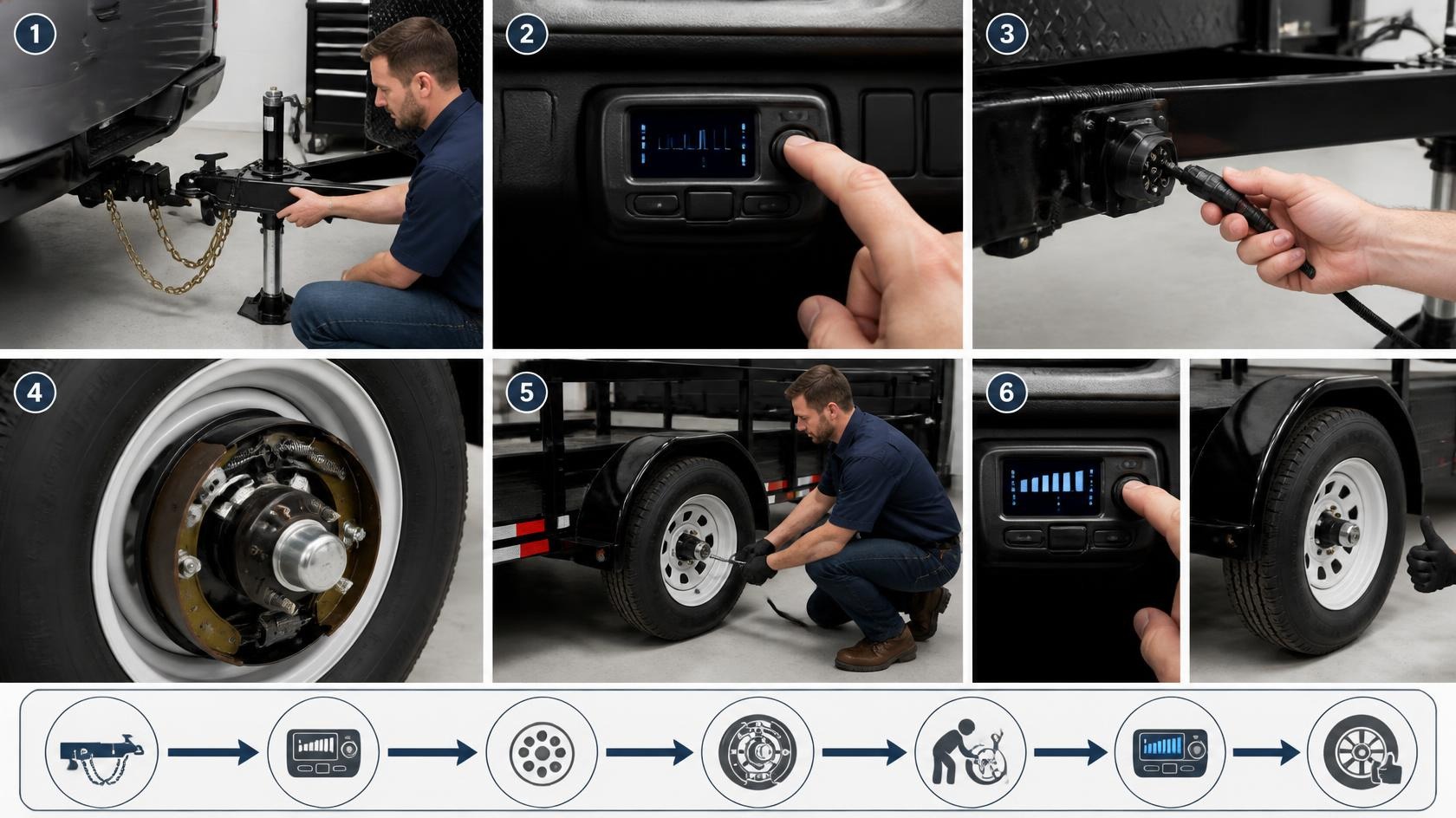
how to reset trailer brake system
What Is a Trailer Brake System?
A trailer brake system is an integrated braking solution that allows a trailer’s wheels to slow down together with the towing vehicle. Instead of relying entirely on the tow vehicle’s brakes, the trailer contributes braking force, reducing stopping distance and improving overall stability.
Trailer brake systems become essential whenever towing heavier loads. They minimize wear on the tow vehicle, improve steering control, reduce trailer sway, and enhance safety during emergency braking.
Without a properly functioning trailer brake system, heavy trailers can push the tow vehicle during braking, increasing the risk of accidents, jackknifing, or loss of control.
Why Would a Trailer Brake System Need Resetting?
A reset is often required after an electrical interruption, controller malfunction, wiring repair, battery replacement, blown fuse, or communication error between the tow vehicle and trailer.
Most modern electronic brake controllers continuously monitor voltage, resistance, and trailer connectivity. When an abnormal condition is detected, the controller may display an error message or temporarily disable braking until the fault is corrected.
Common Reasons Include
- Battery disconnected
- Dead vehicle battery
- Brake controller software error
- Loose trailer plug
- Corroded connector pins
- Faulty ground wire
- Damaged brake wiring
- Brake magnet failure
- Blown fuse
- Controller calibration issue
- Recent brake service
- New brake controller installation
Many of these issues do not indicate permanent damage. A proper inspection followed by a reset often restores normal operation.
Common Signs Your Trailer Brake System Needs Resetting
Recognizing the warning signs early helps prevent unsafe towing conditions and unnecessary component replacement.
Dashboard Warning Messages
- Trailer Brake Disconnected
- Check Trailer Wiring
- Trailer Brake Fault
- Service Trailer Brake System
- Trailer Not Connected
- Brake Output Error
Performance Symptoms
- Weak trailer braking
- No trailer braking
- Uneven braking
- Jerking during braking
- Trailer pushing tow vehicle
- Delayed brake response
- Brake controller flashing
- Brake controller displaying error codes
If any of these symptoms occur, resetting the system should be part of the troubleshooting process after inspecting the wiring and electrical connections.
Safety Precautions Before Resetting
Working on any trailer braking system requires basic electrical safety practices. Before disconnecting components or inspecting wiring, make sure the towing vehicle and trailer are completely secure.
Safety Checklist
- Park on level ground.
- Apply the parking brake.
- Use wheel chocks.
- Turn off the engine.
- Remove the ignition key if applicable.
- Wear insulated gloves.
- Use safety glasses.
- Disconnect the trailer if major electrical work is required.
- Never work beneath an unsupported trailer.
These precautions reduce the risk of accidental movement, electrical shorts, or personal injury during inspection and reset procedures.
Understanding the Main Components of a Trailer Brake System
Before resetting the system, it’s helpful to understand how the major components work together. A fault in any single component can trigger brake controller warnings.
1. Brake Controller
The brake controller is installed inside the tow vehicle and regulates the amount of braking force sent to the trailer. Depending on the model, it may be proportional or time-delayed.
Its primary responsibilities include:
- Monitoring trailer connection
- Adjusting brake output
- Displaying system status
- Detecting electrical faults
- Providing manual brake activation
2. Seven-Pin Trailer Connector
The seven-way connector provides electrical communication between the tow vehicle and trailer. It carries power for lighting circuits, brake control signals, reverse lights, auxiliary charging, and grounding.
Even minor corrosion or moisture inside the connector can interrupt communication and generate false brake system errors.
3. Brake Magnets
Electric trailer brakes rely on electromagnets inside each brake assembly. When energized, these magnets create friction against the brake drum, activating the braking mechanism.
Worn or damaged magnets often cause weak braking performance and may require replacement rather than a simple reset.
4. Breakaway Switch
The breakaway system activates the trailer brakes automatically if the trailer becomes detached from the tow vehicle. It operates using an independent battery and safety switch.
A damaged breakaway switch can sometimes trigger brake controller warnings even though the trailer remains connected.
5. Wiring Harness
The wiring harness distributes electrical power throughout the trailer. Loose connections, damaged insulation, broken conductors, and poor grounding are among the most common causes of trailer brake issues.
Step 1: Inspect the Tow Vehicle Before Resetting
Many trailer brake problems actually originate from the towing vehicle rather than the trailer itself. Performing a systematic inspection helps eliminate unnecessary repairs.
Inspect the Battery Voltage
A weak battery can interfere with brake controller operation. Use a digital multimeter to confirm battery voltage is within the manufacturer’s recommended range.
Typical readings include:
- Engine Off: approximately 12.6 volts
- Engine Running: approximately 13.8–14.7 volts
Low voltage may prevent the brake controller from functioning correctly.
Inspect Brake Controller Power
Verify that the brake controller powers on without displaying warning messages. If the display remains blank, inspect the controller fuse, wiring harness, and power supply.
Check Related Fuses
Many vehicles include separate fuses dedicated to trailer brake controllers. Refer to the owner’s manual to identify the correct fuse location and inspect for damage.
Inspect Ground Connections
A poor ground is one of the leading causes of intermittent trailer brake faults.
Look for:
- Loose bolts
- Rust buildup
- Corrosion
- Broken wires
- Paint preventing metal-to-metal contact
Clean and tighten any suspect ground points before attempting to reset the system.
Step 2: Inspect the Trailer Connector
The trailer connector is one of the most common sources of brake communication problems. Even if the brake controller appears functional, a damaged connector can interrupt the brake signal between the vehicle and trailer.
Before reconnecting the trailer, inspect both the vehicle-side socket and the trailer-side plug for bent pins, corrosion, moisture, dirt, or loose terminals. Clean the contacts with an approved electrical contact cleaner and ensure each pin is firmly seated. Replace severely worn connectors rather than attempting temporary repairs, as poor electrical contact can lead to intermittent brake operation.
Step 3: Reset the Trailer Brake System
Once you’ve completed the initial inspection and confirmed there are no obvious electrical faults, you can proceed with resetting the trailer brake system. While the exact process varies slightly depending on the brake controller manufacturer and vehicle model, the following procedure works for most electric trailer brake systems used in North America.
Step 3.1 – Disconnect the Trailer Plug
Turn the vehicle off completely before disconnecting the seven-way trailer connector.
- Switch off the ignition.
- Wait 30–60 seconds.
- Carefully unplug the trailer connector.
- Inspect the connector one final time for bent pins or moisture.
This allows the brake controller to clear temporary communication faults before establishing a new connection.
Step 3.2 – Check the Breakaway Switch
The breakaway switch is a critical safety device designed to apply the trailer brakes if the trailer becomes disconnected from the tow vehicle.
Inspect the following:
- Safety pin is fully inserted.
- Switch housing is not cracked.
- Battery terminals are clean.
- Breakaway battery is properly charged.
- No damaged wires are visible.
A partially activated or damaged breakaway switch can cause the brake controller to report a fault even when every other component is operating correctly.
Step 3.3 – Reconnect the Trailer
Reconnect the seven-pin connector securely.
After plugging it in:
- Confirm the connector locks firmly into place.
- Ensure no excessive movement exists.
- Verify the cable has enough slack for turning but cannot drag on the road.
The controller should recognize the trailer within several seconds.
Step 3.4 – Restart the Tow Vehicle
Start the engine and allow the brake controller to initialize.
Observe the display carefully.
A properly functioning controller should indicate:
- Trailer Connected
- No Error Messages
- Brake Output Ready
- Gain Setting Visible
If the warning remains, continue with additional diagnostics rather than repeatedly resetting the system.
Step 3.5 – Perform Controller Reset (If Equipped)
Many modern proportional brake controllers include a built-in reset or recalibration function.
Depending on the manufacturer, this may involve:
- Holding the Menu button.
- Selecting Factory Reset.
- Confirming Reset.
- Allowing the controller to reboot.
Always follow the manufacturer’s instructions to avoid erasing customized brake gain settings unnecessarily.
Step 4: Test the Entire Brake System
Never assume the reset solved the problem without performing a complete operational test.
Static Test
- Apply the manual override on the brake controller.
- Listen for the brake magnets engaging.
- Verify no warning messages appear.
- Confirm trailer lights continue operating normally.
Low-Speed Road Test
Choose an open parking lot or another safe area away from traffic.
- Drive at approximately 5–10 mph.
- Use the manual override only.
- Confirm the trailer brakes engage smoothly.
- Repeat the test at 15–20 mph.
- Adjust brake gain if necessary.
The trailer should slow the combination smoothly without locking the wheels or pushing the tow vehicle.
How to Adjust Trailer Brake Controller Gain
Resetting the system is only part of the process. Proper brake controller adjustment is equally important for safe towing.
The gain setting determines how much electrical current reaches the trailer brakes.
| Trailer Weight | Typical Gain Range |
|---|---|
| Light Utility Trailer | 2.0–3.5 |
| Boat Trailer | 3.0–4.5 |
| Travel Trailer | 4.5–6.5 |
| Equipment Trailer | 5.5–7.5 |
| Heavy Commercial Trailer | 6.5–9.0 |
These values are general starting points. Final adjustment should always be based on the trailer manufacturer’s recommendations, road conditions, and actual stopping performance.
Common Trailer Brake Error Messages Explained
| Error Message | Possible Cause | Recommended Action |
|---|---|---|
| Trailer Disconnected | Loose connector | Reconnect plug and inspect pins |
| Check Trailer Wiring | Broken wire or poor ground | Inspect wiring harness |
| Output Shorted | Short circuit | Repair damaged wiring |
| No Trailer | Controller cannot detect trailer | Check connector and magnets |
| Overload | Excessive current draw | Inspect brake magnets |
| Brake Fault | Controller or wiring issue | Perform complete electrical diagnosis |
Electrical Troubleshooting Checklist
If resetting the trailer brake system doesn’t resolve the issue, perform a more detailed electrical inspection. Experienced technicians follow a structured diagnostic process to identify the root cause instead of replacing parts unnecessarily.
Check Battery Voltage
- Verify battery voltage is stable.
- Inspect charging system output.
- Check battery terminals for corrosion.
Measure Connector Voltage
Using a quality digital multimeter:
- Measure brake output voltage.
- Confirm continuity.
- Inspect ground resistance.
- Look for voltage drops under load.
Inspect Trailer Wiring
- Crushed wiring
- Rodent damage
- Loose terminals
- Broken insulation
- Water intrusion
- Improper aftermarket repairs
Check Brake Magnets
Brake magnets gradually wear over time. Excessive wear can reduce braking performance and increase current draw.
Inspect for:
- Uneven wear
- Broken wires
- Weak magnetic attraction
- Abnormal resistance values
Advanced Diagnostic Procedures
When routine inspections fail to identify the problem, advanced electrical testing becomes necessary. Professional technicians often use specialized equipment to pinpoint intermittent faults that may not be visible during a standard inspection.
Continuity Testing
Continuity testing verifies that electrical current can travel through every section of the wiring harness without interruption.
Disconnect power before testing and check:
- Brake output circuit
- Ground circuit
- Breakaway circuit
- Lighting circuits that share common grounds
Voltage Drop Testing
Even when wires appear intact, excessive resistance can reduce voltage reaching the trailer brakes.
Common causes include:
- Corroded connectors
- Loose terminals
- Undersized wiring
- Partially broken conductors
Voltage drop testing helps identify these hidden problems more accurately than visual inspection alone.
Resistance Testing
Brake magnets should exhibit resistance values within the manufacturer’s specified range. A reading significantly higher or lower than expected may indicate an internal fault requiring replacement.
Common Mistakes to Avoid When Resetting a Trailer Brake System
Many trailer brake problems become worse because of improper troubleshooting. Avoid these common mistakes to save time and reduce repair costs.
- Resetting the controller repeatedly without fixing the underlying electrical fault.
- Ignoring corrosion inside the trailer connector.
- Replacing the brake controller before testing the wiring.
- Using incorrect replacement fuses.
- Overlooking damaged ground connections.
- Skipping the road test after resetting the system.
- Setting brake gain too high or too low.
- Using household electrical cleaners instead of products designed for automotive electrical contacts.
- Leaving exposed wiring without proper protection against moisture.
A disciplined diagnostic approach is almost always faster and more cost-effective than replacing parts based on guesswork.
Professional Best Practices
Experienced electrical technicians follow consistent procedures whenever servicing trailer brake systems. These practices improve reliability and reduce the likelihood of recurring faults.
- Inspect connectors before every towing trip.
- Apply dielectric grease to electrical terminals where appropriate.
- Secure wiring away from moving or hot components.
- Replace damaged harnesses instead of making temporary splices.
- Verify proper ground continuity after any repair.
- Test brake operation under real towing conditions before long-distance travel.
- Document recurring faults to simplify future diagnostics.
Following these best practices helps maintain dependable braking performance and extends the service life of the entire trailer electrical system.
Trailer Brake System Maintenance Guide
Resetting your trailer brake system should never replace routine maintenance. A properly maintained brake system is significantly less likely to develop electrical faults, communication errors, or braking performance issues.
Whether you tow occasionally or every day, establishing a preventive maintenance schedule can reduce unexpected breakdowns, improve road safety, and extend the lifespan of your trailer’s braking components.
Before Every Trip
Performing a quick inspection before towing takes only a few minutes but can prevent costly repairs and dangerous situations.
- Inspect the seven-way connector for dirt, corrosion, or bent pins.
- Verify the trailer plug locks securely into the tow vehicle.
- Test all trailer lights.
- Confirm the brake controller recognizes the trailer.
- Inspect the breakaway cable and safety chains.
- Check for loose or hanging wiring.
- Test the manual brake override.
- Listen for unusual noises while moving the trailer.
Monthly Inspection
- Clean electrical connectors using electrical contact cleaner.
- Inspect wiring harness clamps.
- Check for cracked insulation.
- Verify ground connections remain tight.
- Inspect brake drums for abnormal wear.
- Test battery voltage if the trailer uses a breakaway battery.
Annual Maintenance
- Inspect brake shoes.
- Measure brake magnet wear.
- Repack wheel bearings if applicable.
- Replace damaged wiring.
- Test controller calibration.
- Inspect axle wiring.
- Verify all electrical circuits with a multimeter.
Routine maintenance greatly reduces the likelihood of needing an emergency trailer brake reset while traveling.
Complete Trailer Brake Inspection Checklist
Use this checklist during scheduled maintenance or whenever you experience trailer brake issues.
| Inspection Item | Status |
|---|---|
| Tow vehicle battery voltage | ☐ Pass ☐ Fail |
| Brake controller operating correctly | ☐ Pass ☐ Fail |
| Seven-pin connector clean | ☐ Pass ☐ Fail |
| Connector pins straight | ☐ Pass ☐ Fail |
| Ground connection secure | ☐ Pass ☐ Fail |
| Brake wiring intact | ☐ Pass ☐ Fail |
| Breakaway switch operational | ☐ Pass ☐ Fail |
| Breakaway battery charged | ☐ Pass ☐ Fail |
| Brake magnets functioning | ☐ Pass ☐ Fail |
| Brake controller gain adjusted | ☐ Pass ☐ Fail |
| Road test completed | ☐ Pass ☐ Fail |
Case Study: Resolving a “Trailer Brake Fault” Warning
A fleet operator transporting construction equipment reported an intermittent “Trailer Brake Fault” warning that appeared only during long-distance trips. The trailer brakes would function normally at the beginning of the journey but fail after several hours of driving.
Initial Symptoms
- Brake controller displayed intermittent fault messages.
- Trailer lights operated normally.
- No blown fuses were found.
- The fault disappeared temporarily after restarting the vehicle.
Diagnostic Process
- Measured battery charging voltage.
- Tested controller output.
- Performed continuity tests.
- Inspected connector terminals.
- Conducted voltage drop testing.
The investigation revealed corrosion inside one connector terminal that increased electrical resistance whenever the connector warmed during extended towing.
Solution
- Replaced the seven-way connector.
- Cleaned all ground connections.
- Applied dielectric grease.
- Reset the brake controller.
- Completed a road test.
After repairs, the warning did not return, and the trailer completed multiple long-distance trips without additional brake controller errors.
Electric Trailer Brakes vs. Hydraulic Trailer Brakes
Not every trailer uses the same braking technology. Understanding the differences helps determine whether the reset procedure described in this guide applies to your trailer.
| Feature | Electric Brakes | Hydraulic Surge Brakes |
|---|---|---|
| Brake Controller Required | Yes | No |
| Electrical Wiring | Extensive | Minimal |
| Reset Procedure | Often Required | Usually Not Required |
| Maintenance | Electrical & Mechanical | Mainly Mechanical |
| Common Applications | Travel trailers, campers, equipment trailers | Boat trailers, light utility trailers |
If your trailer uses hydraulic surge brakes instead of electric brakes, communication errors with an electronic brake controller generally won’t apply.
When Should You Replace Components Instead of Resetting?
A reset is intended to clear temporary faults or re-establish communication between the trailer and the tow vehicle. However, some problems indicate permanent component failure that requires replacement rather than another reset.
Replace the Brake Controller If:
- The controller repeatedly fails self-tests.
- The display remains blank despite proper power.
- Internal buttons no longer respond.
- Output voltage is inconsistent.
Replace the Trailer Connector If:
- Pins are heavily corroded.
- The housing is cracked.
- Internal terminals are loose.
- The locking mechanism no longer secures properly.
Replace Brake Magnets If:
- Resistance values fall outside specifications.
- Uneven braking occurs repeatedly.
- Magnets exhibit excessive wear.
- Current draw exceeds manufacturer recommendations.
Replace the Wiring Harness If:
- Multiple repairs have already been made.
- Water damage is extensive.
- Insulation is brittle.
- Several conductors are damaged.
Replacing worn components at the appropriate time is often more economical than repeatedly troubleshooting recurring failures.
Expert Tips for Reliable Trailer Brake Performance
Professional Tip 1: Never ignore an intermittent trailer brake warning. Electrical faults typically worsen over time.
Professional Tip 2: Keep the trailer connector covered whenever it isn’t connected to prevent corrosion caused by rain, road salt, and dust.
Professional Tip 3: Perform a manual brake test before every long trip, even if no warning messages are displayed.
Professional Tip 4: Avoid inexpensive replacement connectors with poor-quality terminals. High-quality connectors provide better conductivity and longer service life.
Professional Tip 5: Label repaired wiring during major maintenance. Future troubleshooting becomes significantly easier when circuits are clearly identified.
Professional Tip 6: If you frequently tow different trailers, verify brake gain settings every time you connect a different load.
Why Professional Electrical Diagnostics Matter
Many trailer brake issues appear simple but originate from complex electrical faults that are difficult to identify without proper diagnostic equipment. Randomly replacing controllers, magnets, or wiring often increases repair costs without solving the actual problem.
Professional technicians use multimeters, clamp meters, insulation resistance testers, wiring diagrams, and voltage-drop analysis to locate faults quickly and accurately. This systematic approach minimizes downtime while improving the reliability of the entire electrical system.
The same disciplined troubleshooting methodology is used across commercial transportation, industrial automation, and marine electrical systems, where dependable electrical performance is essential for safe and efficient operations.
How Electrical Marine Solutions Can Help
Although this guide focuses on trailer brake systems, the underlying principles of electrical inspection, troubleshooting, preventive maintenance, and system reliability are central to the services provided by Electrical Marine Solutions.
Our experienced engineers and technicians specialize in diagnosing and maintaining complex electrical systems across the maritime industry. From power distribution and switchboards to automation, control systems, and fault finding, we deliver dependable solutions that keep vessels operating safely and efficiently.
Our Marine Electrical Services Include:
- Marine electrical installation
- Electrical fault finding and troubleshooting
- Switchboard maintenance
- Marine automation systems
- PLC programming and diagnostics
- Generator rewinding and repairs
- Motor inspection and maintenance
- Power distribution systems
- Fire and gas detection systems
- Navigation lighting systems
- Engine control systems
- Preventive electrical maintenance
- Emergency electrical repairs
- Technical consulting for marine and offshore projects
Whether you’re managing a commercial fleet, offshore platform, workboat, fishing vessel, or yacht, partnering with experienced electrical professionals helps reduce downtime, improve safety, and protect your investment.
People Also Ask
Can resetting a trailer brake system fix all brake problems?
No. A reset only clears temporary communication or controller-related issues. If the problem is caused by damaged wiring, worn brake magnets, a failed brake controller, poor grounding, or mechanical brake wear, those components must be repaired or replaced.
Why does my trailer brake controller keep saying “Trailer Disconnected”?
This warning is commonly caused by:
- A loose seven-pin connector
- Corroded connector terminals
- A damaged ground wire
- Broken trailer wiring
- Faulty brake magnets
- A defective brake controller
Inspect each component methodically before replacing parts.
How often should I inspect my trailer brake system?
Perform a basic inspection before every towing trip. A comprehensive inspection should be completed at least once a year or every 12,000 miles, whichever comes first. Commercial trailers operating in demanding environments may require more frequent inspections.
Can a weak battery cause trailer brake problems?
Yes. Low battery voltage can affect the brake controller, reduce brake output, and generate fault messages. Always verify both battery condition and charging system performance when diagnosing trailer brake issues.
Should I disconnect the battery before resetting the brake controller?
In most situations, disconnecting the trailer plug and cycling the ignition is sufficient. Some controllers provide a built-in reset function, while others may require disconnecting power for a short period. Always follow the brake controller manufacturer’s instructions.
How do I know if my brake controller is defective?
Signs of a failing brake controller include:
- Blank or flickering display
- Inconsistent brake output
- Repeated fault messages after repairs
- Controller overheating
- Manual override not functioning
- Failure to detect a properly connected trailer
Can I tow a trailer if the brake system warning light is on?
It is not recommended. A brake system warning indicates that the trailer’s braking performance may be compromised. Continuing to tow without diagnosing the problem can increase stopping distances and create a serious safety risk.
What tools are useful for troubleshooting trailer brake systems?
Professional diagnostics typically involve:
- Digital multimeter
- Clamp meter
- Circuit tester
- Electrical contact cleaner
- Wire brush
- Terminal cleaning kit
- Dielectric grease
- Trailer wiring diagram
- Torque wrench
- Basic hand tools
Does rain or moisture affect trailer brake systems?
Yes. Moisture can enter connectors, promote corrosion, increase electrical resistance, and interrupt communication between the tow vehicle and trailer. Protecting connectors with covers and keeping terminals clean helps minimize moisture-related issues.
Can poor grounding cause intermittent trailer brake faults?
Absolutely. Poor ground connections are one of the most common causes of intermittent brake controller errors. Cleaning corrosion, tightening fasteners, and ensuring proper metal-to-metal contact are essential steps in troubleshooting.
Common Symptoms and Recommended Solutions
| Symptom | Possible Cause | Recommended Solution |
|---|---|---|
| Trailer brakes not engaging | Disconnected wiring, failed controller | Inspect wiring and reset controller |
| Weak braking performance | Low gain setting or worn brake magnets | Adjust gain and inspect magnets |
| Controller displays fault message | Electrical communication issue | Inspect connectors and perform system reset |
| Uneven braking | Mechanical brake wear | Inspect drums, shoes, and magnets |
| Intermittent warnings | Loose connector or poor ground | Clean and tighten all electrical connections |
| Trailer pushes tow vehicle | Insufficient brake output | Increase controller gain and inspect brake system |
Best Practices for Long-Term Reliability
Consistent maintenance and careful operation are the keys to maximizing trailer brake system performance. The following practices are widely recommended by experienced technicians:
- Inspect electrical connectors before every towing trip.
- Store trailer connectors with protective covers when not in use.
- Replace damaged wiring immediately rather than using temporary repairs.
- Keep brake controller software or firmware updated if applicable.
- Verify brake gain whenever trailer weight changes.
- Inspect wheel bearings and brake assemblies during routine maintenance.
- Perform periodic voltage-drop and continuity testing on older trailers.
- Use only high-quality replacement electrical components.
- Document maintenance activities to simplify future troubleshooting.
- Schedule professional inspections if recurring faults cannot be resolved through standard diagnostics.
Conclusion
Understanding how to reset a trailer brake system is an essential skill for anyone who regularly tows a trailer. While many warning messages can be resolved through a proper reset procedure, the most reliable solution always begins with a careful inspection of the electrical system. Connectors, wiring, grounds, brake magnets, and the brake controller should all be evaluated before replacing components.
Preventive maintenance is just as important as troubleshooting. Regular inspections, clean electrical connections, proper brake controller calibration, and timely replacement of worn parts help ensure dependable braking performance while reducing the likelihood of unexpected failures on the road.
For organizations that depend on reliable electrical systems—whether in transportation, industrial environments, or the maritime sector—a structured diagnostic approach delivers better safety, lower maintenance costs, and greater operational reliability.
If you’re looking for experienced professionals to diagnose, maintain, or upgrade complex marine electrical systems, Electrical Marine Solutions provides dependable engineering expertise, advanced troubleshooting, and technical support for commercial vessels, offshore facilities, and marine operations worldwide.
Frequently Asked Questions
What is the fastest way to reset a trailer brake system?
Disconnect the trailer plug, switch off the ignition, inspect the connector, reconnect the trailer, restart the vehicle, and verify that the brake controller detects the trailer correctly.
Why does my trailer brake warning keep coming back?
Recurring warnings usually indicate an unresolved electrical issue such as a poor ground, damaged wiring, worn brake magnets, or a faulty brake controller.
Can I reset the trailer brake controller without disconnecting the trailer?
Some controllers allow an internal reset through their menu, but many communication-related faults are best cleared by disconnecting and reconnecting the trailer after the ignition is turned off.
How long does it take to reset a trailer brake system?
A basic reset generally takes between 5 and 15 minutes. Additional troubleshooting may require more time depending on the underlying fault.
What should I do if resetting the system doesn’t work?
Inspect the wiring, connectors, ground circuits, brake magnets, fuses, breakaway switch, and brake controller. Perform electrical testing with a multimeter to identify the root cause.
Is dielectric grease recommended for trailer connectors?
Yes. Applying dielectric grease to clean connector terminals helps reduce corrosion and improves long-term electrical reliability.
Can damaged brake magnets trigger controller fault messages?
Yes. Worn or defective brake magnets can alter electrical resistance and current draw, causing the controller to display error messages.
Should I test the brakes after every reset?
Absolutely. Perform both a manual override test and a low-speed road test to confirm that the trailer brakes operate correctly before towing on public roads.
Are trailer brake systems affected by extreme weather?
Yes. Rain, snow, road salt, and temperature fluctuations can accelerate corrosion and affect electrical connections, making regular inspections even more important.
When should I seek professional assistance?
If fault messages persist after a proper reset and inspection, or if you encounter intermittent electrical problems that cannot be diagnosed with standard testing, consult a qualified technician with experience in trailer and electrical system diagnostics.
Need Expert Electrical Troubleshooting?
Electrical issues demand accurate diagnosis—not guesswork. Whether you require advanced fault finding, marine electrical engineering, automation support, switchboard maintenance, generator services, or complete electrical system upgrades, Electrical Marine Solutions is ready to help.
Explore our services, speak with our experienced engineers, and discover reliable electrical solutions designed to keep your operations running safely and efficiently.
Contact Electrical Marine Solutions today to discuss your project or schedule a professional consultation.
