

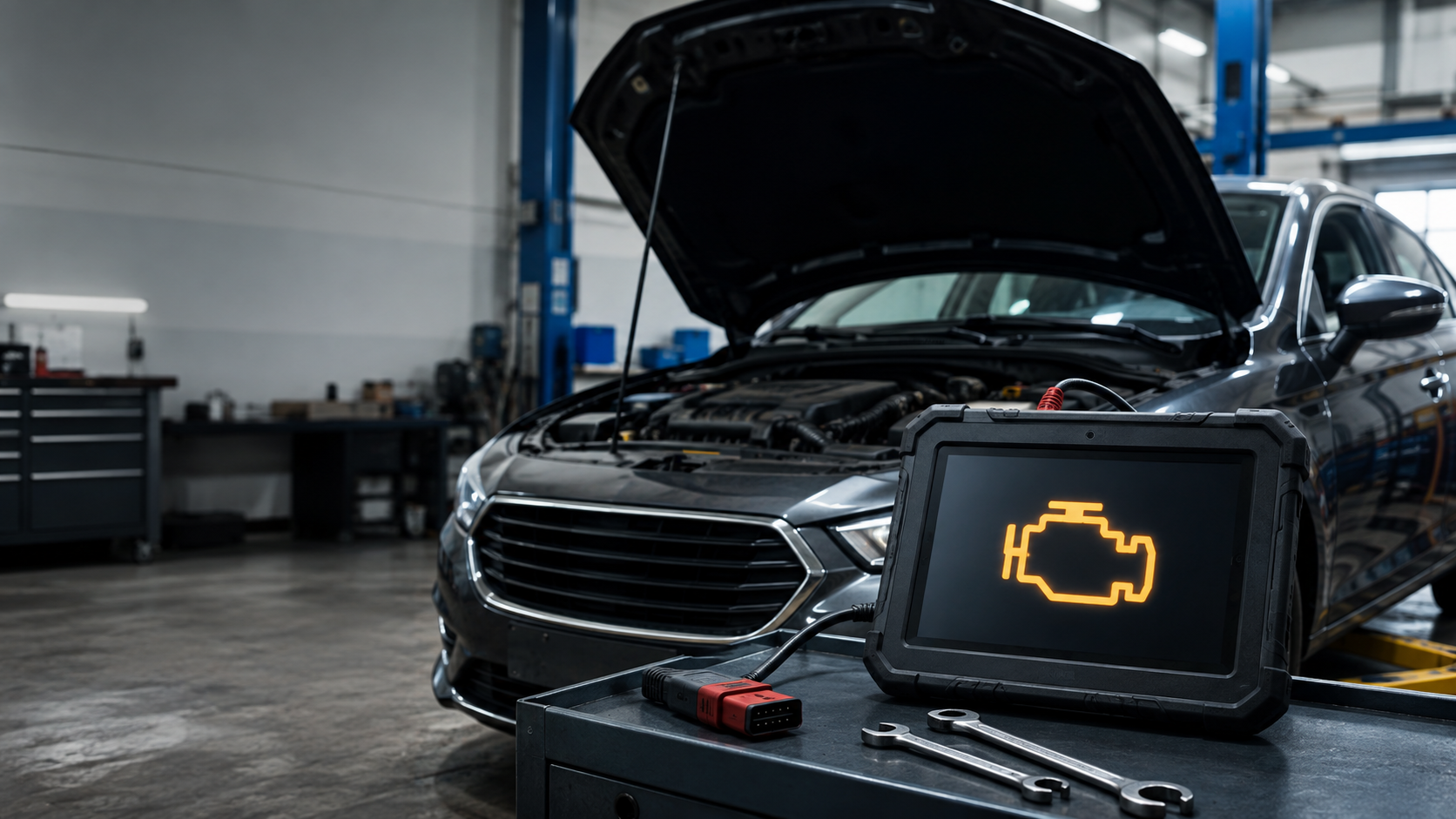
You’re driving along, everything feels normal, and then a small amber icon lights up on your dashboard: the check engine light. For most drivers, the first reaction is a mix of confusion and low-grade panic. Is it safe to keep going? Should you pull over right now? Can you finish your commute, or do you need to call a tow truck?
The honest answer to “is it ok to drive with check engine light on?” is: it depends. There’s no single rule that applies to every car in every situation. What matters most is how the light is behaving and what your vehicle is telling you at the same time.
A few key factors determine whether continued driving is reasonable:
- Whether the light is solid or flashing
- How the vehicle is running — smoothly, or with shaking, hesitation, or power loss
- Whether other dashboard warning lights have also appeared, such as oil pressure or temperature
- The underlying cause, which you usually won’t know until the car is scanned
A steady, solid check engine light does not automatically mean you need to stop the car immediately. In many cases, it signals a fault that should be looked at soon, but doesn’t necessarily prevent you from finishing a short trip. A flashing light is a different story — it typically points to something more urgent, like an active engine misfire, and continuing to drive can risk further damage.
In the sections below, we’ll walk through the warning signs to watch for, when it’s reasonable to keep driving, when you should stop as soon as it’s safe, and the steps to take once that light comes on.
Key takeaway: A check engine light should never be ignored, even when the vehicle seems to drive normally. What looks like a minor issue today can become a costly repair tomorrow.
Is It OK to Drive With Check Engine Light On?
The short, direct answer: it depends primarily on whether the light is solid or flashing, and on how the car is actually performing. A solid light often allows for limited, cautious driving. A flashing light generally does not.
Driving With a Solid Check Engine Light
Limited driving may be reasonable when several conditions are true at the same time:
- The check engine light is solid, not flashing.
- The engine runs smoothly, without hesitation or rough idling.
- There is no major loss of power when accelerating.
- The temperature gauge stays in its normal range.
- There is no visible smoke coming from the vehicle.
- There are no unusual smells, such as burning oil or fuel.
- There are no severe noises, like knocking or grinding.
- No other critical warning lights — such as oil pressure or battery — are illuminated alongside it.
If all of that checks out, many drivers can continue on to their destination or drive to a repair shop without immediate danger. That said, “can drive” is not the same as “should ignore.” The vehicle still needs to be diagnosed soon, because whatever triggered the light hasn’t gone away just because the car feels fine.
Driving With a Flashing Check Engine Light
A flashing check engine light is a more urgent signal, and it should be treated differently than a solid one.
- A flashing light is often associated with an active engine misfire or another serious fault that’s happening in real time.
- Continuing to drive in this condition can increase the risk of damage to the engine or catalytic converter, sometimes turning a moderate repair into an expensive one.
- The safest approach is to find a safe place to pull over, stop driving, and arrange for a tow or professional roadside assistance rather than continuing the trip.
Solid vs. Flashing Check Engine Light
Understanding the difference between a solid and a flashing light is one of the most important things a driver can know when this warning appears.
Solid Check Engine Light
A solid light generally indicates that the vehicle’s computer has detected a fault, but it isn’t necessarily an emergency. The engine may continue to run in a way that feels completely normal to the driver, which is part of why this warning is so easy to underestimate. The car isn’t necessarily struggling — it’s reporting that something is outside of expected parameters.
Even so, diagnosis is necessary. A fault that seems harmless today can affect fuel economy, emissions, or other components over time. In many cases, a short trip to a repair facility is a reasonable way to handle a solid light, provided the vehicle is otherwise driving normally.
Flashing Check Engine Light
A flashing light requires more urgent attention. It’s frequently connected to engine misfires, where unburned fuel can make its way into the exhaust system and damage the catalytic converter — a component that is often expensive to replace. Because of this, prolonged driving with a flashing light is not recommended. The longer the vehicle continues to run under these conditions, the greater the potential for compounding damage.
is it ok to drive with check engine light on
When Is It Generally OK to Drive With the Check Engine Light On?
There is no universal rule that applies to every make, model, or situation — vehicles differ, and so do the faults that can trigger this light. That said, there are common circumstances where limited driving is generally considered reasonable:
- The warning light is solid, not flashing.
- The car drives normally, without hesitation or rough running.
- No severe symptoms are present, such as heavy shaking or stalling.
- Engine temperature is normal and not climbing toward overheating.
- No oil-pressure warning appears alongside the check engine light.
- No major power loss occurs when accelerating or maintaining speed.
It’s worth being clear about what this does not mean. Driving under these conditions does not mean the underlying problem is harmless or can be put off indefinitely. It simply means the immediate safety risk is likely low enough to permit continued, cautious driving in the short term.
Important Point
There’s a meaningful difference between driving directly to a repair facility and continuing normal, everyday driving for days or weeks while the light stays on. The former is often reasonable when the car is behaving well. The latter allows a developing problem more time to get worse, potentially turning a simple fix into a larger repair bill.
When Is It NOT OK to Drive With the Check Engine Light On?
Some signs point to a more urgent problem — one where continuing to drive isn’t a reasonable option, even for a short distance.
Flashing Check Engine Light
Treat a flashing light as an urgent situation. Avoid unnecessary driving, and get the vehicle off the road and to a safe location as soon as possible.
Severe Engine Shaking
Noticeable shaking or vibration from the engine can indicate rough operation or an active misfire — the same kind of issue that a flashing light often signals.
5.3 Major Loss of Power
A sudden or significant drop in power can create a real safety risk, particularly when merging, passing, or driving on a highway where maintaining speed matters.
Overheating
If the temperature gauge is climbing toward the red zone, the engine should not continue operating. Overheating can cause serious, sometimes irreversible damage in a short amount of time.
Oil Pressure Warning
An oil-pressure warning appearing alongside the check engine light deserves immediate attention. Running an engine with inadequate oil pressure can cause rapid and severe internal damage.
Smoke or Strong Burning Smell
Visible smoke or a strong burning odor can point to a serious mechanical or electrical issue. This is not a symptom to drive through — it calls for stopping the vehicle and assessing the situation.
Severe Engine Noise
Unusual knocking, grinding, ticking, or other concerning sounds are worth taking seriously. These noises can be an early warning of mechanical failure that’s already in progress.
Common Reasons the Check Engine Light Comes On
The check engine light can be triggered by a wide range of issues, from minor to significant. Here are some of the most common causes.
Loose or Damaged Gas Cap
Your vehicle’s fuel system is designed to be sealed, in part to control fuel vapor emissions. A loose, cracked, or missing gas cap can break that seal, which is often enough to trigger the check engine light through the emissions monitoring system.
Faulty Oxygen Sensor
The oxygen sensor monitors the level of unburned oxygen in the exhaust, helping the engine’s computer fine-tune the air-fuel mixture. When it malfunctions, it can affect fuel efficiency and emissions.
Worn Spark Plugs
Spark plugs ignite the air-fuel mixture inside the engine. As they wear out, they can contribute to misfires, rough idling, and reduced performance.
Bad Ignition Coil
The ignition coil generates the electrical spark that the spark plug needs to ignite fuel. A failing coil can cause misfires similar to those caused by worn spark plugs.
Catalytic Converter Problem
The catalytic converter helps reduce harmful emissions before they leave the exhaust system. A failing converter can affect performance and will often cause the vehicle to fail an emissions test.
Mass Airflow Sensor Problem
This sensor measures the amount of air entering the engine, which the computer uses to calculate the correct fuel mixture. A malfunction here can lead to poor performance or rough running.
Vacuum or Intake Leak
An unwanted leak in the intake system can let extra air into the engine, throwing off the air-fuel ratio and potentially causing rough idling or hesitation.
EVAP System Fault
The evaporative emissions (EVAP) system captures and manages fuel vapor. Leaks or faults anywhere in this system — not just the gas cap — can trigger a check engine light.
E-E-A-T note: It’s important to understand that the check engine light alone cannot tell you exactly which component has failed. It signals that the vehicle’s computer detected something out of range, but pinpointing the actual cause requires a proper diagnostic process.
Can You Drive if the Car Runs Normally but the Check Engine Light Is On?
This is one of the most common versions of this question: “check engine light on but car runs fine — can I keep driving?”
It’s entirely possible for a car to drive normally while a fault is present. Some issues affect emissions systems or background monitoring functions before they have any noticeable effect on how the vehicle performs. In other words, a smooth-driving car isn’t proof that everything under the hood is working exactly as it should.
Because of this, normal operation doesn’t guarantee the underlying issue is minor — it just means it hasn’t yet progressed to the point of affecting drivability. A diagnostic scan is still the right next step, even if nothing feels wrong.
It helps to think about it in two broad categories:
Normal operation + solid light: This generally allows for arranging a diagnosis soon, without treating the situation as an emergency.
Poor operation + flashing light: This should be treated as urgent, regardless of how the car has been driving up to that point.
What Should You Do When the Check Engine Light Comes On?
Here’s a practical, step-by-step process to follow the moment that light appears.
Step 1: Stay Calm
A check engine light is common and doesn’t automatically mean disaster. Panicking won’t help you assess the situation clearly.
Step 2: Check the Light
Look at whether it’s solid or flashing. This single detail shapes almost everything else you do next.
Step 3: Look for Other Warning Lights
Scan the rest of the dashboard for anything else that’s lit up, including:
- Oil pressure warning
- Temperature warning
- Battery warning
- Brake warning
Step 4: Assess How the Vehicle Drives
Pay attention to how the car feels as you continue:
- Shaking or vibration
- Hesitation when accelerating
- Poor acceleration or sluggishness
- Noticeable loss of power
- Strange or new noises
- Unusual smells
Step 5: Check the Fuel Cap
If the light appeared shortly after refueling, pull over when safe and make sure the gas cap is on securely. This is a quick check that resolves a surprising number of cases.
Step 6: Get the Vehicle Scanned
An OBD-II scanner can read the diagnostic trouble code stored by the vehicle’s computer, giving you or a mechanic a starting point for figuring out what’s wrong.
Step 7: Get the Cause Diagnosed
A trouble code points you in a direction, but it doesn’t always name the exact fix. Replacing parts based solely on a code, without further diagnosis, isn’t always the right approach and can lead to unnecessary expense.
Can You Drive to a Mechanic With the Check Engine Light On?
Whether it’s reasonable to drive directly to a repair facility depends on the same set of factors already covered above.
Potentially Reasonable When:
- The light is solid.
- The vehicle operates normally.
- There’s no overheating.
- There’s no major power loss.
- There are no severe noises.
- There’s no smoke or strong burning smell.
Consider Other Options When:
- The light is flashing.
- The engine is shaking badly.
- The vehicle is losing significant power.
- The temperature is rising.
- Another critical warning light appears alongside it.
When in doubt, prioritize safety over convenience, and follow your vehicle manufacturer’s specific guidance where available — some owner’s manuals include direct instructions for how to respond to this exact warning.
is it ok to drive with check engine light on
What Happens If You Ignore the Check Engine Light?
Ignoring a check engine light doesn’t make the underlying issue disappear — it just delays dealing with it, often at a cost. Over time, ignoring the warning can lead to:
- The underlying problem worsening, sometimes progressing from a minor fault to a major one.
- Declining fuel economy, as the engine runs less efficiently.
- Decreased engine performance, including reduced power and responsiveness.
- Increased emissions, which can also cause a vehicle to fail inspection.
- Effects on other components, as one unresolved issue puts added strain on connected systems.
- Higher repair costs, since small problems tend to be cheaper to fix than the larger ones they can turn into.
- A vehicle that eventually becomes less reliable or breaks down entirely.
The specific consequences depend heavily on what actually triggered the light in the first place. A loose gas cap left unaddressed is a very different situation than an ignored misfire — but in both cases, the smart move is finding out rather than guessing.
Can a Check Engine Light Turn Off by Itself?
Yes, this can happen, and it often confuses drivers. A few points are worth understanding:
- Some faults are temporary and can resolve on their own — for example, a loose gas cap that gets tightened, or a sensor reading that briefly went out of range.
- The vehicle’s computer runs its own internal checks over a series of drive cycles, and it may turn the light off automatically once it confirms the fault is no longer present.
- Even after the light turns off, diagnostic information often remains stored in the vehicle’s computer and can be retrieved later.
- A warning that disappears should not automatically be considered fully resolved. It may mean the issue is gone, or it may mean the conditions that trigger it simply haven’t been met again yet.
- If the check engine light comes back repeatedly, that pattern itself is worth investigating, even if the light clears each time.
How an OBD-II Scanner Helps
An OBD-II (On-Board Diagnostics II) scanner is a tool that connects to your vehicle’s diagnostic port and communicates with its onboard computer.
- What OBD-II means: It’s the standardized diagnostic system used in most vehicles sold since the mid-1990s, designed to monitor engine and emissions performance.
- What diagnostic trouble codes are: These are alphanumeric codes the vehicle’s computer stores when it detects a fault — for example, a code related to a misfire or a sensor reading outside its normal range.
- How a scanner retrieves codes: Plugging in a scanner allows you to pull these stored codes, which can then be looked up to get a general idea of what triggered the warning.
- Why codes help narrow down the problem: Rather than guessing at what’s wrong, a code gives you and any mechanic a concrete starting point for further diagnosis.
Important Warning
A diagnostic trouble code does not always mean the named component itself has failed. For example, a code referencing an oxygen sensor might actually be caused by a wiring issue, a bad connector, a vacuum leak, or some other root cause entirely. Codes are a clue, not a final answer.
How Much Does It Cost to Fix a Check Engine Light?
There’s no single price tag for “fixing a check engine light,” because the cost depends entirely on what’s actually wrong. Several factors influence the final bill:
- Vehicle make and model — parts and labor rates vary widely between manufacturers.
- Diagnostic requirements — some issues are quick to identify, while others take more time and testing.
- Parts — the cost of a sensor is very different from the cost of a catalytic converter.
- Labor — how accessible the faulty component is affects how long a repair takes.
- Severity of the problem — a simple fix versus a more involved repair changes the total cost significantly.
- Location — labor rates differ by region and by type of repair shop.
Some fixes, like tightening or replacing a gas cap, can be relatively inexpensive. Others, like replacing a catalytic converter, tend to be far more costly. Rather than assuming the worst — or the best — case, it’s worth getting an actual diagnosis and a repair estimate before approving any work, especially anything expensive.
How to Prevent Check Engine Light Problems
While not every issue is preventable, regular maintenance goes a long way toward reducing how often this warning appears.
- Follow the manufacturer’s maintenance schedule outlined in your owner’s manual.
- Replace worn spark plugs as recommended, rather than waiting for problems to appear.
- Maintain appropriate fluid levels, including oil and coolant.
- Address unusual engine symptoms early, before they develop into bigger issues.
- Keep the fuel cap in good condition, checking that it seals properly.
- Use the correct fluids and parts specified for your vehicle.
- Don’t ignore other dashboard warnings, since small issues can compound over time.
- Keep maintenance records, which can help you and any mechanic spot patterns or recurring issues.
FAQ
Is it OK to drive with check engine light on?
It can be reasonable for limited driving when the light is solid, the car runs normally, and no serious symptoms are present. A flashing light is a different situation and generally calls for stopping as soon as it’s safe rather than continuing to drive.
How long can I drive with a solid check engine light?
There’s no universal safe mileage or time limit — it depends entirely on the underlying cause, which usually isn’t clear until the vehicle is scanned. The safest approach is to get the car diagnosed as soon as reasonably possible, rather than driving on it indefinitely.
Can I drive with a flashing check engine light?
Generally, no. A flashing light typically points to a more serious, active issue such as an engine misfire, and continued driving can increase the risk of damage. It’s best to stop driving when it’s safe to do so and get professional help.
Can I drive if the check engine light is on but the car runs fine?
You can often drive short distances if the vehicle is otherwise operating normally, but running fine doesn’t rule out a real problem. Some faults affect emissions or monitoring systems before they ever show up in how the car drives, so a diagnostic scan is still worthwhile.
Does a check engine light always mean something is seriously wrong?
No. Causes range from relatively minor issues, like a loose gas cap, to more serious mechanical problems, like a failing catalytic converter or an active misfire. The only way to know which one you’re dealing with is through proper diagnosis.
Will the check engine light go away after fixing the problem?
Often, yes. Once the underlying issue is repaired, the vehicle’s computer typically turns the light off after confirming, over a series of drive cycles, that the fault is no longer present.
Should I disconnect the battery to turn the light off?
Disconnecting the battery may clear the warning temporarily, but it doesn’t fix whatever caused it in the first place. Without a proper diagnosis and repair, the underlying issue remains, and the light is likely to return.
Should I use an OBD-II scanner?
An OBD-II scanner can be a genuinely useful tool for getting a general sense of what triggered the warning. Its main limitation is that a code points toward an area of concern rather than always naming the exact failed part, so it’s best used as a starting point rather than a final diagnosis.
Can a bad gas cap cause the check engine light?
Yes. A loose, cracked, or missing gas cap can break the seal in the fuel vapor system, which is often enough to trigger an emissions-related warning through the EVAP system.
What should I do if the check engine light comes on while driving?
Start by checking whether the light is solid or flashing, then look for other warning lights and pay attention to how the vehicle is running. If everything seems normal and the light is solid, it’s often reasonable to continue cautiously to a repair facility. If the light is flashing or you notice serious symptoms like shaking, overheating, or major power loss, stop driving as soon as it’s safe and seek professional help.
is it ok to drive with check engine light on
Conclusion
So, is it ok to drive with check engine light on? In many cases, yes — at least for a limited distance. When the light is solid, the vehicle operates normally, and there are no serious accompanying symptoms, it’s often reasonable to drive a short distance, including directly to a repair facility. That said, “reasonable to drive” is not the same as “safe to ignore.” Whatever triggered the light should still be diagnosed soon, since problems that seem minor today can develop into more expensive or more serious issues over time.
A flashing light, or the presence of serious symptoms like overheating, major power loss, an oil-pressure warning, smoke, or severe noise, changes the picture entirely. These situations call for much more urgent action — stopping the vehicle as soon as it’s safe to do so rather than continuing on.
When in doubt, follow the guidance in your owner’s manual and don’t hesitate to seek help from a qualified mechanic. A check engine light is your vehicle’s way of asking for attention — responding to it promptly is one of the simplest ways to avoid bigger problems, and bigger bills, down the road.
If your check engine light is on, check your vehicle owner’s manual for manufacturer-specific instructions. For additional vehicle safety information, visit NHTSA Vehicle Safety Resources.
